
Grandfather Flung Into the Air by Yellowstone Bison in Terrifying Viral Attack
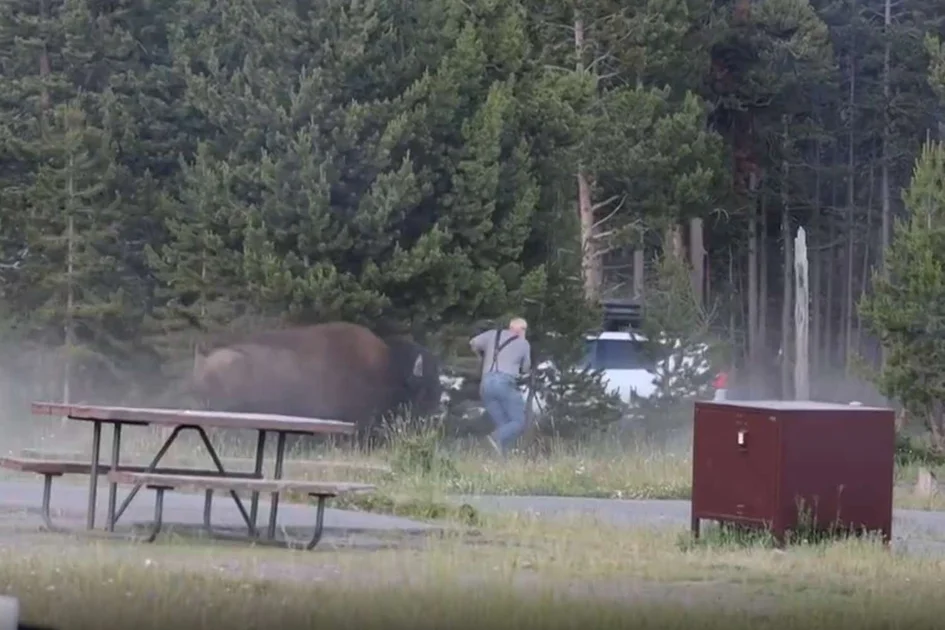
A 65-year-old grandfather from Washington state, identified as Carl Isom-McDaniel, was violently rammed by a bull bison at Yellowstone National Park on Friday evening, July 10, 2026, suffering multiple broken bones in an incident captured on video that has since gone viral. The attack occurred near the Bridge Bay Campground close to Yellowstone Lake, during the final hour before sunset.
Witness footage shows Isom-McDaniel and his grandson stopping at a safe distance to photograph a bison lying in the grass. The animal, estimated to weigh around 2,000 pounds (900 kg), suddenly flopped on its side in an agitated manner before springing to its feet and charging. A white truck that approached was also rammed by the bison before it continued its charge toward the pair. The grandfather attempted to move behind nearby trees but was caught by the animal, which hooked him with a horn and launched him several feet into the air.
Emergency responders arrived to find Isom-McDaniel conscious but in significant pain. Despite suffering multiple fractures, he maintained his composure and even cracked jokes while waiting for medical treatment, according to witness accounts reported by the Times of India. The grandson managed to evade the animal and escaped without injury. Isom-McDaniel was transported to a local hospital, though the National Park Service (NPS) has not yet released an official statement on the incident.
The dramatic footage, filmed by photographer Mike MacLeod, has renewed public attention on wildlife safety in Yellowstone, one of America’s most visited national parks.
The Dangers of Approaching Bison: A Persistent Threat in Yellowstone
Bison are responsible for more injuries to humans in Yellowstone than any other animal, according to the National Park Service. Despite their seemingly docile appearance, these massive animals can sprint three times faster than a human and are highly unpredictable, particularly during the summer mating season and when accompanied by calves.
The NPS recommends that visitors maintain a distance of at least 25 yards (23 meters) from bison at all times and explicitly warns against approaching them for photographs. The incident involving Isom-McDaniel underscores how quickly a seemingly calm animal can turn aggressive. Prior to charging the grandfather, the bison had already confronted other visitors and a passing vehicle, displaying clear signs of agitation that went unheeded by many in the area.
This attack comes amid a peak tourist season for Yellowstone. The park regularly sees tens of thousands of visitors each day in July, many of whom are unfamiliar with wildlife behavior. Park officials have repeatedly urged the public to respect the animals' space and never underestimate their speed, strength, or unpredictability.
The viral nature of the video has sparked widespread discussion about the balance between wildlife viewing and safety. Some commentators have pointed out that while the grandfather and grandson appeared to be at an appropriate distance initially, the bison's sudden charge demonstrated that even seemingly safe distances can prove inadequate when an animal is agitated.
Broader Implications: Wildlife Encounters and National Park Safety
The Isom-McDaniel attack highlights a growing challenge for national parks across the United States: managing human-wildlife interactions in an era of surging visitation. Yellowstone alone recorded over 4.5 million visits in 2025, and with that volume comes an inevitable increase in dangerous encounters.
Wildlife experts note that bison attacks often result from a combination of factors: visitors getting too close for photographs, failure to recognize warning signs in animal behavior, and the sheer density of people in popular park areas. The 25-yard rule is frequently ignored, and enforcement is difficult given the park’s vast size and limited ranger presence.
This incident also raises questions about how parks can better educate the public, particularly as social media encourages visitors to seek dramatic close-up shots. Some parks have considered implementing stricter penalties for approaching wildlife, including fines or temporary bans, though enforcement remains resource-intensive.
The attack on Isom-McDaniel is not an isolated event. Earlier this year, a separate bison incident in Yellowstone led to minor injuries when a tourist attempted to touch a calf. In 2025, a woman was gored while walking too close to a bison herd. Park officials stress that these incidents are preventable if visitors follow basic safety guidelines.
In the broader context, the incident may accelerate calls for improved safety messaging and possibly new technology solutions, such as real-time wildlife location alerts via park apps or enhanced signage at high-risk areas like Bridge Bay Campground.
A Reminder of Nature’s Power Amid a Surprising Spirit
Despite the severity of his injuries—multiple broken bones and the trauma of being hurled into the air—Isom-McDaniel’s decision to keep his sense of humor has become a notable part of the story. Witnesses reported that he remained conscious and in good spirits, even joking with bystanders and first responders.
This resilience has resonated with the public, offering a human counterpoint to the stark warning that the video represents. It also serves as a reminder that while wildlife encounters can turn dangerous quickly, the outcome is not always tragic. As Yellowstone continues to attract millions seeking connection with nature, the responsibility to maintain safe distances lies with each visitor.
For now, the park service is expected to review the incident and may issue updated guidance for the campground area. Meanwhile, Isom-McDaniel faces a long recovery, but his story—one of both danger and dignity—will likely reinforce the message that Yellowstone’s wildlife should be admired from afar.
Comments