
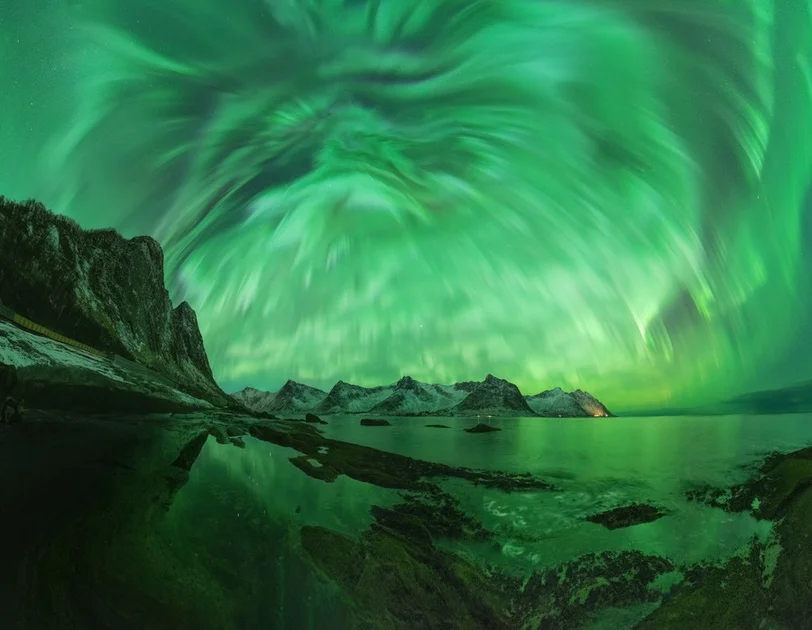
Northern Lights Alert: Aurora Possible Across 19 US States Tonight
A cloud of charged particles from the Sun is expected to reach Earth overnight, potentially triggering visible auroras across parts of the northern United States. The National Oceanic and Atmospheric Administration (NOAA) has issued a forecast for a G1 to G2 geomagnetic storm, giving skywatchers in as many as 19 states an opportunity to witness the northern lights, provided local weather and space conditions cooperate.
The event stems from a coronal mass ejection (CME) — an immense burst of magnetized plasma — launched by the Sun several days ago. Unlike solar flares, which release intense radiation almost instantly, CMEs carry billions of tons of charged particles that take days to cross the 93-million-mile gap between the Sun and Earth. When this cloud collides with our planet’s magnetic field, it can briefly disturb the magnetosphere and produce the glowing displays known as aurora borealis.
While forecasters emphasize this is not a widespread outbreak, the timing coincides with a period of heightened solar activity that has already produced dramatic light shows around the globe. Just two days ago, astronauts aboard the International Space Station witnessed one of the most intense auroras of their mission, with European Space Agency astronaut Sophie Adenot describing it as “absolutely spectacular” and bright enough to require special camera adjustments.
Best States to Watch the Northern Lights Tonight
The strongest viewing potential will be near the U.S.-Canada border, where geomagnetic activity is naturally more intense. Northern portions of Washington, Idaho, Montana, North Dakota, South Dakota, Minnesota, Wisconsin, Michigan, and Maine offer the best chances for a clear sighting. If the storm briefly strengthens, observers in parts of Oregon, Wyoming, Nebraska, Iowa, Illinois, Indiana, Ohio, New York, Vermont, and New Hampshire could also catch a faint glow near the northern horizon.
Success depends heavily on local conditions. Even a moderately strong G2 storm can produce vivid displays if the interplanetary magnetic field aligns favorably and cloud cover stays clear. Skywatchers should seek locations far from city lights with an unobstructed northern view. Modern smartphone cameras often reveal colors and structures invisible to the naked eye, making long-exposure photography a reliable backup for faint displays.
Why Aurora Activity Is Surging in 2026
The northern lights have become a more frequent headline in recent years because the Sun is approaching the peak of its 11-year solar cycle, known as Solar Cycle 25. This period of maximum magnetic activity brings more sunspots, flares, and CMEs, each capable of sending charged particles toward Earth. Scientists have noted that this cycle has been more energetic than initial predictions suggested, leading to several powerful geomagnetic storms in 2024 and 2025.
Auroras form when solar particles are guided by Earth’s magnetic field toward the polar regions, where they collide with oxygen and nitrogen molecules in the upper atmosphere. Oxygen at roughly 60 miles altitude produces the characteristic green glow, while higher-altitude oxygen can create red hues, and nitrogen contributes blue and purple tones. From the ground, these interactions appear as dancing curtains of light; from orbit, astronauts see them as vast glowing rings wrapped around the poles.
Space Station Perspective Highlights Scale of Event
The aurora witnessed by the ISS crew on June 28 underscores the scale of current solar activity. Looking down from 250 miles above Earth, astronauts saw intense green light stretching hundreds of miles, bright enough to illuminate the station itself. Such perspectives remind researchers that what appears as a faint glow on the horizon is often a massive atmospheric phenomenon driven by forces far beyond our planet.
For those hoping to see the show tonight, patience and preparation are key. NOAA will update its aurora forecast in real time, and local astronomy groups often provide alerts when activity spikes above predicted levels.
Broader Implications: Solar Activity and Modern Infrastructure
While tonight’s storm is classified as minor to moderate, even G2 events can affect power grids, satellite operations, and radio communications at high latitudes. Utilities and airlines in northern regions monitor these storms for potential disruptions, though the most severe impacts — like those seen during the 1859 Carrington Event — require storms many times stronger than what is forecast tonight.
The heightened solar activity also has a cultural and economic dimension. As aurora tourism grows in popularity, accurate forecasts help travelers plan trips to destinations like Alaska, Iceland, and northern Scandinavia. Meanwhile, the same solar particles that paint the sky can pose radiation risks to astronauts and airline passengers flying polar routes, prompting ongoing research into better prediction models.
For now, the message for Americans across the northern tier is simple: look up tonight. Whether the lights appear as a faint green curtain or a full-blown celestial show, events like this remind us how closely connected we are to the star at the center of our solar system. As Sophie Adenot put it after watching from orbit, “Earth rarely looks the same twice from 250 miles above the planet.”
For more on how solar activity intersects with sports and geopolitics, see Germany World Cup: Lahm, Matthäus urge Kimmich midfield move and French Justice System Under Scrutiny as High-Profile Trials Hit Critical Junctures.
Comments