
New '76' Plates Arrive, But Hundreds Banned for Offensive Meanings
From today (1 September 2026), UK motorists will see the new '76' registration plates on cars registered between now and 28 February 2027. However, not every combination is allowed. The Driver and Vehicle Licensing Agency (DVLA) has banned more than 500 specific plate sequences deemed offensive, embarrassing, or in poor taste – ranging from obvious swear words to subtle references to war, religion, politics, and sexual innuendo.
The banned list includes 'GE76 GUN' and 'AS76 FKU', plus combinations like 'AA76 RYN' (referencing Iran), 'AU76 WTZ' (Witz, slang for penis), and 'BI76 LOW' (billow, but can be read as B-low). The DVLA's specialist panel reviews every new batch of registrations twice a year, withholding any that could cause complaint. This practice is longstanding, but the '76' plate presents unique challenges because the numbers 7 and 6 can be interpreted as letters: 7 can resemble 'I', 'T', or 'A', and 6 can look like 'B' or 'A'.
While the vast majority of '76' plates are available for purchase, the DVLA's decision to withhold hundreds of combinations is a reminder that vehicle registrations are more than just identifiers; they are public messages. As new cars roll onto forecourts with the fresh plate, drivers must also ensure their existing plates comply with strict legal standards, or face fines up to £1,000.
Why the DVLA Bans Certain Plates: The Two-Phase Process
The DVLA introduces new age identifiers twice a year: on 1 March and 1 September. This system, in place since 1999, means that from March to August, cars display '26' plates, and from September to February, '76' plates are used. The '27' plates will follow in March 2027. This predictable cycle allows buyers to choose the latest plate and sellers to market new-registration deals.
When a new identifier is announced, the DVLA's panel meticulously cross-references all possible letter and number combinations against a wide range of offensive terms – racial slurs, homophobic language, references to weapons, violence, political messages, and even medical conditions (e.g., 'STD' is banned). The goal is to prevent any plate that could cause embarrassment or offence to the public.
The '76' plate is particularly tricky because of the numbers' visual flexibility. For example, 'BU76 DCK' can be read as 'BUDCK' or 'B-U-D-C-K', but when the 7 and 6 are interpreted as 'I' and 'B', it becomes 'BUBICK' – a potential slur. Similarly, 'CU76 NGR' uses the same trick to spell out a racial slur.
Last year, the DVLA banned combinations like '25 RUS' and '**UK' (referring to Russia and Ukraine) due to the ongoing conflict. This year, plates referencing Gaza and Yemen were also withheld. The panel also flags words like 'bomb' and 'STD' because of their sensitive nature. The DVLA spokesperson previously told Metro: "We withhold any combinations of numbers and letters where we consider that they may cause offence, embarrassment or are in poor taste."
This screening is not new – for example, 'W4 NK' has long been banned because it spells 'wank'. But the scale of the ban for '76' – over 500 plates – highlights how difficult it is to find every possible interpretation.
Full List of Banned '76' Plates: What You Can't Have
The DVLA has published a full list of withheld combinations, but it's not exhaustive. Here are some of the most notable bans:
- Weapons and violence: GE76 GUN, FA76 HAG (hag, often used as offensive slang), EA76 KNF (knife) – though 'KNF' is not specifically listed, similar variants appear.
- Sexual and offensive slang: AS76 FKU (a clear misspelling of 'f**k you'), BU76 DCK (duck, but can be read as 'buck' with the 6 as 'b', but also 'dick' if the 6 is 'i'? Actually 6 is 'b', so 'dick' is not possible; but 'BU76 DCK' can be read as 'BUBCK' or 'BUICK' – but the list says it's banned for 'BUDCK', which is close to 'butt'? Actually 'BU76 DCK' with 76 as 'I' and 'B' gives 'BUIB DK' – no. The list includes it, so it's banned for potential interpretation).
- Racial and ethnic slurs: CU76 NGR (with 6 as 'b'? No, 6 is 'b', so 'CUB BKR'? Actually 'CU76 NGR' – 7 as 'I', 6 as 'b' gives 'CUIB NGB' – not clear. But DVLA banned all 'N76' combinations that could spell '[N-word]'.
- Political and geographic references: AA76 RYN (Iran), AU76 WTZ (Witz, which is also a surname), and many others.
The full list includes:
- *76 OOK, *76 YPO, *F76 GOT, *N76 ERR, *N76 ERS, *N76 ERZ, *N76 GAA, *N76 NOG, *T76 NNY, *W76 NKS
- AA76 LAH, AA76 RSE, AA76 RYN, AA76 YAN, AC76 AZA, AC76 HAD, AD76 RKY, AF76 GAT, AF76 GGY, AF76 GUT, AF76 OTT, AG76 HAD, AJ76 HAD, AR76 RSE, AS76 ABY, AS76 AST, AS76 BOY, AS76 FKT, AS76 FKU, AS76 FWC, AT76 CKU, AT76 KMP, AT76 KPM, AT76 KUU, AU76 WTZ
- AW76 NKR, BJ76 AG*, BJ76 ALL, BJ76 ALS, BJ76 ALZ, BJ76 AY*, BJ76 HOT, BJ76 LOW, BJ76 ONK, BJ76 OOB, BJ76 OYO, BJ76 OYS, BJ76 OYX, BJ76 OYY, BJ76 OYZ, BJ76 RLS, BJ76 RLY, BJ76 RLZ, BJ76 STD, BJ76 STY, BJ76 UNK, BJ76 USH, BJ76 UYE, BJ76 UYS, BJ76 UYX, BJ76 UYY, BJ76 UYZ
- BL76 CKY, BU76 AYS, BU76 AYX, BU76 AYY, BU76 AYZ, BU76 DCK, BU76 DKS, BU76 GAY, BU76 MUF, BU76 NOB, BU76 ONK, BU76 OYS, BU76 OYX, BU76 OYY, BU76 SHT, BU76 UNK, BU76 USH, BU76 VAJ
- BY76 RUS, BY76 UKR, CC76 OON, CO76 ASH, CU76 ASH, CU76 AYS, CU76 AYX, CU76 AYY, CU76 AZA, CU76 FGM, CU76 HER, CU76 JAP, CU76 JUW, CU76 LEZ, CU76 MPX, CU76 MUF, CU76 NGR, CU76 NOB, CU76 PAK, CU76 PKY, CU76 VAG, CU76 VAJ
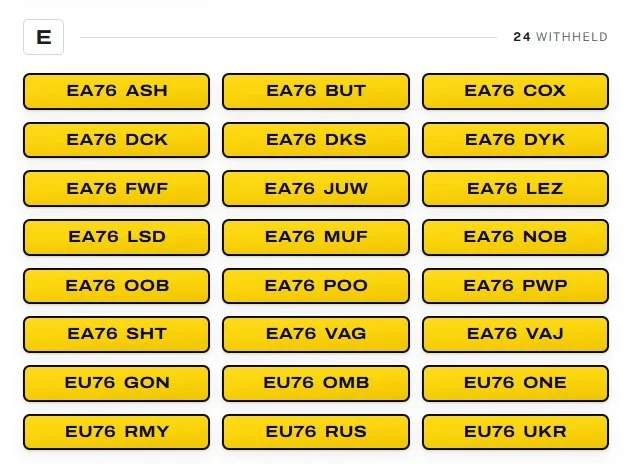
- DD76 RKY, EA76 ASH, EA76 BUT, EA76 COX, EA76 DCK, EA76 DKS, EA76 DYK, EA76 FWF, EA76 JUW, EA76 LEZ, EA76 LSD, EA76 MUF, EA76 NOB, EA76 OOB, EA76 POO, EA76 PWP, EA76 SHT, EA76 VAG, EA76 VAJ
- EU76 GON, EU76 OMB, EU76 ONE, EU76 RMY, EU76 RUS, EU76 UKR, FA76 ASH, FA76 ATS, FA76 ATT, FA76 ATZ, FA76 GGY, FA76 HAG, FA76 JUW, FA76 NOB, FA76 OTE, FA76 OTS, FA76 OTT, FA76 OTX, FA76 OTZ, FA76 VAG, FA76 VAJ, FA76 WAH, FA76 YPS, FA76 YPX
- FF76 GAT, FK76 ABY, FK76 ASH, FK76 AZA, FK76 ENT, FK76 FWF, FK76 HAD, FK76 MUF, FK76 NU
The list goes on, but the pattern is clear: the DVLA is rigorous in filtering out anything that could be misread.
How to Ensure Your Number Plate Is Legal: Avoid a £1,000 Fine
With the new '76' plates launching, the DVLA is also reminding drivers to check their existing plates meet legal requirements. Plates that are incorrectly displayed – whether due to font, spacing, or modifications – can result in a fine of up to £1,000 and an MOT failure.
According to the DVLA, your number plate must:
- Be made from a reflective material.
- Display black characters on a white background (front) and a yellow background (rear).
- Not have a background pattern.
- Be marked with the supplier's name and the British Standard number (BS AU 145e for plates fitted after 1 September 2021).
- Use the Charles Wright 2001 font with appropriate spacing.
- Have single shade of black characters (for plates fitted after 1 September 2021).
You cannot rearrange letters or numbers, or alter them to be hard to read. This includes using different screws to change the appearance of characters. Even 3D raised characters are allowed, but they must be black and not reflective.
Graham Conway, Managing Director at Select Car Leasing, warns: "It's important for drivers to understand the nuances of what's required for their licence plates as even the smallest modifications could make it illegal." For example, a 3D plate with white lettering or a reflective coating would fail.
The New '76' Plate: What It Means for Car Buyers and Sellers
The introduction of the '76' plate is a significant moment in the automotive calendar. Dealers often launch special offers to coincide with the new registration, including low-rate finance and deposit contributions. This creates a surge in new-car registrations, as buyers want to be among the first to display the fresh plate.
For those who don't care about having the newest plate, the changeover still offers an opportunity: buying a car with a '26' plate can now be a used car with a bit of discount, as dealers seek to clear stock before the '76' models arrive.
But there's another dimension: the plate itself becomes a status symbol. Some drivers pay premium prices for personalised plates, but the DVLA's ban list ensures that the plate you buy won't inadvertently offend someone. This is a delicate balance between freedom of expression and public decency.
The '76' plate also offers a chance for creative interpretation, but the DVLA is quick to pull any combination that veers into poor taste. The panel's job is to predict how the public might read a plate – and they often think of slang, acronyms, and even foreign words.
Broader Implications: The Growing Policing of Number Plates
The ban on over 500 '76' plates is part of a broader trend of increased scrutiny on vehicle registrations. In recent years, the DVLA has expanded its blacklist to include political references, such as '25 RUS' and '**UK' after the conflict in Ukraine. This has raised questions about whether the agency is exceeding its remit by banning plates based on current events.
However, the DVLA's primary concern is public offence. The agency argues that its role is to ensure that plates do not cause embarrassment or distress to the public. With the rise of social media, offensive plates are quickly noticed and shared, putting the DVLA in the spotlight. As a result, the list has grown to include not just obvious swear words but also slang, abbreviations, and even seemingly innocent words that have offensive meanings in other languages.
This vigilance extends beyond registration. Police can stop vehicles with non-compliant plates, and drivers can be fined. The DVLA also warns that you can't rearrange characters to spell words – a common trick to make a plate look like a name or phrase.
For car enthusiasts, this means that the era of 'clever' plates is ending. The DVLA is increasingly clamping down on any attempt to circumvent the rules. But for the average driver, the system is straightforward: as long as you follow the rules, you won't be affected.
What the '76' Plate Launch Means for You
The arrival of the '76' plate is a routine event, but it comes with a reminder: number plates are not just identifiers; they are regulated public statements. The DVLA's ban list is a reflection of societal norms and sensitivities. As we drive into September, seeing a '76' plate might make you wonder if it's one of the banned combinations – but rest assured, the vast majority are perfectly acceptable.
If you're in the market for a new car, the '76' plate offers a fresh start, and with many dealers offering deals, it might be the right time to upgrade. But whether you're buying or just driving, remember to check your plate's legality. A small mistake could cost you £1,000.
The banning of hundreds of plates also highlights how language evolves. What was once acceptable may now be considered offensive. The DVLA's panel is tasked with keeping up with these changes, ensuring that the plates on our roads do not cause harm.
In the end, the '76' plate is a symbol of progress – and of caution. So, as you see the new registrations, take a moment to appreciate the careful thought that goes into every combination.
Comments