
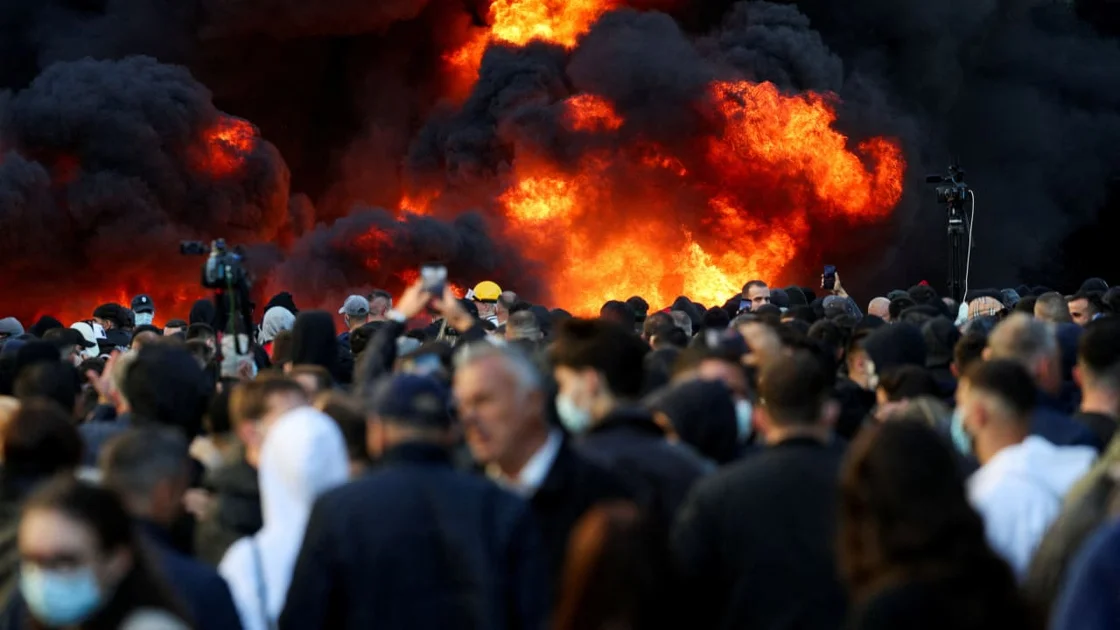
Clashes Erupt in Tirana as Student-Led Protests Turn Violent
Albanian Prime Minister Edi Rama has rejected calls to resign after three days of violent clashes in the capital Tirana, where thousands of student-led protesters attacked government buildings, smashed windows, and fought running battles with riot police. The unrest, which began as a student movement demanding better university conditions and job prospects, has escalated into the most serious challenge to Rama's 13-year rule.
According to the Associated Press, protesters voiced anger over perceived corruption, the cost and quality of education, and a controversial deal to sell parts of Albania's pristine southern coastline to a luxury resort development backed by Jared Kushner, son-in-law of US President Donald Trump. On Thursday, Rama issued a written statement to Reuters, saying: "My responsibility is to listen, address legitimate concerns and keep Albania moving forward. The alternative would be a betrayal of the Albanians who gave me a strong mandate to complete negotiations on European Union membership."
The violence peaked on Wednesday and Thursday, with part of the education ministry building set on fire, and attacks on the prime minister's office, finance and interior ministries, and several surrounding businesses. Riot police responded with water cannon, tear gas, and batons. An estimated 89 people, including 61 police officers, were injured during overnight clashes, according to The Guardian. Tirana's streets were left littered with burned-out garbage bins, shattered bus stops, and broken traffic lights.
A Movement Born from Months of Frustration
The current wave of protests marks a significant escalation from months of largely peaceful demonstrations. Since June, the anti-government "Flamingo" movement has held daily protests in central Tirana, symbolised by pink flamingo images, initially sparked by the Kushner-backed resort project on the Adriatic coast. That movement demanded Rama's resignation, accusing his government of corruption and ignoring public concerns.
The new student-led demonstrations, which began on Tuesday outside the education ministry, have galvanised broader discontent. Secondary school students joined in, swelling the numbers, and the protests quickly spread beyond the capital to other major cities including Durrës, Shkodër, Lezhë, Vlora, Gjirokastër, and Korçë. "Young Albanians are tired of all the corruption, tired of all the arrogance. They want to live in a better country and they are not afraid to use violence," said Afrim Krasniqi, director of the Albanian Institute for Political Studies in Tirana, speaking to The Guardian.
The protesters' grievances are multifaceted. A student who identified herself as Kiara told the Associated Press: "Our prime minister is the meaning of the word corruption. You can only find work in your field if you know a guy who knows a guy." Others, like lawyer Lulzim Tanushi, echoed these sentiments, saying, "This government is corrupted, led and governed by a corrupt prime minister. Since Rama came to power he has abused and ruined people's lives."
Government Response: Defiance and Calls for Calm
Prime Minister Rama, who won a historic fourth term last year on a platform centred on EU membership, has steadfastly refused to step down. In his statement, he emphasised that governments are changed through democratic elections, not revolutions. "We had elections last year, not a revolution," he told Reuters. He acknowledged the rising cost of education but condemned the violence, stating: "Attacking institutions, destroying public property and threatening public safety have nothing to do with the legitimate demands of students."
Deputy Prime Minister Albana Koçiu called for "calmness, self-restraint and maturity," adding that "Albania does not need to burn to change." Education Minister Mirela Kumbaro also weighed in, saying that while she respects the right to protest, "civic student protest and violence against public buildings and property are two different things." Parliament cancelled its session on Thursday as violence erupted nearby.
Injuries and Escalation: A City on Edge
The scale of the violence has shocked many in Albania, a country that has largely avoided such scenes since the fall of communism. The BBC reported that masked protesters threw stones and firecrackers at police, who responded with tear gas and water cannon. In Skanderbeg Square, police hit fleeing protesters with batons as tourists looked on. One particularly inflammatory incident involved a young man being carried away with a broken leg, which further incensed the crowd despite subsequent apologies from officials.
The protests have also taken an economic toll, with damaged businesses and government buildings. The unrest has created an atmosphere of unpredictability. "There is no prognosis. Nobody can say what will come next," Krasniqi told The Guardian. The international community is watching closely, given Albania's aspirations to join the European Union by 2030. Rama has vowed not to let violence derail that goal, but the protests threaten to undermine his credibility both at home and abroad.
The Kushner Resort Deal: A Catalyst for Anger
The proposed luxury resort development on Albania's southern coast, backed by Jared Kushner, has been a lightning rod for discontent. Critics argue that the deal exemplifies corruption and the selling off of national assets to foreign interests. The project, which aims to transform pristine coastline into a high-end tourist destination, has been criticised for its potential environmental impact and lack of transparency. The Flamingo movement, which began in June, was initially a response to this deal, and it has now merged with the student-led protests to create a broader anti-government coalition.
Political Implications: A Turning Point for Albania?
This crisis represents the biggest challenge yet to Rama's dominance. Since coming to power in 2013, he has transformed Albania's international standing and made EU membership a central pillar of his governance. However, accusations of corruption, authoritarianism, and economic mismanagement have persisted. The current protests, which have united students, workers, and middle-class Albanians, suggest that public patience may finally be running out.
The violence also raises questions about the stability of the Balkans, a region with a history of political turmoil. Albania, a NATO member since 2009, has been a stabilising force in the region, but prolonged unrest could have wider repercussions. The government's heavy-handed response has drawn criticism from human rights groups, who have called for restraint. Meanwhile, the opposition has seized on the protests to demand early elections.
What Next? A Nation at a Crossroads
As the protests enter their fourth day, there is little sign of resolution. Rama has offered to discuss the rising cost of education but has ruled out resigning. Protesters, emboldened by their numbers and the attention they have garnered, show no signs of backing down. The coming days will be crucial in determining whether Albania can find a peaceful path forward or descend further into chaos.
The international community, particularly the EU and the US, will be watching closely. The Kushner-linked resort project has already drawn scrutiny, and any perception of foreign interference could inflame tensions further. For now, Albania stands at a crossroads, with its young protesters demanding a better future and its long-serving prime minister vowing to stay the course. The world waits to see which force will prevail.
Comments