
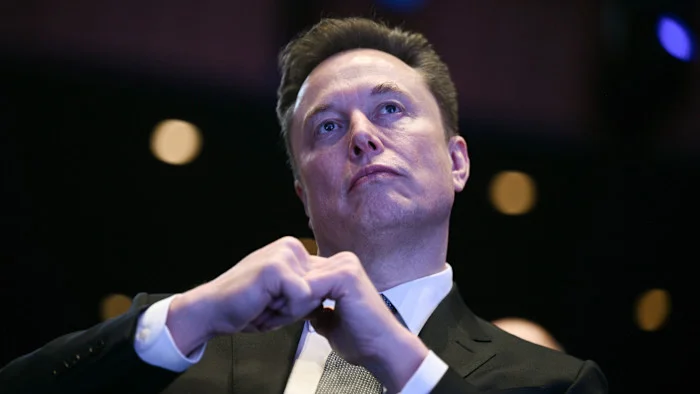
Elon Musk Drops a Bomb on Retirement Planning: 'Don't Bother Saving'
In comments that have reignited debates about the future of work and personal finance, Elon Musk is telling Americans to stop worrying about retirement savings. The Tesla and SpaceX CEO argues that the coming wave of artificial intelligence and humanoid robots will render traditional nest eggs obsolete within a decade. Speaking on the Moonshots with Peter Diamandis podcast in January—comments that are now circulating widely after a fresh round of reporting—Musk said, “Don’t worry about squirreling money away for retirement in 10 or 20 years. It won’t matter.”
The world’s richest man doubled down on his prediction that by 2030, artificial general intelligence will surpass “the intelligence of all humans combined.” He envisions a world where humanoid robots outnumber people on Earth and AI performs half or more of all current jobs. In his view, the resulting productivity explosion will create such abundance that the link between wages, savings, and living standards will dissolve entirely. Instead of a universal basic income, Musk foresees what he calls a “universal ‘you can have whatever you want’ income.”
Musk’s remarks, first reported in late April 2026, have sparked pushback from financial advisors and even his podcast host, Peter Diamandis, who told Business Insider he would not be passing that advice along. “I’m not sure I’m going to be passing that advice along,” Diamandis said in a video call published on April 24. While Diamandis shares Musk’s techno-optimism, he stopped short of endorsing the idea that millions of Americans should abandon their 401(k) plans.
The Core Argument: Zero Scarcity on the Horizon
Musk’s controversial stance rests on a simple premise: AI and robotics will soon make goods and services so cheap that saving money becomes pointless. On the podcast, he described the coming shift as a “supersonic tsunami” of technological change. “Anything short of shaping atoms, AI can do probably half or more of those jobs right now,” he said. White-collar roles, he predicted, will be replaced first, followed by nearly every form of labor that doesn’t involve physically manipulating matter in novel ways.
This leap in productivity, Musk argues, will surpass “what people possibly could think of as abundance.” His vision extends beyond material goods. He claimed that within five years, AI will help people obtain better medical care than what is currently available, regardless of their savings or insurance status. Educational opportunities, housing, and even food could become nearly free if AI-driven robots handle production and distribution.
Musk has long suggested that money itself will become irrelevant. During the U.S.-Saudi Investment Forum in November 2025, he compared future work to a hobby: “If you want to work, [it’s] the same way you can go to the store and just buy some vegetables, or you can grow vegetables in your backyard. It’s much harder to grow vegetables in your backyard, and some people still do it because they like growing vegetables.”
Why Musk’s Comments Matter: The Retirement Crisis Meets AI Hype
Musk’s remarks land at a moment when millions of Americans are already struggling to save for retirement. According to Federal Reserve data, about one in four non-retired adults have no retirement savings at all, and nearly half worry they won’t have enough to live comfortably in old age. Against that backdrop, a message that says “don’t bother saving” could be dangerously seductive—or refreshingly honest, depending on one’s view of AI’s trajectory.
Financial planners have spent decades drilling the gospel of compound interest: save early, save consistently, and diversify. Musk is now telling a generation of workers that those rules may not apply in the world of 2030. The stakes are enormous. If he is wrong, millions of people who heeded his advice could face poverty in old age. If he is right, the entire $30 trillion retirement industry could be upended.
Diamandis, a noted futurist and author himself, provided a more measured take. He explained that Musk’s argument hinges on the government delivering a “universal high income” (UHI)—a step beyond basic income—funded by the immense wealth generated by AI. “It means that things will be so cheap that Americans won’t need to have a nest egg in their old age,” Diamandis said. Yet he remained skeptical enough to distance himself from Musk’s absolute dismissal of savings.
Historical Precedents and Skeptics
Critics point out that similar predictions of technological utopia have been made before, often falling short. In the 1960s, economists like John Maynard Keynes predicted a 15-hour workweek by the 21st century. Automation fears in the 1980s and 1990s led to widespread predictions of mass unemployment that never fully materialized. Instead, new jobs emerged that no one had imagined.
Musk’s timeline is also aggressive. He says AI will surpass all human intelligence by 2030—barely four years from today. While AI systems like GPT-4 and its successors have made stunning strides, most experts believe artificial general intelligence remains further out. A 2025 survey of AI researchers by the University of Oxford found a median estimate of 2045 for the arrival of human-level AGI, with wide disagreement.
Even if Musk’s timeline is wrong, his comments highlight a growing consensus: AI will disrupt the labor market profoundly. A Goldman Sachs report from early 2026 estimated that 30% of current work tasks could be automated by 2035, potentially displacing 300 million workers globally. The difference is that most economists advocate for retraining and social safety nets, not abandoning savings entirely.
Perspective: A Vision That Changes the Rules
Musk’s retirement savings comments are not just a quirk of a billionaire out of touch with ordinary struggles. They reflect a deeper ideological shift in Silicon Valley: the belief that technology will so completely transform scarcity that traditional financial advice becomes obsolete. This worldview, sometimes called “effective accelerationism” or e/acc, argues that the only rational response to exponential technological growth is to embrace the disruption, not hedge against it.
For the average worker, the implications are dizzying. If Musk is correct, the mundane advice to save 10% of your income and invest in index funds will look as quaint as a horse-and-buggy. People might not need to worry about outliving their savings because healthcare, housing, and food could all be provided at near-zero cost by AI-driven systems. The very concept of “retirement” would change—not as a period of leisure funded by decades of work, but as a natural state in an age of abundance.
But even if one accepts the premise of abundance, serious questions remain. Who controls the AI and robots? Who decides how the wealth is distributed? Musk’s vision of a “universal high income” assumes that governments—or perhaps the companies that own the AI—will simply give everyone everything they want. History offers few examples of ruling elites voluntarily relinquishing power and wealth. Critics worry that without strong democratic institutions and robust social contracts, the age of AI could produce a nightmare of inequality rather than a utopia.
What This Means for Financial Planning Today
For now, most financial advisors are sticking to the old script. Fidelity, Vanguard, and Charles Schwab continue to recommend saving 15% of pretax income annually, including employer matches. Social Security’s trustees report that the program’s trust fund will be depleted by 2034, meaning benefits could be cut by 23% unless Congress acts. The gap between Musk’s vision and the current reality is vast.
Nevertheless, Musk’s comments are likely to influence a generation of young investors who already distrust traditional institutions. A 2025 survey by the CFA Institute found that 34% of adults under 30 believe they will never retire, and 28% say AI will make their jobs obsolete within a decade. For those already convinced the system is broken, Musk’s message that “it won’t matter” may feel like validation.
It’s worth noting that Musk himself, with a net worth exceeding $200 billion, does not face the same constraints as a typical worker. His advice comes from a position of extreme privilege—he can afford to be wrong. But for a nurse, a teacher, or a factory worker, the penalty for being wrong about retirement savings is devastating. And even in a world of AI abundance, having a cushion of savings could provide autonomy and choice that a “universal high income” might not guarantee.
Broader Trends and Future Implications
Musk’s comments are part of a broader conversation about the social contract in the age of AI. The idea that work is the primary way to earn a living is being questioned not just by futurists but by policymakers. Several countries, including Finland and Canada, have experimented with universal basic income trials. In March 2026, California launched a two-year pilot program providing $1,000 per month to 1,000 residents, exploring whether such payments improve well-being without discouraging work.
The AI revolution is also affecting the entertainment and sports industries, where debates about retirement and career longevity are ongoing. For instance, in snooker, questions about when to step away are never far from the spotlight, as seen in ongoing discussions around top players like Ronnie O’Sullivan. Ronnie O'Sullivan's Snooker Future in the Spotlight as Crucible Campaign Reignites Retirement Debate highlights the personal and professional calculations that come with timing a career’s end—a calculus Musk says AI will soon render irrelevant for everyone.
Similarly, in entertainment, AI-generated content is already blurring lines between human creativity and machine production. The recent debate over changes in House of the Dragon Season 3 sparked controversy that illustrates how even storytelling is being reshaped by technology. If AI can write scripts, compose music, and generate lifelike performances, what happens to the livelihoods of actors, writers, and musicians? Musk’s answer is that they won’t need to worry—abundance will provide. But the transition period, which could last decades, will be painful for those caught in between.
Conclusion: A Heated Debate That Isn’t Going Away
Elon Musk’s retirement savings comments have forced an uncomfortable conversation. Is the traditional advice to save and invest still valid in an era of exponential AI growth? Or are we standing at the edge of a transformation so profound that it rewrites the rules of economics?
For now, the majority of experts urge caution. Peter Diamandis, despite his optimism, refuses to endorse Musk’s advice to abandon saving. Most economists and financial planners agree. But the conversation is no longer fringe. When the world’s richest man—a figure with a track record of disrupting industries—says retirement savings won’t matter, people listen.
Whether Musk is a visionary ahead of his time or a billionaire disconnected from reality, his comments have already achieved one thing: they have made millions of people question whether their financial plans are built for a world that may not exist 20 years from now. That question, unsettled and unsettling, will only grow louder as AI continues its relentless advance.
Comments