
Logan Fire Threatens Communities as Crews Battle Dual Blazes in Utah and British Columbia
Firefighters in two North American communities are battling significant wildfires that share the name "Logan," forcing evacuations and straining resources as dry conditions and shifting winds fuel the flames. In Logan, Utah, a fast-moving vegetation fire dubbed the "USU Fire" prompted immediate evacuation orders on Saturday, August 1, 2026, while in Logan Lake, British Columbia, the Guichon Creek wildfire continues to burn out of control after igniting on July 29. Both incidents highlight the volatile early-August fire conditions across the West, where climate change and prolonged drought are intensifying the frequency and severity of wildfires.
USU Fire in Logan, Utah: Evacuations and Structure Threats
A rapidly moving vegetation fire reported at the 1400 block of Canyon Road in Logan, Cache County, Utah, on the morning of August 1, 2026, has forced localized evacuations and threatened structures. According to WatchDuty, a live fire tracking service, the blaze, now called the "USU Fire," has grown to at least 5 acres. Radio traffic reported by emergency responders indicates that crews are conducting structure protection in the area of 1420 E, with one house roof already on fire and another structure threatened. The fire is moving quickly through grass and brush, with one scanner page on X urging residents within a one-mile radius of 600 E & Canyon Road to evacuate immediately.
Social media posts from residents and local news outlets show large columns of smoke and flames consuming vegetation near the Utah State University campus area. The Island area of Logan has been specifically mentioned in evacuation orders. As of the latest update, there are no reports of injuries, and the cause of the fire remains under investigation. Fire crews have had to navigate road construction on Canyon Road, which has hampered some initial response efforts, but they are now working to establish containment lines.
Guichon Creek Fire Near Logan Lake, BC Swells to 145 Hectares
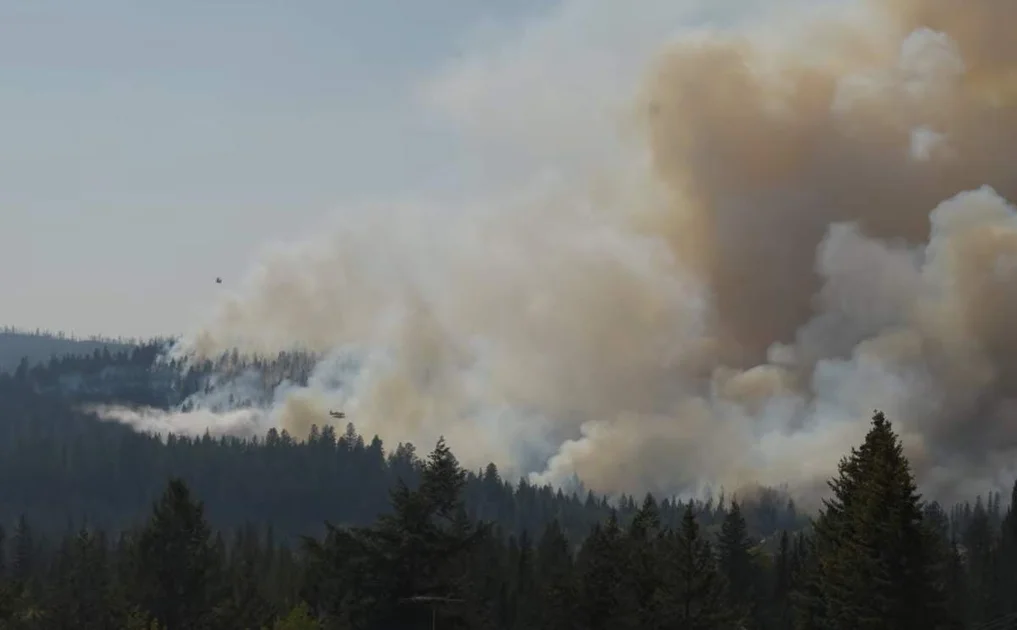
Meanwhile, in British Columbia, the Guichon Creek wildfire, which sparked on July 29 just west of Logan Lake near Guichon Creek, continues to challenge firefighting crews. After initially being estimated at 10 hectares, the fire ballooned to 152 hectares by Friday morning, July 31, before being slightly downgraded to 145.25 hectares by the afternoon. The BC Wildfire Service (BCWS) reports the blaze remains out of control, with all evacuation alerts still in effect. Thirty-one ground personnel, supported by helicopters and heavy equipment, are working on containment, primarily on the northern flank of the fire. Air tankers, skimmers, and helicopters have been conducting aerial attacks when visibility permits.
Local residents have described the fire's rapid spread as "terrifying." Logan Lake Mayor Robin Smith told CFJC Today that the fire, which was first spotted around 2:00 p.m. on Wednesday, grew "very, very quickly" and was highly visible from the community. "It was pretty scary," Smith said, noting that the situation has improved thanks to an aggressive initial attack. "The BC Wildfire Service came in really fast and really hard and knocked the flames down really good," he added. Resident Chris Maude echoed the sentiment, saying, "We sat here and watched it jump the highway up toward the transfer station, and it was terrifying how quickly it can move."
Context: A Region on Edge Amidst Record Heat and Drought
The twin Logan fires underscore a broader trend: wildfire season is starting earlier and lasting longer, with more intense blazes threatening communities across North America. Both Logan, Utah, and Logan Lake, BC, have experienced above-average temperatures and below-normal precipitation in recent weeks, creating tinder-dry vegetation. In Utah, the USU Fire is just one of several wildfires currently burning in the state, with others like the Skyline Fire in Oakland Hills, California, also making headlines. The rapid spread of the USU Fire, which jumped from 5 to 10 acres in a matter of minutes, is typical of grass fires fueled by dry grass, high winds, and rugged terrain.
For Logan Lake, a community of about 2,000 residents, the Guichon Creek fire is a stark reminder of the devastating wildfires that have struck British Columbia in recent years. The 2021 Lytton Creek wildfire, which burned 83,000 hectares and destroyed much of the village of Lytton, is still fresh in the minds of many. The Guichon Creek fire has already forced the evacuation of some residents and has put others on alert. Local officials are urging residents to stay prepared and heed all evacuation orders.
The BC Wildfire Service has been using a multi-pronged approach, including night vision-equipped helicopters, to combat the blaze. "Skimmers and air tankers actioned this fire to support firefighting personnel and heavy equipment," BCWS stated. Despite these efforts, the fire exhibited Rank 2 and 3 behavior on Thursday, which means a surface fire with occasional candling and a slow-to-moderate rate of spread. The unpredictable nature of the fire has kept crews on high alert, especially as winds are forecast to pick up over the weekend.
Perspective: Climate Change and the Rising Cost of Wildfire Response
The simultaneous battles in Logan, Utah, and Logan Lake, BC, are not isolated incidents but part of a worrying trend. Scientists and fire experts point to climate change as a major driver of longer fire seasons and more severe fires. Warmer temperatures dry out vegetation earlier in the year, creating a longer window for fires to ignite and spread. In addition, decades of fire suppression have left many forests with an overabundance of fuel, making fires more intense when they do occur.
The economic and emotional toll on communities is immense. In Logan, Utah, residents are worried about their homes and the loss of natural habitat. In Logan Lake, the local economy relies heavily on tourism and recreation, and the wildfire threatens not only homes but also the surrounding forest that draws visitors. The cost of fighting these fires is also significant, with millions of dollars spent on air tankers, helicopters, and ground crews. As fires become more frequent, insurance premiums in wildfire-prone areas are rising, and some insurers are even refusing to cover homes in high-risk zones.
There is also a human cost: firefighters are working long hours in dangerous conditions, and local residents are living under the constant threat of evacuation. Mayor Robin Smith expressed his gratitude for the firefighting efforts but also acknowledged the anxiety in his community. "Anything can happen and change at any time," he said. This sentiment is echoed by many who live in the fire-prone West. While the immediate focus is on containing the current blazes, the longer-term challenge is to adapt to a new reality where wildfires are more common and more destructive.
Community Resilience and Response
In both Logan, Utah, and Logan Lake, BC, community members have come together to support one another. In Logan, Utah, local residents have shared information about evacuation zones and offered shelter to those displaced. The Logan City Police Department and Cache County Sheriff's Office are coordinating efforts, and the American Red Cross has set up an evacuation center at a local school. In Logan Lake, the District of Logan Lake has been providing regular updates on its website, and the local fire department has been working alongside BC Wildfire Service crews.
The response to the Guichon Creek fire has been praised for its coordination. "It was the most coordinated... I jokingly said we had our own private air show," Mayor Smith said, referring to the aerial assault on the fire. This collaborative approach is critical as wildfires become more complex and require a multi-agency response. With climate modeling predicting more extreme weather events, communities must invest in both fire prevention and response capabilities. This includes clearing brush around homes, creating defensible space, and ensuring that evacuation plans are in place.
The Road Ahead: Containment and Recovery
As of August 1, 2026, both fires are still active, and crews are working around the clock to contain them. In Logan, Utah, the USU Fire is still at zero percent containment, according to fire officials, and evacuation orders remain in place for the Island area. The Cache County Sheriff's Office has set up a temporary evacuation point at Logan High School, and residents are urged to sign up for emergency alerts. In Logan Lake, BC, the Guichon Creek fire remains out of control, but crews have made progress on the northern flank. The BC Wildfire Service expects to have additional personnel and equipment arriving on site this weekend to support the firefighting effort.
The road to recovery will be long for both communities. Once the fires are contained, there will be assessments of damage, cleanup efforts, and the long process of rebuilding. For some, like the family affected by the USU Fire in Utah, the loss of a home is a devastating blow. For others, the anxiety of not knowing if their home has survived is still too real. But as has been seen in past fires, communities in Logan and Logan Lake are resilient. They have banded together in the face of adversity, and they will work to rebuild and recover.
As the fire season continues, experts urge residents in fire-prone areas to have an emergency plan in place, including food, water, and important documents ready to go at a moment's notice. They also encourage everyone to follow fire bans and restrictions, and to report any signs of smoke or fire immediately. The fires in Logan, Utah, and Logan Lake, BC, are a stark reminder of the power of nature and the importance of being prepared.
Senior Editor's Note
This article will be updated as new information becomes available. For more on the latest fire incidents, check out our coverage of the Woodside Fire Explodes to 100 Acres, Forces Highway 1 Closure and Evacuations on Sonoma Coast. For a look at how fires can affect local businesses, read about Verdi's Cafe Fire: Mumbles Landmark Gutted, Family Vows to Reopen. Stay informed, stay safe.
Conclusion: A Call for Vigilance
The Logan fires are a wake-up call for communities everywhere. With climate change making these events more common, it's not a matter of if a fire will strike but when. Whether it's the USU Fire in the hills of Utah or the Guichon Creek blaze in British Columbia, the message is the same: we must be prepared, we must work together, and we must do everything we can to mitigate the risks. As the firefighting efforts continue, all eyes are on the skies, hoping for rain and for containment lines that hold. In the meantime, the brave men and women on the front lines are doing everything they can to protect lives and property, and for that, we owe them our deepest gratitude.
Comments