
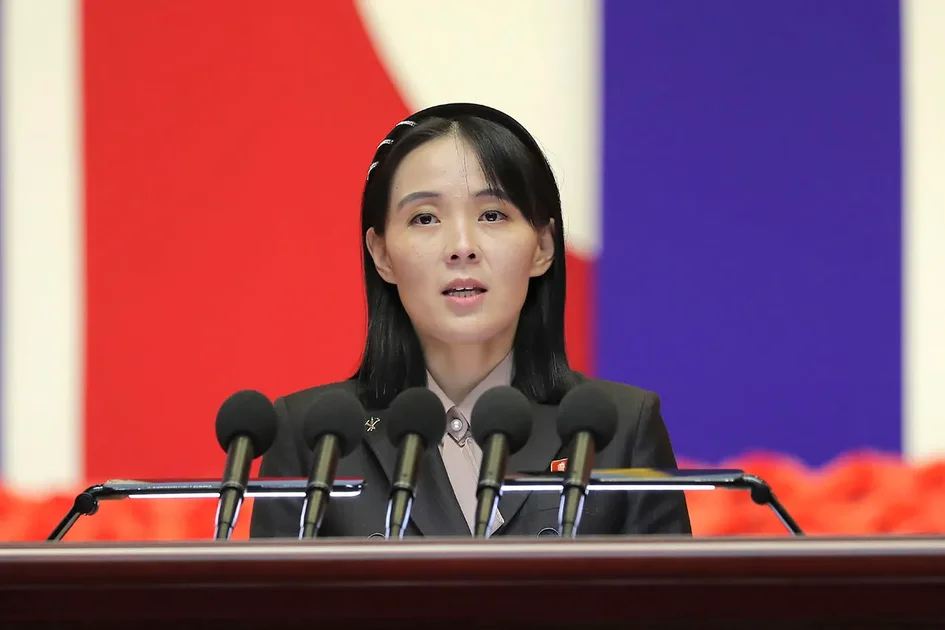
Kim Yo Jong Declares North Korea's Nuclear Status 'Absolutely Non-Negotiable' Ahead of Xi Summit
Kim Yo Jong, the powerful sister of North Korean leader Kim Jong Un, issued a stark warning on Thursday, June 6, 2026, declaring that Pyongyang's status as a nuclear-armed state is "absolutely non-negotiable" and dismissing U.S. calls for denuclearization as an "anachronistic dream." The statement, published by the state-run Korean Central News Agency (KCNA), came just one day before Chinese President Xi Jinping is scheduled to arrive in Pyongyang for his first visit to North Korea in nearly seven years.
"Our status as a nuclear power is absolutely non-negotiable. We will not tolerate any threats," Kim Yo Jong said. She further asserted that the policy of "continuously strengthening self-defensive nuclear war deterrence, as declared by the head of state, is an irreversible and final conclusion that must be executed unconditionally."
The Xi Visit and the Nuclear Showdown
The timing of Kim Yo Jong's remarks is critical. Xi Jinping is set to meet with Kim Jong Un on Monday, June 8, 2026, in what analysts see as Beijing's attempt to reinforce its ties with its only formal treaty ally amid growing global tensions. The visit also follows a May summit between Xi and U.S. President Donald Trump, during which, according to White House readouts, the two leaders affirmed a shared goal of denuclearizing the Korean Peninsula.
Kim Yo Jong directly refuted that account, labeling the U.S. claims as "false" and insisting that Pyongyang possesses "the most accurate information" regarding what was actually discussed. "Some officials in the United States have failed to wake from their escapist and anachronistic dream," she added, signaling that North Korea will not be swayed by diplomatic pressure.
'Irreversible and Final'
Kim Yo Jong’s language marks a definitive hardening of North Korea’s position. The phrase "irreversible and final conclusion" has been deployed repeatedly by senior North Korean officials in recent weeks, particularly after Kim Jong Un visited a newly unveiled nuclear material production facility. During that visit, the North Korean leader called for an "exponential" expansion of the country's atomic arsenal. State media photos showed what appeared to be a large centrifuge hall, indicating the facility is likely a uranium enrichment plant using advanced technology.
Adding to the pressure, Kim Jong Un also toured a major munitions factory and ordered a 2.5-fold increase in missile production capacity over the next five years, according to reports from Yonhap News Agency citing North Korea's state newspaper, The Rodong Sinmun.
The Strategic Calculation
Why is North Korea choosing this moment to draw such a hard line? Analysts believe that Xi’s visit is a double-edged sword for Pyongyang. On one hand, it signals China’s continued support and provides a platform for Kim Jong Un to project confidence and defiance. On the other hand, it raises the stakes for North Korea to demonstrate that it is not bending to external pressure—especially from the United States.
Context: Why This Matters Now
The Collapse of Diplomacy and the Nuclear Build-Up
The current escalation traces back to the collapse of high-stakes diplomacy between Kim Jong Un and former President Donald Trump in 2019. Since then, North Korea has abandoned talks and focused almost exclusively on expanding its nuclear and missile programs. The country has conducted an unprecedented number of missile tests, including intercontinental ballistic missiles (ICBMs) capable of reaching the U.S. mainland, and has repeatedly updated its nuclear doctrine to allow for preemptive strikes.
Kim Yo Jong herself has emerged as one of the most influential figures in the regime. As Director of the General Affairs Department of the Workers' Party of Korea and an alternate member of the Politburo, she is widely seen as the chief architect of North Korea's messaging and foreign policy strategy. Her direct involvement in nuclear negotiations signals that the regime considers the issue existential.
The Chinese Factor
China remains North Korea’s most important economic and diplomatic lifeline. Beijing has repeatedly called for restraint and dialogue but has also vetoed multiple UN Security Council resolutions aimed at tightening sanctions on Pyongyang. Xi’s visit is widely interpreted as an effort to manage the situation ahead of potential further provocations.
However, the visit also puts Xi in a delicate position. The United States has urged China to use its leverage to pressure North Korea to denuclearize. By visiting Pyongyang so soon after the U.S.-China summit, Xi may be signaling that Beijing prioritizes its partnership with North Korea over Washington's demands.
The 'Anachronistic Dream' Rhetoric
Kim Yo Jong’s dismissal of denuclearization as an "anachronistic dream" is particularly pointed. It suggests that North Korea views the U.S. goal as outdated and irrelevant to the current geopolitical reality. In her statement, she argued that the U.S. assertion to "backbite the status of the DPRK as a nuclear weapons state has no legally binding force"—implying that Washington’s attempts to impose denuclearization are unilateral and illegitimate.
The Global and Regional Stakes
The implications of North Korea’s hardened stance extend far beyond the Korean Peninsula. A nuclear-armed North Korea directly challenges the global non-proliferation regime and threatens the security of U.S. allies in the region, including South Korea and Japan.
Arms Race in Northeast Asia
South Korea has already begun discussions about developing its own nuclear deterrent, while Japan has signaled a willingness to host U.S. nuclear weapons under a "nuclear sharing" arrangement. This could trigger an arms race in Northeast Asia, potentially destabilizing the entire region.
Impact on Global Supply Chains
Heightened tensions on the Korean Peninsula also have ripple effects on global trade and supply chains. The region is home to some of the world’s busiest shipping lanes and manufacturing hubs. Any disruption—whether from military exercises, sanctions, or outright conflict—could impact the flow of goods, including semiconductors, automobiles, and energy resources. For instance, the ongoing Strait of Hormuz Closure Sparks Plastic Shortages and Global Supply Crisis demonstrates how quickly geopolitical flashpoints can create cascading economic disruptions.
The Nuclear Umbrella Question
The United States maintains a policy of "extended deterrence," promising to use its nuclear umbrella to protect allies like South Korea and Japan. However, North Korea’s rapidly advancing missile and nuclear capabilities are testing the credibility of that promise. If Pyongyang can reliably strike the U.S. mainland, Washington may be less willing to intervene in a conflict on the peninsula.
What This Changes: A New Normal
Kim Yo Jong’s statement is not just a diplomatic snub—it is a declaration of a new normal. North Korea is signaling that it will no longer engage in negotiations on denuclearization. The only acceptable outcome, from Pyongyang’s perspective, is international recognition as a nuclear weapons state.
The End of Denuclearization as a Goal?
For nearly three decades, the United States and its allies have pursued the goal of a denuclearized Korean Peninsula. That goal now appears more distant than ever. Some analysts argue that Washington should shift its strategy from seeking denuclearization to pursuing arms control and risk reduction measures—such as limits on missile testing or a freeze on fissile material production.
Xi’s Delicate Balancing Act
Xi Jinping faces a similar dilemma. He wants to maintain influence over Pyongyang without being drawn into a confrontation with the United States. By visiting North Korea, he may hope to coax Kim Jong Un into restraint—but Kim Yo Jong’s defiant statement suggests that the North Korean leadership is in no mood for compromise.
A Broader Trend of Nuclear Assertiveness
North Korea’s stance is part of a broader global trend of nuclear assertiveness. Russia has repeatedly brandished its nuclear arsenal during the war in Ukraine, while Iran continues to enrich uranium to near-weapons-grade levels. The erosion of arms control treaties, such as the Intermediate-Range Nuclear Forces (INF) Treaty, has further weakened the non-proliferation architecture.
Kim Yo Jong’s comment that the U.S. is living in an "anachronistic dream" may be more than rhetoric—it reflects a fundamental shift in how nuclear-armed states view the world order.
Conclusion: The Clock Is Ticking
As Xi Jinping lands in Pyongyang, the world watches to see whether China can exert any moderating influence on North Korea. But if Kim Yo Jong’s statement is any indication, the answer may be no. North Korea has drawn a red line that it says is "absolutely non-negotiable," and it is willing to face the consequences.
The question now is what the international community will do in response. More sanctions? Military deterrence? Or grudging acceptance of a nuclear North Korea? None of these options are easy, and each carries significant risks.
In the meantime, the centrifuges keep spinning. And Kim Yo Jong has made it clear: the bombs are not up for discussion.
Comments