
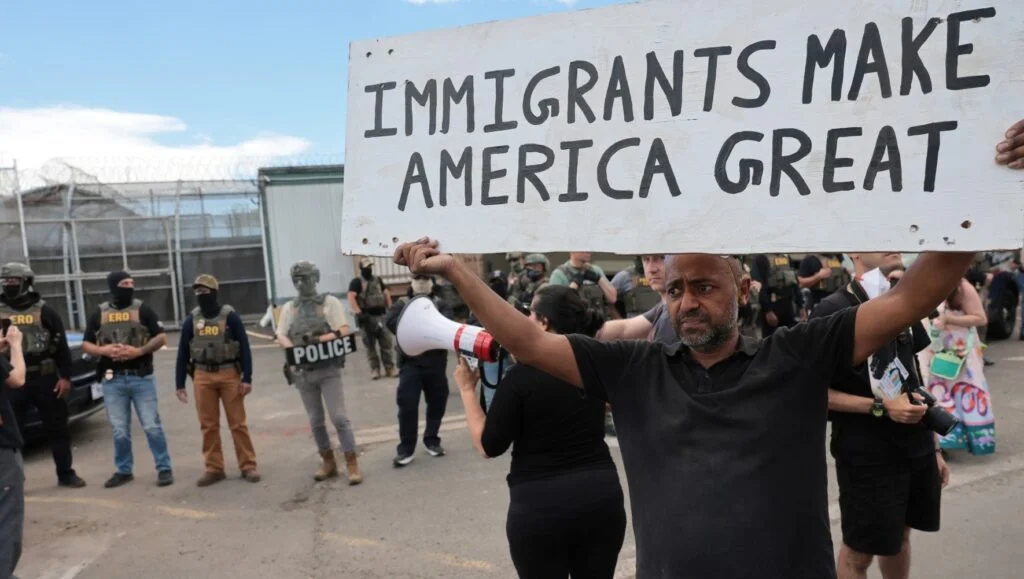
ICE Surges Officers into New York City in New Enforcement Operation
Immigration and Customs Enforcement (ICE) has begun a targeted enforcement operation in New York City, moving more than a month after White House border czar Tom Homan first promised a surge of federal agents into the metropolitan area. Multiple sources confirmed to NewsNation that the operation started in Queens on Monday and is expected to expand into other parts of the city and surrounding suburbs beginning Tuesday.
The operation comes after Homan said last week that an increased ICE presence would be deployed to New York City following an alleged attack on a federal building. Although Homan maintained the move had been planned before the attack, he argued it underscores what he called growing threats against immigration officers.
"There's just another example of someone attacking ICE because of the constant mis-messaging and vilification of the men and women of ICE," Homan told reporters last week.
According to sources, ICE is initially relying on officers already assigned to the New York field office rather than pulling agents from other locations. The operation is specifically targeting individuals who have had detainers lodged by ICE with local jails and prisons that were not honored, meaning those individuals were released back onto the streets despite federal requests to hold them.
However, officials acknowledge that the enforcement actions will produce what are termed "collateral arrests" — meaning people who are not specific targets but are found to be in the country illegally may also be detained. Homan has repeatedly stated that anyone in the country illegally "isn't off the table" for enforcement operations, even if they are not on a DHS target list.
A Department of Homeland Security spokesperson declined to confirm the operation's start, citing operational security, but reiterated that "ICE agents uphold our nation's immigration laws in all 50 states, seven days a week, 24 hours a day."
ICE officers remain restricted by the New York State Protect Our Courts Act, which prohibits arrests of individuals going to or leaving court.
The Political Stakes: A Governor's Race Hinges on Immigration
The timing of the ICE operation injects immigration enforcement directly into an already heated New York gubernatorial race between Democratic incumbent Kathy Hochul and Republican challenger Bruce Blakeman. As the campaign moves toward its fall peak, a large-scale immigration crackdown could upend the race and make Trump's immigration agenda a central issue.
Both candidates have so far focused largely on affordability, but the physical presence of federal agents conducting enforcement in the state's largest city is likely to shift attention. "Physical proximity is always important, so something in New York would focus the attention in New York for a while," said Grant Reeher, a Syracuse University political science professor. "They are still talking about this issue in Minnesota, for example."
Hochul has taken a firm stance against cooperating with federal immigration enforcement. In May, she signed a bill banning local and state law enforcement from entering into agreements that allow them to act as federal immigration agents. The law directly targets arrangements like the one Blakeman has championed in Nassau County.
On Monday, in Buffalo, Hochul addressed Homan directly: "I encourage Tom Homan to talk to the big boss and ask him his position, because I am not giving that invitation nor that permission."
Blakeman, the Nassau County executive, has taken the opposite approach. He signed an agreement to deputize 10 Nassau County police officers as ICE agents and is renting space in the county jail for ICE to hold detainees. In a statement, Blakeman argued that cooperation makes a major federal surge unnecessary. "By cooperating with ICE, a surge is not necessary in my county as we have removed many illegal migrants with criminal records for rape, robbery and other heinous crimes without raiding any schools, churches and daycare centers," he said.
A Siena University poll conducted last month found that only 9% of New York voters named immigration as the issue they were most concerned about, but the advent of visible enforcement operations could quickly change those numbers.
Upstate Detention Expansion Paves the Way for More Arrests
Even before the New York City operation began, ICE had been quietly increasing its detention capacity across upstate New York. The buildout suggests the agency is preparing for a significant increase in the number of people it will hold in-state as enforcement ramps up in the metropolitan area.
Expanding detention capacity in upstate regions provides ICE with logistical advantages. Rather than transporting detainees hundreds of miles to facilities in Texas or Louisiana, the agency can hold individuals closer to where they are arrested, reducing costs and legal complications. For a state that has long resisted federal immigration enforcement, the expansion of ICE infrastructure represents a tangible shift in the balance of power.
Governor Hochul has limited authority to block federal detention facilities on non-state land, meaning the upstate expansion can proceed regardless of her opposition. "This is a federal operation, and they have the resources to build or lease facilities that suit their needs," Reeher noted.
The Blue-State Dilemma: Starving ICE of Resources May Not Work
The New York operation and upstate detention expansion illustrate a broader challenge facing blue states and sanctuary cities that have tried to limit ICE's footprint. For years, immigration activists have successfully pressured local governments to block or restrict immigration detention centers, arguing that constraining ICE's physical capacity limits its ability to arrest and hold large numbers of people.
In the New York City metro area, the only sizable immigration detention facility is Delaney Hall in Newark, New Jersey, a privately run jail operated by the GEO Group on a $1 billion, 15-year contract. Since reopening last year, the facility has become a flashpoint for protests, with demonstrators rallying against poor conditions and demanding its closure. New Jersey Governor Mikie Sherrill and other prominent Democrats have joined calls to shut down Delaney Hall and are suing the Trump administration to block plans for a larger jail elsewhere in the state.
But the strategy of squeezing ICE's capacity may be losing its effectiveness. Since President Trump returned to office, Republicans have channeled more than $100 billion in additional funding to ICE through the budget reconciliation process — roughly ten times the agency's annual budget. That financial windfall means ICE can now easily afford to transport detainees to facilities in southern states where detention costs are lower, bypassing blue-state resistance entirely.
Border czar Tom Homan has warned that attempts to close facilities like Delaney Hall will backfire. During a visit to New Jersey last month to defend conditions at the facility, Homan told Democratic officials that shutting down the jail would not stop enforcement — it would simply force ICE to send detainees further away, making it harder for families and lawyers to maintain contact.
Klaus Galiano, a former ICE attorney now on the board of the American Immigration Lawyers Association, noted that the agency's expanded budget removes one of the main obstacles activists had relied on. "ICE now has more money than it knows what to do with," he told The Atlantic. "Efforts to starve the agency of resources are now essentially futile."
What the Operation Means for New Yorkers
For residents of New York City and surrounding areas, the immediate question is how far the operation will reach and how long it will last. Sources indicate the initial focus is on individuals with unserved detainers — people who were released by local authorities despite ICE requests to hold them. But Homan's statements suggest the net could widen significantly.
The operation also raises practical questions about how local law enforcement will respond. Under New York's new law, state and local police cannot enter into agreements with ICE, but they are also not required to actively resist federal agents. In practice, this creates a gray area where ICE operates independently while local authorities maintain a carefully neutral posture.
Eric Gonzalez, the Brooklyn District Attorney, told reporters last week that his office would monitor the operation closely but would not interfere with federal law enforcement as long as it stays within legal bounds. "We have our jurisdiction, they have theirs," he said.
The coming weeks will test whether New York's sanctuary policies can withstand a sustained federal enforcement campaign or whether the political and practical pressures will force adjustments on both sides.
Broader Implications: Immigration Enforcement Becomes a National Flashpoint
The New York operation is not happening in isolation. Across the country, the Trump administration has intensified enforcement in blue cities and states, testing the limits of sanctuary policies and local resistance. In Minnesota, enforcement operations earlier this year sparked protests and legal challenges that are still working their way through the courts.
Reeher cautioned that the impact of the New York operation will depend heavily on what else is happening in the news. "How long will the Iran war last? Will inflation start to curb when it ends? Will the president cook up something else for the media to focus on?" he asked.
But for now, all eyes are on New York. The state is already seeing the buildout in detention capacity, the county partnerships around Nassau, and the political clash between Hochul and Blakeman over how far ICE should go. The actual start of enforcement operations in Queens marks the moment when the debate moves from campaign statements to real-world consequences.
As one source close to the operation put it: "This is just the beginning. The question is how many people will be affected before it's over."
For readers interested in how national news intersects with local weather alerts, a flash flood warning has recently hit Atlanta suburbs as heat indices near 100°F. Meanwhile, the ongoing coverage of Steven Bartlett's Iran War Warning highlights how multiple crises are competing for public attention.
Comments