
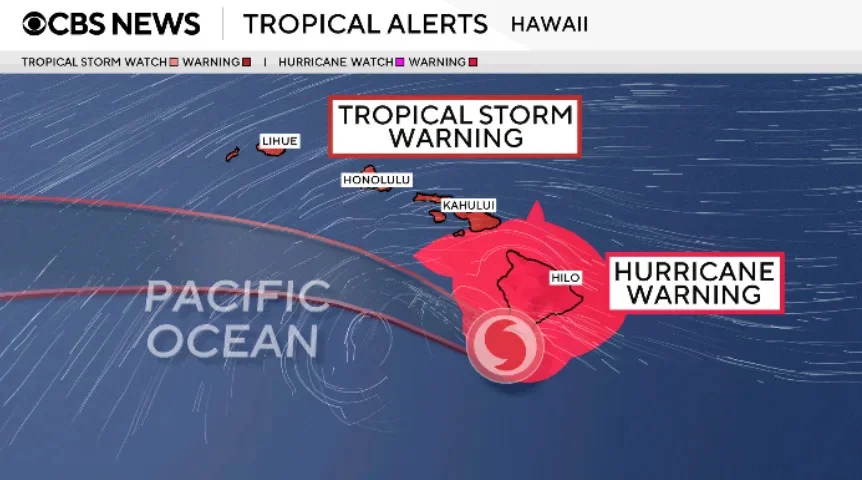
Hurricane Lala Leaves Trail of Destruction Across Hawaii
Hurricane Lala, a Category 1 storm that skirted the southern tip of Hawaii's Big Island over the weekend, has left a trail of destruction, claiming at least one life, sweeping more than 100 homes off their foundations, and plunging over 200,000 households into darkness. By Monday, the storm had weakened to a tropical storm as it continued its westward track across the Pacific, but officials warned that the danger was far from over, with flash flood warnings still in effect across several islands.
The storm, which at its peak packed maximum sustained winds near 91 mph, slammed the Big Island's southern coast on Saturday night, bringing hurricane-force winds, torrential rainfall, and powerful waves. The National Weather Service’s Honolulu office confirmed that two homes in the Kau District community of Naalehu were swept away, with Hawaii County Mayor Kimo Alameda reporting via Instagram that “several occupied homes may have been swept off their foundations” in the Alihu and Waiheno areas. A search and rescue mission involving Civil Defense, the National Guard, and the Coast Guard was launched immediately.
“What makes this very challenging is that there's rushing water, there's debris and there's boulders on the road and it's dark,” Mayor Alameda said, describing the treacherous conditions facing first responders.
Governor Josh Green, speaking in a video update on X, confirmed that one person had died in a storm-related car accident at the island's southernmost point. While officials initially said it was unclear if the crash was directly caused by the storm, the governor’s office later listed it as storm-related. “It is with deep sadness that we confirm the first fatality from Hurricane Lala,” Green said, without providing further details. He added that he has initiated the process for a major disaster declaration, which would unlock federal assistance for recovery efforts.
Widespread Power Outages and Infrastructure Damage
The storm’s fury left more than 200,000 utility customers without electricity, mostly on the Big Island, according to utility tracker PowerOutage.us. At least three hospitals were operating on generator power, and damage to roads and several small bridges made some areas inaccessible. The Wainaku Street Bridge in Hilo was submerged, and a downed utility pole was captured dangling dangerously over Mamalahoa Highway near Ocean View.
State and county offices, as well as public schools and courts, remained closed on Monday as crews worked to clear debris and restore services. The governor noted that the full extent of the damage was still being assessed, but early reports indicated that the storm had taken a heavy toll on infrastructure, particularly in rural and coastal communities.
The storm also generated a significant number of medical emergencies. Honolulu EMS transported more than 200 people to hospitals, and lifeguards made 59 rescues on Saturday alone. Honolulu Mayor Rick Blangiardi urged residents to stay out of the water on Sunday, saying, “It’s not a day to come to the beach. It’s not a day to go paddling or surfing.” The city also deployed search and rescue crews to find a hiker missing at Oahu’s Lulumahu Falls Trail.
Why This Storm Matters: Hawaii’s Vulnerability and Recent History
Hawaii is no stranger to the threat of tropical cyclones, but direct hits are rare. In fact, no hurricane has made a direct landfall on the state since Hurricane Iniki devastated Kauai in 1992, killing six people and causing billions of dollars in damage. Lala did not technically make landfall—it passed within 30 miles of South Point—but its eyewall, the most dangerous part of the storm, brushed the southern Big Island, unleashing the kind of rainfall and wind that can be just as destructive.
The storm dumped astonishing amounts of rain. In Maui County, Kapalua received 48 inches over the weekend, with five locations across the state measuring 35 inches or more. The National Hurricane Center had warned of 10 to 20 inches of rain on the Big Island, with isolated totals up to 25 inches, but those figures were quickly surpassed. The flash flooding that resulted swept homes away, cut off roads, and forced residents to flee to higher ground.
One dramatic rescue involved an elderly woman who was pulled from a home that had been washed away in Naalehu. The woman, whose name has not been released, was hospitalized but is expected to survive. The rescue was one of many carried out by local responders, the National Guard, and the Coast Guard, often under dangerous conditions.
The storm also highlighted the vulnerability of the state’s infrastructure. Many roads and bridges in rural Hawaii are old and not designed to withstand the kind of torrential runoff that accompanies such storms. The governor’s office said several small bridges have been damaged or destroyed, isolating some communities. The storm has also reignited conversations about climate change and the increasing intensity of tropical cyclones in the Pacific.
“This is a stark reminder that Hawaii is not immune to the devastating forces of nature,” said Dr. Emily Fairweather, a climatologist at the University of Hawaii at Manoa. “We are seeing more frequent and more intense storms in the Pacific, and this is a call to shore up our resilience.”
The Human Toll and Community Response
The human impact of Lala extends beyond the one confirmed fatality. More than 100 homes were uprooted or destroyed, according to Governor Green, who expressed relief that the number of casualties was not higher. “Amazingly, it appears that the properties that were washed away did not, at least as of this moment, have any fatalities associated with them,” he told a press conference. “There were a lot of people that went to hospital for minor accidents.”
The storm disrupted daily life for thousands of residents. Power outages forced many to rely on generators, and water supplies were compromised in several areas. The American Red Cross opened shelters across the state, and the Hawaii National Guard deployed 180 members to assist with search, rescue, and cleanup efforts. Local community organizations have also mobilized to provide food and supplies to affected families.
In Hilo, residents were seen wading through waist-deep water in the streets, while social media video showed cars being swept along roads and bridges overtaken by floodwaters. The storm also caused widespread cancellations, including flights, ferry services, and public events. Schools and businesses remained shuttered on Monday, adding to the disruption.
Despite the devastation, the sense of community was strong. Neighbors helped neighbors, and first responders worked around the clock. “We will rebuild, and we will recover,” Mayor Alameda said. “This is a tough time, but Hawaii is tougher.”
Broader Implications: A Changing Pacific and What It Means for the Future
Lala’s impact is part of a concerning trend of increasingly powerful and destructive tropical cyclones in the Pacific. Scientists have long warned that warmer ocean temperatures, driven by climate change, are fueling stronger hurricanes and typhoons, with heavier rainfall and higher storm surges. Lala, which intensified from a tropical storm to a Category 1 hurricane in just over a day, serves as a vivid example of rapid intensification—a phenomenon that has become more common in recent years.
“We are seeing storms that rapidly intensify, sometimes by 40-50 mph in 24 hours, which makes forecasting and preparedness much more difficult,” said NOAA hurricane specialist Dr. Michael Brennan. “This is a global trend, and Hawaii is particularly vulnerable because of its isolated location and the limited time residents have to prepare.”
The storm also underscores the need for improved infrastructure and disaster preparedness in Hawaii and other Pacific islands. The damage to roads, bridges, and power grids will likely take weeks or months to repair, and the cost could run into the hundreds of millions of dollars. Local officials are calling for federal aid and for more investment in resilient infrastructure.
Ironically, Lala is expected to regain hurricane strength over the open waters of the Pacific later this week, though it poses no immediate threat to land. As it continues westward, it will be closely monitored by the National Hurricane Center, which notes that the storm could affect other islands in the Pacific, though no warnings are currently in effect.
For Hawaii, the recovery from Lala is just beginning. As the floodwaters recede and the cleanup gets underway, residents are left to ponder the broader implications of a warming world and the increasing likelihood of storms like Lala becoming a more frequent part of life in paradise.
“We have to take these storms more seriously,” Governor Green said. “We have to invest in our infrastructure, in our early warning systems, and in our communities. This won’t be the last time we face this.”
Comments