
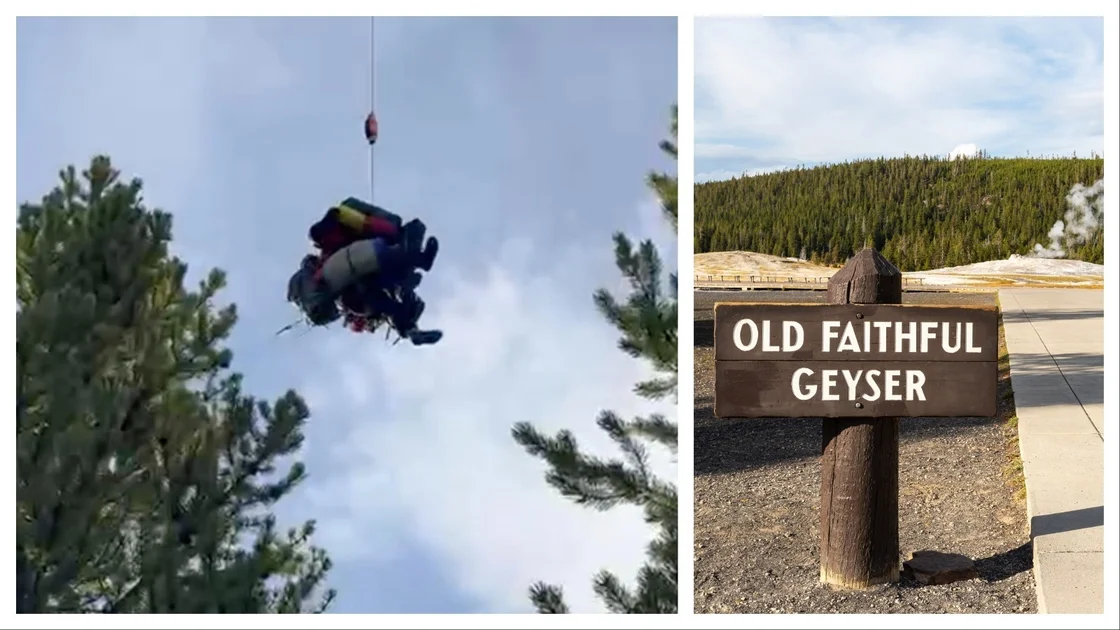
Hiker recounts frantic rescue after grizzly attack near Old Faithful
A grizzly bear attack on a popular hiking trail near Yellowstone National Park’s Old Faithful geyser left two hikers seriously injured on Monday, May 4, 2026, prompting immediate trail closures and a swift emergency response. The incident occurred on the Mystic Falls Trail, a heavily traveled route that leads to a 70-foot waterfall about two miles northwest of Old Faithful.
Craig Lerman, a hiker from Baltimore, Maryland, was the first person to find one of the victims. Lerman told the Cowboy State Daily that he noticed bear prints in the mud and then a bloody hat with a torn-off watch before hearing cries for help. “He heard me coming and started saying, ‘Help. Help me,’” Lerman recounted. The victim, a 28-year-old man, was lying on the trail “tore up pretty bad” with cuts across his face, back, legs, and stomach. Lerman took over the 911 call for the man, who had already managed to use his blood-covered phone to call for help.
National Park Service (NPS) emergency services personnel responded on foot and later airlifted both victims to Eastern Idaho Regional Medical Center via helicopter. Park officials confirmed that “one or more bears” were involved, but have not yet released the species or the condition of the hikers. The attack is under investigation, and large areas of the park west of Grand Loop Road have been temporarily closed, including the Fairy Falls Trail, Sentinel Meadows Trail, and several backcountry campsites.
Rare but serious: bear attacks in Yellowstone’s recent history
While Yellowstone sees more than 4 million visitors each year, bear attacks remain rare. This is the first reported bear-related injury in the park in 2026. The most recent non-fatal attack occurred in September 2025, when a 29-year-old man was injured by a grizzly bear while hiking alone near Turbid Lake. The last deadly bear mauling in Yellowstone was in 2015, when a 63-year-old man from Billings, Montana, was killed while hiking alone in the Lake Village area.
That 2015 attack led to the capture and killing of an adult female grizzly because it had eaten part of the victim’s body—behavior considered abnormal for a bear defending its young. In contrast, the 2025 attack was deemed a surprise encounter, and the bear was not relocated or killed. The outcome for the bear or bears involved in Monday’s attack will depend on whether the encounter is judged to be defensive or predatory.
Yellowstone is home to both grizzly bears and black bears. Grizzlies can be more aggressive and grow up to twice the size of black bears. NPS spokesperson Ashton Hooker said that authorities have not yet identified which species was involved in Monday’s incident, as the two can be difficult to distinguish in the field.
Broader implications for visitors and park management
The attack underscores the constant challenge of managing human-wildlife interaction in one of the world’s most visited national parks. With summer visitation approaching its peak, the closure of popular trails near an iconic attraction like Old Faithful will affect thousands of tourists in the coming days. Park officials have urged visitors to carry bear spray, hike in groups, make noise, and maintain a distance of at least 100 yards from all wildlife.
This incident also follows broader environmental stresses. Just as Mexico City Sinking Nearly a Foot Yearly as Water Crisis Worsens, NASA Data Reveals highlights how climate and resource pressures reshape landscapes, Yellowstone’s bear population dynamics are shifting with changing food availability and warming temperatures. Grizzly bears in the Greater Yellowstone Ecosystem have expanded their range in recent decades, bringing them into more frequent contact with humans.
For the hikers and their families, the trauma is immediate. Lerman described giving the victim his T-shirt to keep him warm, and noted that the man’s mother was on the phone with his brother—who was the other victim, just 14 years old—trying to keep him calm. “I never saw the other guy,” Lerman said. “He was 14, and I believe that was his brother.” The attack serves as a grim reminder that even well-traveled trails can become sites of sudden danger. As the NPS continues its investigation, the question remains: was this a defensive encounter, or something more aggressive? The answer will determine not only the fate of the bear, but also how the park communicates risk to millions of future visitors.
Comments