
Chaos After Midnight: Gatwick Runway Blocked Sparks Mass Emergency Declarations
A late-night operational incident at London Gatwick Airport escalated into a full-scale aviation emergency early Wednesday, July 15, 2026, after a British Airways aircraft became disabled on the main runway. At least nine inbound passenger planes were forced to declare low-fuel emergencies — squawking the universal distress code 7700 — as they circled over southeast England waiting for the runway to be cleared.
Flight tracking data confirmed that the disruption began shortly before midnight when British Airways Flight BA2673, an Airbus A320 arriving from Palma de Mallorca, Spain, landed at Gatwick but remained stationary on the tarmac. Airport rescue and firefighting services raced to the scene, and the runway was temporarily shut down for safety reasons. According to reports, the aircraft suffered a nose steering issue that left it immobilized, blocking departures and preventing new arrivals.
The knock-on effect was immediate and severe. Multiple flights that were already airborne and bound for Gatwick entered holding patterns above the English countryside. As fuel levels dropped, flight crews had no choice but to declare emergencies to secure priority landing clearance or permission to divert. The situation unfolded across a 90-minute window, with at least 14 flights ultimately being redirected to alternative airports.
Key Flights Affected
The aircraft that declared emergencies included five easyJet flights (from Agadir, Valencia, Fuerteventura, Athens, and Rome), two British Airways flights (from Bari and Tenerife), one Jet2 flight from Lanzarote, and one TUI Airways flight from Rhodes. These nine planes transmitted the Squawk 7700 code, which air traffic control systems instantly flagged as a low-fuel or general emergency.
All nine diverted aircraft landed safely at nearby airports, including London Luton and London Stansted. Additional flights also diverted to other regional hubs without formally declaring emergencies. One British Airways passenger posted on social media that their flight had landed at Stansted instead of Gatwick, adding: "Still on the plane to see what’s happening next. Hoping we can be flown back."
Runway Reopens After Ground Incident Cleared
Just before 1:30 a.m. BST, Gatwick Airport confirmed that the runway had been fully reopened. The disabled British Airways plane was towed off the tarmac after emergency crews completed their investigation. Within minutes, the first inbound flights began landing again. EasyJet flight U28076 from Malaga touched down at 1:36 a.m., followed closely by a TUI flight from Tenerife.
Gatwick Airport issued no official statement explaining the exact cause of the aircraft being stuck on the runway, but aviation sources pointed to a mechanical issue — possibly related to the plane’s nose wheel steering system — that rendered the aircraft unable to move under its own power. The British Airways flight crew reportedly alerted ground control immediately after landing, triggering the emergency response.
What Caused the Queue?
Because the incident occurred on the main single-runway at Gatwick — one of Europe's busiest single-runway airports — any obstruction effectively halts all air traffic. Unlike dual-runway hubs such as Heathrow or Frankfurt, Gatwick relies on a single active runway for the vast majority of its movements. When a plane becomes stuck on that runway, no aircraft can land or take off until the obstruction is cleared.
Arriving flights that were already in the air could not be held indefinitely. Holding patterns are designed to manage short delays, but when the delay stretches beyond 30 to 45 minutes, fuel consumption starts to approach safety reserves. The nine crews that declared emergencies were acting within standard aviation protocols, which permit pilots to declare a fuel emergency when the remaining fuel is sufficient for only a limited time beyond the planned landing.
Why This Matters: The Stakes of a Single Runway Failure
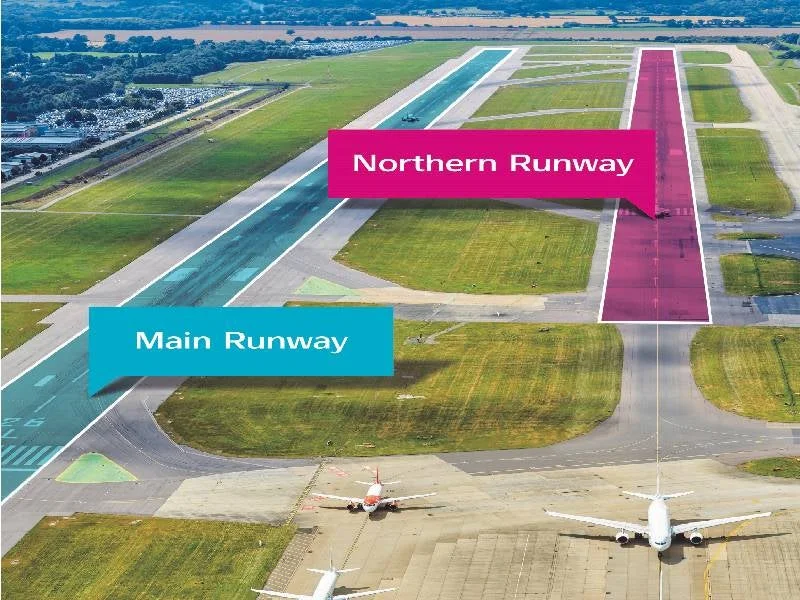
The Gatwick runway incident highlights a structural vulnerability shared by many major airports around the world: reliance on a single active runway. Gatwick operates with one main runway (and a standby runway used only when the main is closed for maintenance). When that runway is blocked — whether by a disabled aircraft, debris, or an emergency response — the airport essentially stops functioning.
At least nine planes declared emergencies and diverted, but many more flights were delayed or canceled. The ripple effects will likely be felt throughout July 15 as aircraft, crews, and passengers are repositioned. Passengers whose flights were diverted to Luton or Stansted faced hours of uncertainty, waiting for buses or connecting flights back to Gatwick.
Aviation experts have long warned that high-traffic single-runway airports create a bottleneck risk. In 2024, a similar incident at Stansted involving a stalled aircraft caused cascading delays across the London airspace system. Wednesday’s event at Gatwick underscores that risk.
Fuel Emergencies Are Rare — But Serious
While passengers often hear about "low-fuel emergencies" in aviation news, they remain relatively uncommon in commercial aviation because airlines build generous fuel margins into every flight plan. The fact that nine separate crews felt compelled to declare an emergency suggests an unusually long period of runway unavailability — longer than the standard holding fuel reserves of about 30 to 45 minutes. Each of those nine aircraft likely had enough fuel to reach a diversion airport but not enough to continue circling indefinitely.
Interestingly, the Squawk 7700 code is not unique to fuel emergencies — it covers all in-flight emergencies — but in this case, flight tracking data and pilot communications strongly indicated that fuel depletion was the primary driver. No medical, security, or technical emergencies were reported among the nine aircraft themselves. They were simply stranded in the air, waiting for a runway that was blocked by another plane.
Broader Implications: Can Gatwick Cope With Growing Demand?
This incident comes at a time when London Gatwick is handling record passenger numbers. The airport recently announced a multi-billion-pound investment plan to upgrade terminal facilities and prepare for a potential second regular runway, but that project remains years away from completion. For now, the airport operates at near capacity during peak hours, leaving little margin for error.
Wednesday’s emergency also raises questions about airline contingency planning and airport coordination. When nine planes simultaneously declare fuel emergencies, the London air traffic control system is placed under extreme pressure. Controllers must coordinate diversions to multiple airports while ensuring that aircraft maintain safe separation. That complexity increases the risk of secondary incidents — though in this case, all aircraft landed safely.
In a broader perspective, this event mirrors trends seen across European aviation in recent years. As air travel rebounds and surpasses pre-pandemic levels, airports and air traffic management are struggling to keep pace. Staff shortages, aging infrastructure, and increased congestion have all contributed to a rise in operational incidents. The Gatwick runway blockage is a vivid reminder that the margin for error in modern aviation is razor-thin — and that even a single mechanical failure can cascade into a major disruption.
What Passengers Should Expect Next
Passengers whose flights were diverted or delayed may be eligible for compensation under UK and EU regulations. Under UK law (retained from EU Regulation 261/2004), passengers who are delayed by more than three hours due to an incident within the airline’s control may be entitled to compensation of up to €600, depending on flight distance. However, because a disabled aircraft on the runway is often classified as an "extraordinary circumstance," airlines may argue that the delay was unavoidable. Travel experts advise passengers to document their flight numbers, delays, and any communications from the airline, and to submit claims regardless.
As of early Wednesday morning, Gatwick was fully operational, but residual delays are expected to persist through the day. The airport advised passengers to check with their airlines before traveling to the airport.
Conclusion: A Wake-Up Call for Aviation Infrastructure
Nine planes declaring emergencies at one of the world’s busiest airports is not a routine event — it is a symptom of systemic pressure on the aviation system. The Gatwick incident was resolved without injury or damage, but it exposed critical vulnerabilities: single-runway dependency, the tightrope of fuel planning, and the domino effect of a single mechanical failure.
As global air travel continues to grow, the question is not whether similar incidents will happen again, but when. Airports like Gatwick may need to accelerate investment in redundancy — whether through additional runways, enhanced ground handling equipment to clear disabled aircraft faster, or more robust air traffic management tools to handle mass diversions.
For now, the passengers aboard those nine emergency-declaring flights are safe. But the incident will likely prompt renewed scrutiny of operational resilience at major airports across the UK and Europe.
Comments