
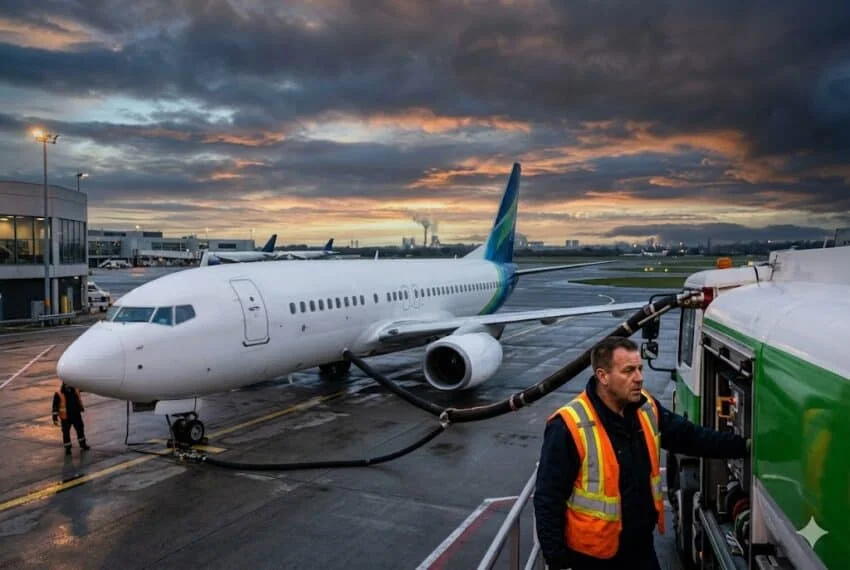
Frontier Airlines Grounded by Hidden Cost: $17.6 Million in Extra Taxi Time
New data from AirInsight reveals that Frontier Airlines is bleeding cash on the tarmac. An analysis of 2026 taxi times at the top ten US airports shows that Frontier’s aircraft are spending an average of 36.1 minutes taxiing per flight—8.5 minutes longer than the industry average of 27.6 minutes. At the airline’s operating cost of $143 per minute, those extra minutes have added up to a staggering $17.6 million in excess taxi time over the last four months.
Those ten airports account for just 21% of Frontier’s total flights, but the inefficiency is disproportionately expensive. To put that number in perspective, the report notes that the wasted taxi time is worth roughly 20% of a heavily discounted A321neo. The data, drawn from US Department of Transportation records, underscores a structural problem that goes beyond airport congestion.
What’s Driving the Long Taxi Times?
While many airlines blame airport infrastructure for ground delays, Frontier’s data suggests the issue is internal. The airline’s average taxi time across its top airports is significantly higher than peers flying the same routes. Analysts point to scheduling practices, gate assignment inefficiencies, and fleet turnaround coordination as likely culprits. Frontier has not yet publicly commented on the report.
This operational friction comes at a particularly bad time. Shares of Frontier’s parent company, Frontier Group Holdings (NASDAQ:ULCC), fell 8.3% in afternoon trading on July 27 after American Airlines slashed its full-year profit forecast due to soaring jet fuel prices. American cited geopolitical tensions with Iran for the spike, lowering its guidance to a range between a loss of $0.65 and a profit of $0.65 per share. The warning sent shockwaves through the airline sector, punishing ultra-low-cost carriers like Frontier that operate on razor-thin margins.
The Perfect Storm: Fuel Costs, Geopolitics, and Consumer Confidence
Frontier’s taxi time problem is now colliding with a broader industry headwind. Jet fuel prices surged more than 7% after President Trump declared the Iran ceasefire “over” and ordered renewed strikes. For a low-cost carrier where fuel represents one of the largest operating expenses, even a small percentage increase can wipe out quarterly profits.
A Vulnerable Business Model
Frontier’s model relies on high aircraft utilization and low fares. When planes spend nearly ten extra minutes taxiing per flight, that not only burns fuel but also erodes daily flight cycles. The airline has been trying to grow its network, adding destinations in Costa Rica, the Dominican Republic, and Mexico. But the operational drag at its busiest hubs undermines those ambitions.
Meanwhile, consumer confidence is wavering. Renewed conflict in the Middle East, combined with rising gas prices, is beginning to dampen discretionary travel demand. Leisure-oriented carriers are often the first to feel the pinch when households tighten budgets. Frontier stock, at $5.49 per share, is still trading 30.7% below its 52-week high of $7.91 from June 2026, despite a 20% gain year-to-date. Investors who bought $1,000 worth of shares five years ago would now hold just $365.67.
TikTok Troubles Multiply
Beyond the spreadsheets, Frontier is also wrestling with a growing reputation crisis on social media. A recent viral TikTok video—now with 1.7 million views—chronicled a nightmare flight from Atlanta to Jacksonville. The passenger, Kenzie (@morbuckzz), documented a cascade of delays: a last-minute gate change from concourse E to T, a one-hour boarding delay, a 45-minute wait while crew searched for lost bags, and then an announcement that the brakes were stuck. She filmed what she described as “foggy” condensation inside the cabin, which persisted until takeoff. The video has fueled a wave of negative sentiment among budget travelers.
Broader Implications for Ultra-Low-Cost Carriers
Frontier’s taxi time inefficiency is not just a Frontier problem—it’s a warning for the entire ultra-low-cost carrier (ULCC) model. As fuel costs climb and consumer confidence softens, any operational waste becomes magnified. Unlike full-service carriers that can raise fares or lean on premium cabins, ULCCs have little buffer.
Industry Trends and What Comes Next
The airline industry is entering a phase of heightened volatility. American Airlines’ profit warning signals that even strong travel demand may not be enough to offset fuel price spikes. Frontier’s stock swing is part of a broader pattern: the shares have had 70 moves greater than 5% over the past year, reflecting acute sensitivity to macro news.
For context, read about how United Airlines Flight Makes Emergency Landing at Military Base as Storm Hits Phoenix, another example of how operational challenges can cascade into major disruptions for carriers.
In the longer term, Frontier may need to reconsider its scheduling and ground operations at its busiest airports. The $17.6 million taxi time figure is not a one-off anomaly—it represents a recurring cost that, if left unchecked, will compound as fuel gets more expensive. The airline could also look to fleet simplification or more aggressive negotiation with airport authorities.
As the ULCC sector navigates geopolitical turbulence and rising input costs, the airlines that tighten their operations fastest will be the ones that survive. Frontier’s taxi problem is a reminder that in aviation, sometimes the biggest battles are fought not in the air, but on the ground.
This article was updated on July 27, 2026 at 5:15 PM ET.
Comments