
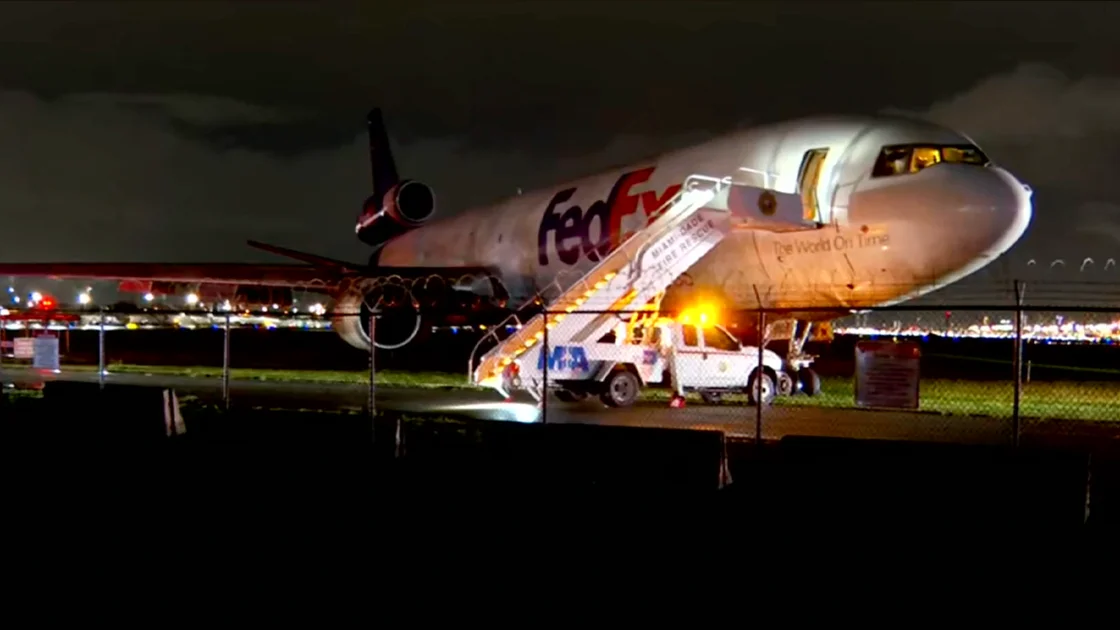
FedEx MD-11 Overruns Runway at Miami International, Triggering Ground Stop
A FedEx McDonnell Douglas MD-11 cargo plane ran off the end of a runway at Miami International Airport on Wednesday night, forcing a temporary ground stop and disrupting one of the busiest travel days of the year. The incident occurred at approximately 8:40 p.m. local time on Runway 26R, the airport's shortest runway, according to Miami-Dade Sheriff's Office and airport officials.
Both people on board the aircraft were uninjured, and emergency crews from Miami-Dade Fire Rescue and the sheriff's office reported no signs of fire or smoke. The plane came to rest on the grass near Northwest 67th Avenue, just short of a busy road. Miami International Airport confirmed on X that all runways except Runway 9R were closed following the overrun, and the FAA issued a ground stop for departures bound for Miami until at least 9:45 p.m.
Immediate Impact on Holiday Travel
The grounding triggered cascading delays across the airport during the Thanksgiving travel rush. Initial ground stops lasted about 45 minutes, but hourlong delays rippled through departing flights. With only one runway operating, delays settled between 30 and 45 minutes, according to airport officials. Travelers were advised to check directly with their airlines for updates before heading to the airport.
One passenger, Greg Smith, told WSVN he was trying to return to London when his 10 p.m. departure was diverted to Orlando. "Radio silence. We were all getting it on our phone," Smith said. "Then, finally, they made an announcement telling us that our plane went to Orlando." Despite the disruption, Smith remained philosophical: "It does happen and, like I said, it is what it is. Safety first."
Wet Weather and Short Runway Under Investigation
Preliminary reports indicate the aircraft departed from Frederick W. Smith International Airport in Memphis before landing at MIA. At the time of the incident, rainy conditions had reduced visibility to 7 miles with a 13 mph tailwind, according to CBS Miami. An airport employee who witnessed the aftermath said the crew appeared to struggle to slow the aircraft on the wet pavement.
"They tried as hard as they could to stop, but I don't know if it was the weather because the rain and the wind were really bad, and they just couldn't stop in time and went right off the runway and veered off into the grass," the employee said. The overrun occurred on Runway 26R, which the worker noted is the airport's shortest runway, raising questions about whether runway length and weather conditions combined to create a hazardous landing scenario.
FAA and NTSB Involvement
The FAA confirmed the incident and is investigating. The agency posted on X that the FedEx McDonnell Douglas MD-11 overran Runway 26R at approximately 8:40 p.m. The National Transportation Safety Board has not yet announced whether it will launch a formal investigation, but such overruns typically prompt federal scrutiny of weather, crew procedures, and runway conditions.
A Troubling Pattern at MIA
The incident is not the first runway excursion at Miami International this year. On September 6, a 21 Air cargo plane flying for Amazon Prime overshot a runway, crashed, and killed five airport employees while injuring five others. That accident raised concerns about cargo operations at the airport and prompted local officials to review runway safety protocols.
The earlier crash is likely to amplify scrutiny of Wednesday's incident, even though no injuries were reported. The fact that both events involved cargo aircraft overrunning runways during inclement weather may fuel calls for enhanced braking systems, runway end safety areas, and revised landing procedures during storms.
Cargo Operations Under the Microscope
FedEx, one of the world's largest cargo airlines, operates a significant hub at Memphis and flies frequent routes into Miami. The MD-11, a tri-jet freighter, is a workhorse of the cargo industry but has been involved in several high-profile accidents over the years. While the cause of Wednesday's overrun remains under investigation, the incident highlights the unique risks cargo pilots face when operating heavy aircraft in adverse weather at airports with varying runway configurations.
Thanksgiving Travel Chaos Highlights Systemic Vulnerabilities
The timing of the incident—on the eve of Thanksgiving, historically one of the busiest travel periods in the United States—magnified its impact. Millions of Americans were expected to fly during the holiday week, and any disruption at a major hub like Miami can cascade across the national airspace system. The ground stop affected not only arrivals into Miami but also departures and connecting flights, leaving passengers stranded or rerouted.
Miami International Airport is among the busiest in the country for both passenger and cargo traffic. Its runway system, while extensive, has faced challenges during severe weather. The closure of all but one runway for several hours demonstrated how quickly a single incident can strain operations.
Passenger Frustration and Communication Gaps
Travelers at MIA described confusion and a lack of real-time information. Greg Smith noted that passengers learned about the diversions through their phones before official announcements were made. "Radio silence," he said, describing the gap between the incident and clear communication from airlines and airport authorities. Such gaps are a recurring pain point during irregular operations, and they underscore the need for better passenger notification systems.
Broader Implications for Aviation Safety and Infrastructure
The FedEx overrun adds to a growing list of runway excursions in the U.S. and abroad, prompting industry experts to revisit safety margins. The FAA has been pushing for upgraded runway safety areas and engineered materials arresting systems (EMAS) at airports with limited overrun space. Miami's Runway 26R, being the shortest, may lack the buffer zones of longer runways, making it more vulnerable to overruns during wet conditions.
Moreover, the incident raises questions about tailwind limits and landing distance calculations. A 13 mph tailwind can significantly increase landing distances, and pilots must account for contaminated runways. Whether the crew correctly calculated those factors will be part of the investigation.
Economic and Operational Ripples
Cargo delays can have economic consequences beyond passenger inconvenience. FedEx and other integrators rely on tight schedules to move packages, and a disrupted hub can delay deliveries across the region. With e-commerce at peak volume during the holiday season, even a few hours of runway closure can create backlogs.
What Happens Next
Investigators will examine flight data, cockpit voice recordings, weather reports, and runway conditions. The FAA may issue recommendations, and FedEx will conduct its own internal review. In the meantime, Miami International Airport is expected to resume normal operations as soon as the aircraft is removed and the runway is inspected.
For travelers, the incident serves as a reminder to build buffer time into holiday itineraries and to monitor flight status closely. For the aviation industry, it is another data point in the ongoing effort to prevent runway excursions—a category of accident that, while often non-fatal, carries significant safety and operational costs.
As the busy Thanksgiving travel period continues, authorities will be watching closely to ensure that the remaining runway can handle the load and that no further disruptions occur. Passengers are encouraged to check with their airlines for the latest updates, and airport officials have expressed appreciation for travelers' patience as they work to safely resume normal operations.
Comments