
Doximity Stock Surges 70% on AI Revenue Optimism
Shares of Doximity (NYSE: DOCS) skyrocketed nearly 70% in premarket trading on Friday, August 7, 2026, after the medical professional network reported fiscal second-quarter results that beat revenue expectations and signaled growing momentum for its AI-powered products. The stock was indicated at $35.10, up from Thursday's close of $20.66, adding roughly $2.6 billion in market value in a single session.
The surge came after Doximity announced quarterly revenue of $156.6 million, a 7.3% year-over-year increase and a 3.5% beat over analyst estimates of $151.3 million. The company also raised its full-year revenue guidance by $6 million to a midpoint of $676 million, citing stronger demand for its AI search and workflow tools. However, the results were not uniformly positive—adjusted earnings per share of $0.29 missed consensus by 4.2%, and the company lowered its adjusted EBITDA guidance midpoint by $10 million to $319 million, citing increased investments in AI computing.
Investors focused on the forward-looking potential. The stock's jump implies traders are valuing every additional dollar of revenue guidance at roughly $430 in equity value, a clear signal that the market is pricing in an AI-driven growth inflection rather than just a single-quarter beat.
AI Revenue Remains in Early Stages
Doximity's AI initiatives—particularly its clinical assistant "Doximity Ask" and its AI Search functionality—have captured Wall Street's attention. The company reported zero AI Search revenue in the quarter, but management anticipates that the majority of contracted AI revenue will be recognized in the fiscal third quarter. This forward-looking optimism contrasts with the current financial metrics.
In the quarter, Doximity reported adjusted EBITDA of $74.8 million, exceeding the high end of its guidance by 7.6%, but still 6% lower than the prior year. Adjusted EBITDA margin contracted to 47.7% from 54.7% a year ago, reflecting higher spending on AI compute and product development. Non-GAAP gross margin also slipped to 88% from 91% due to these investments.
Free cash flow fell 34% year over year to $39.6 million, partly due to working capital timing and increased AI-related capital expenditures. Despite the cash flow dip, Doximity's balance sheet remains solid with over $1 billion in cash and marketable securities, giving it ample flexibility to fund its AI push.
Why the Market Is Betting on Doximity's AI Opportunity
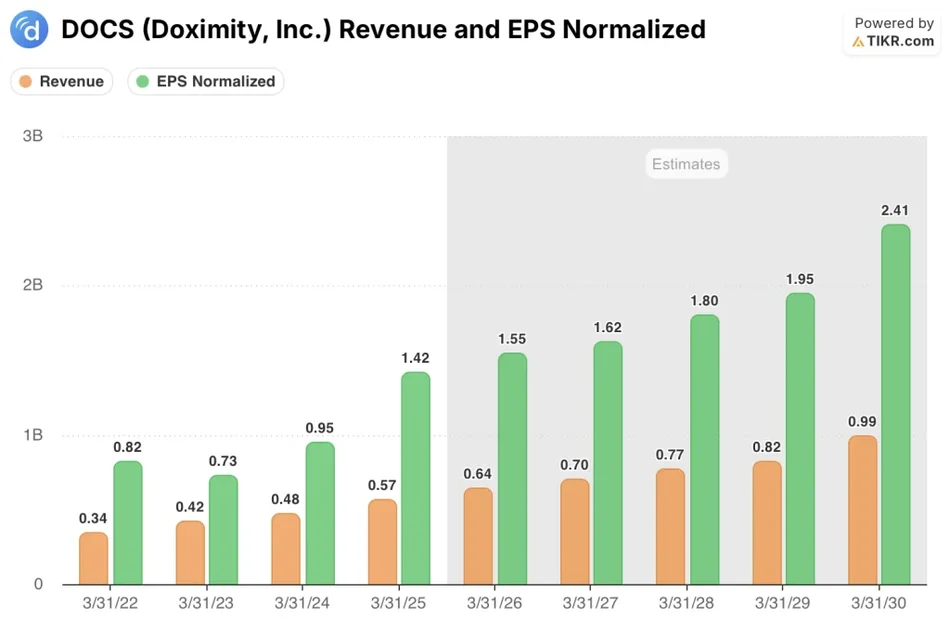
Doximity operates a digital platform used by over 80% of U.S. physicians, making it a unique gateway to the healthcare professional community. The company has historically generated strong revenue growth, with a five-year compound annual growth rate of 21.9%. However, recent growth has decelerated—annualized revenue growth over the last two years was 15.2%, and the current quarter's 7.3% growth is well below that trend.
The market's reaction suggests that investors are looking beyond near-term deceleration toward a potential AI-driven reacceleration. CEO Jeff Tangney highlighted that "Doximity Ask" was the top-performing U.S.-based clinical AI model, and that workflow active prescribers grew over 30% sequentially, while AI Search queries rose more than 25%.
If these AI products can convert user engagement into monetization, Doximity could be entering a new growth phase. The company's large physician network provides a distribution advantage that competitors would find hard to replicate. The market's willingness to pay a premium for this optionality is evident in the stock's premarket move, which pushed it 42% above the average analyst price target of $24.65.
Mixed Guidance Reflects Investment Phase
Doximity's fiscal 2027 outlook reflects the trade-off between growth investments and profitability. The company raised its revenue midpoint by $6 million to $676 million (a 0.9% increase), but lowered its adjusted EBITDA midpoint by $10 million to $319 million (a 3.0% decrease). The implied adjusted EBITDA margin at the midpoint is now 47.2%, down 1.9 percentage points from May's guidance.
Management indicated that increased spending on AI computing would persist through fiscal 2027, which explains the margin compression. This pattern—revenue growth acceleration with near-term profit pressure—is typical of companies transitioning to AI-centric business models. Investors appear willing to accept lower near-term margins if it positions Doximity for a larger share of the AI healthcare market.
For context, the broader tech sector has seen similar reactions. For example, Datadog Stock Drops 17% Despite Q2 Beat, Raised Guidance shows that even when a company beats expectations, the market can react negatively if growth quality is questioned. Doximity's situation is the opposite: a modest beat with a clear AI narrative triggered a massive rally.
A High-Stakes Bet on AI in Healthcare
Doximity's surge is part of a broader trend of AI-driven valuations across the tech sector. Investors are increasingly rewarding companies that demonstrate AI product traction, even if current financial impact is minimal. The fact that Doximity's stock jumped 70% on a $6 million revenue guidance increase underscores the speculative nature of AI optimism.
The key question is whether Doximity can deliver on the AI revenue promise. Management's confidence is based on contracted revenue that is expected to be recognized in fiscal Q3. If the company reports meaningful AI Search revenue next quarter, the stock could maintain its gains. If not, the valuation could quickly revert.
The healthcare vertical is particularly attractive for AI applications, given the potential to reduce administrative burden and improve clinical workflows. Doximity's physician-only network gives it a unique data advantage that could be leveraged to build specialized AI models. However, competition is intensifying—tech giants and well-funded startups are also targeting healthcare AI.
Investors should also consider that Doximity's stock has been volatile in the past. The current premarket surge could be overstated if AI revenue fails to materialize as expected. The company's guidance implies an adjusted EBITDA margin of around 47%, which is still high by software standards, but the downward trend is a concern if investments do not yield returns.
In the near term, Doximity's fundamentals are solid: revenue growth, a strong physician user base, and ample cash reserves. The stock's valuation now reflects an AI growth trajectory that is yet to be proven. As with any growth stock, the risk-reward profile has become more skewed toward upside if AI delivers, but the downside is equally amplified if expectations are not met.
For investors looking at the broader tech landscape, the recent Oklo Stock at $42: Pre-Revenue Nuclear Startup Faces Reality Check offers a cautionary tale about how quickly sentiment can shift when growth narratives fade. Doximity's story is distinct because it has a profitable base, but the market's reaction shows that AI sentiment can elevate even mature companies to high valuations.
The Road Ahead for Doximity
The next few quarters will be critical for Doximity. The company must convert its AI product pipeline into measurable revenue, starting with fiscal Q3. Management's guidance points to a 1.2% year-over-year revenue increase for the next quarter, which seems conservative given the AI buzz. If actual results exceed this guidance significantly, the stock could continue to rise.
On the other hand, if AI revenue is delayed or the EBITDA guidance is cut further, the stock could experience a sharp correction. The market has already priced in a high probability of AI success, leaving little room for error.
For now, Doximity's stock surge reflects a bet on the future of AI in healthcare. The company has the user base, the technology, and the cash to execute, but execution remains the key variable. As the AI healthcare market evolves, Doximity could either cement its position as a leader or fall behind faster-moving competitors.
Comments