
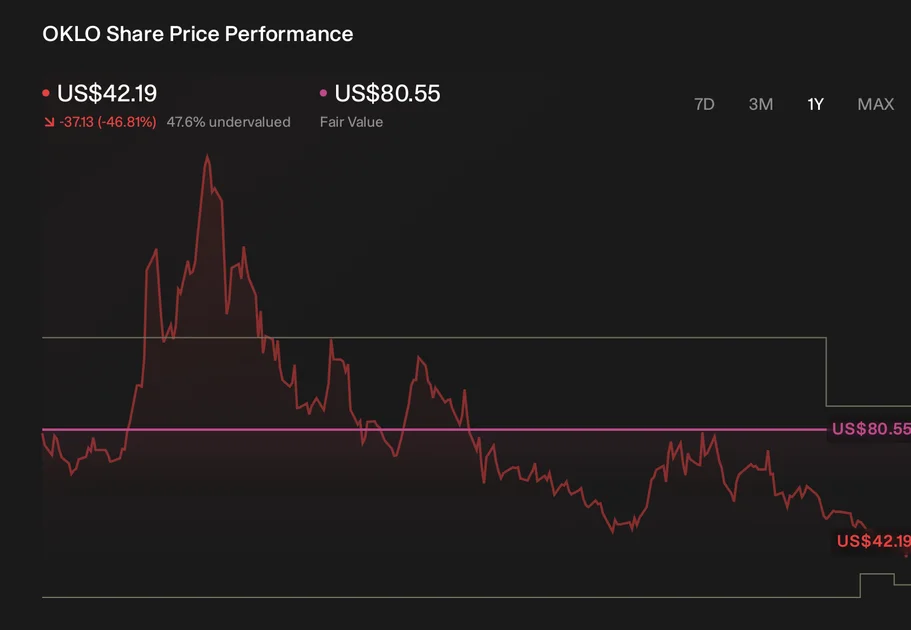
Oklo Stock at $42: Pre-Revenue Nuclear Startup Faces Reality Check
Oklo Inc. (NYSE: OKLO) is scheduled to release its second-quarter 2026 earnings before the market opens on Thursday, August 7, and investors are bracing for another report that will likely show continued losses. The pre-revenue advanced nuclear company, which has seen its stock fall from a 52-week high of $193.84 to around $42, remains at the center of a heated debate about whether its future growth potential justifies its current valuation. Analysts expect a loss of $0.17 per share for the quarter, a modest 5.6% improvement year-over-year, but the company's trajectory remains clouded by heavy capital expenditures and no commercial operations.
A Steep Decline from Peak Hype
Just over a year ago, Oklo was one of the market's most celebrated AI-adjacent stocks, with its market capitalization peaking at over $27 billion. The narrative was powerful: a fleet of small modular reactors (SMRs) positioned near data centers would provide clean, always-on power for the AI boom. But that enthusiasm has faded dramatically. The stock's current market cap stands at roughly $7.3 billion, and it now trades near the bottom of its 52-week range of $36.61 to $193.84.
The sell-off is part of a broader cooling of investor sentiment around AI-driven energy demand. While hyperscalers like Microsoft, Amazon, and Meta continue to announce massive data center projects, the market has begun to question how quickly companies like Oklo can actually deliver. The company's first Aurora powerhouse is not expected to operate until late 2027 or 2028, assuming no regulatory or construction delays. This timeline places any real revenue generation years away, leaving the stock dependent on a narrative that is increasingly under scrutiny.
The Core Question: Hype vs. Fundamentals
The central tension for Oklo investors is whether the stock's current price reflects prudent optimism or speculative excess. The company remains a classic pre-revenue venture: it has signed agreements, secured customers, and is progressing through licensing milestones, but it has yet to sell a single watt of commercial nuclear power. In its most recent quarter, Oklo reported operating losses, which are expected to widen as it ramps up construction and regulatory activities.
According to its latest balance sheet, Oklo holds roughly $2.5 billion in cash and marketable securities with no long-term debt. This provides a substantial runway to execute its strategy, likely funding operations well into the late 2020s. However, this is also part of the concern: the company is burning through cash on a grand scale as it attempts to build and license a novel technology that has never been deployed commercially.
The company's most notable customer win is Meta Platforms, which has prepaid for power from a planned Oklo reactor project in Ohio. That project is expected to come online by 2030 and reach full capacity of 1.2 gigawatts by 2034. This is a long-dated commitment that adds credibility but does little for near-term revenue. Analysts point out that the lack of a clear margin profile, combined with the inherent complexity of nuclear infrastructure, makes Oklo a high-risk speculative investment rather than a foundational energy play.
The Financial Reality on August 7
When Oklo reports Q2 earnings, the market will focus on a few key data points: cash burn rate, updates on the Aurora-INL project, progress at the Ohio site, and any new customer announcements. The company has had a mixed earnings history recently, beating estimates once but missing in the prior three quarters, with an average negative surprise of 37.2%.
Zacks currently ranks Oklo as a "Sell" (#4), and the Earnings ESP indicator suggests a low likelihood of a positive surprise this time, given that the consensus and most accurate estimates align at -$0.17. On the operational side, Oklo has made tangible progress: NRC approval of its Principal Design Criteria topical report, ongoing DOE safety reviews, and PJM interconnection applications for the Ohio campus. It has also advanced construction at its Aurora Fuel Fabrication Facility and worked on AI-driven fuel validation with NVIDIA and Los Alamos National Laboratory. Yet these milestones, while meaningful, do not translate into revenue.
The Industry Comparison: Bloom Energy's Momentum
The challenges facing Oklo become sharper when compared to Bloom Energy (NYSE: BE), another energy company riding the AI wave. Bloom recently posted landmark results: first-ever quarterly revenue above $1 billion, a 165.5% jump year-over-year, and a swing to a net profit of over $196 million from a loss of $42.6 million in the year-ago quarter. Its stock has surged approximately 370% over the past year.
Bloom sells fuel cells that are deployable today, not in 2030. That stark difference in commercial maturity is why many analysts argue that Bloom is currently the better investment for capturing AI-driven energy demand. Oklo, by contrast, offers a potentially larger long-term solution but with far more execution risk. The comparison underscores that the energy sector's AI rally is not monolithic; there is a clear bifurcation between companies with existing revenue streams and those still in the development phase.
A Wider Trend of Skepticism Toward AI Energy Plays
Oklo's struggles are not unique. The broader market has shown increased caution around AI infrastructure spending, a theme that has also hit technology stocks. The recent 17% drop in Datadog's stock despite a Q2 beat and raised guidance, covered in a related analysis, highlights how investors are now punishing companies that fail to show superlative results or offer clarity on long-term profitability. In this environment, a pre-revenue nuclear startup with years until commercialization becomes a difficult sell, regardless of the strength of its pipeline.
The Risk of Overpromising and Under-Delivering
The nuclear industry has a long history of project delays and cost overruns. Oklo's small modular reactor design is innovative, but the regulatory pathway is still being defined. The NRC approval of its design criteria is a critical step, yet full certification and construction remain years away. The company is also pursuing a complex vertical integration strategy, building its own fuel fabrication capabilities, which increases both potential rewards and operational risks.
For investors, the key concern is that the stock price already assumes a high probability of success. At $42, Oklo is valued at $7.3 billion, which implies that the market expects this company to eventually capture a significant share of the data center power market. If there is any slip in the timeline—a construction delay, a regulatory bottleneck, or a softened customer commitment—the downside could be substantial.
What This Means for Investors
The upcoming earnings report will likely not change the fundamental picture for Oklo. The company will remain pre-revenue, losses will continue, and the stock will remain a bet on a future that is promising but unproven. The source of volatility in the coming months will be less about financials and more about narrative and news flow: licensing milestones, customer announcements, and progress at the Ohio site.
For speculative investors with a high tolerance for risk, Oklo offers the potential for extraordinary returns if it executes successfully. The combination of AI-driven electricity demand, government support for nuclear power, and the unique positioning of SMRs makes a compelling long-term story. No other energy source can provide the same round-the-clock, carbon-free power density for a massive data center campus.
However, for those looking for a more balanced risk-reward profile, the current consensus among many analysts is that patience is warranted. The company is likely to be a significant financial success story if it works, but the margin for error is essentially zero right now. The market's recent behavior suggests that investors are no longer willing to extend indefinite credit to growth stories without tangible results.
The Bottom Line: Watching from the Sidelines
As Oklo prepares to release its earnings, the debate remains: Is $42 a bargain for a company with an enormous addressable market, or is it still too expensive for a business with no product yet? The answers will become clearer in the coming quarters as the company moves from paper milestones to physical construction.
The most rational approach for many investors may be to monitor the company's progress closely, as the Motley Fool's analysis suggests. The stock remains a speculative long-term play, not a value investment based on current financials. It is a story of what could be, not what is—and in that respect, it is emblematic of a market that is slowly waking up to the difference between promise and delivery.
For now, the energy sector's AI boom continues, but the enthusiasm is becoming more selective. Companies with revenues and profits, like Bloom Energy, are being rewarded. Those with only promises, like Oklo, are being asked to prove themselves first. The Q2 report on August 7 will be a small step in that long process, but it will not resolve the company's fundamental question. Investors would be well advised to watch for concrete operational updates and be prepared for continued volatility as this multibillion-dollar bet remains in its earliest and most uncertain stage.
Comments