
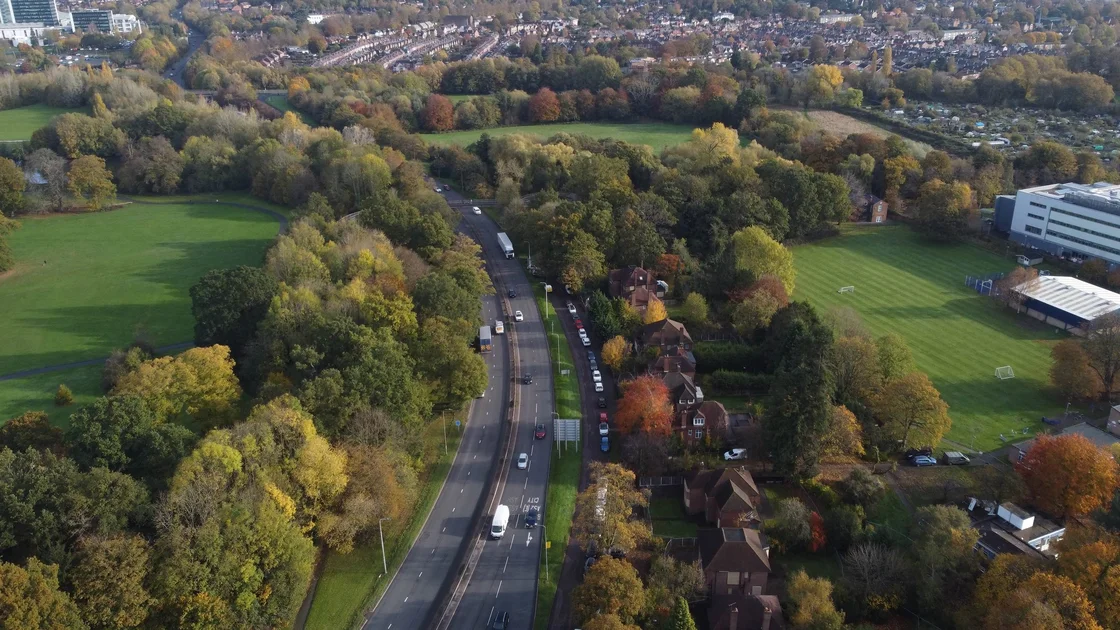
Derby Woman Who Lost Home to A38 Scheme Calls Cancellation a 'Criminal Waste'
Gail Roberts, the last resident of Queensway in Derby, has spoken out after the A38 road expansion that forced her from her home was shelved by the government. Roberts described the project as a "criminal waste of taxpayers' money" and said the decision to halt the £600m upgrade, announced in June 2026, left her "appalled but not surprised."
Roberts, who suffers from multiple sclerosis, was among 15 homeowners issued compulsory purchase orders (CPOs) to make way for the dual carriageway expansion. After a two-year dispute over the value of her four-bedroom house, she accepted £40,000 less than an independent valuation. She told the BBC that the stress of the ordeal contributed to a collapse in January 2023, which temporarily cost her the use of her legs.
The government's decision to shelve the A38 Derby Junctions scheme, along with the A46 Newark Bypass, is part of a plan to save up to £700m to boost defence spending. The Department for Transport (DfT) said the schemes were "yet to enter contract" and "not as far along as other road projects." However, East Midlands mayor Claire Ward called the move "completely unacceptable," and Prime Minister Andy Burnham, during a recent visit to Ilkeston, said he would "not abandon the ambition" of the project.
The Human Cost of a Shelved Road Scheme
Roberts moved into her home in 2011 and spent two years renovating it with her husband. The couple first heard about the A38 proposals in 2012, and the CPO was issued in 2021. As neighbours accepted the orders and moved out, Roberts found herself "stuck in a lovely house in a derelict street." She described the valuation dispute as "absolutely infuriating," noting that she had to accept £40,000 less than what an independent valuer had suggested.
The emotional toll was severe. "I've lost so many years of my life to this, to the point where I was in hospital," she said. In January 2023, she collapsed and lost the use of her legs temporarily. Two neurologists linked her decline to stress. "I think on the surface I handled it well, but clearly underneath, it was there constantly," she added.
In autumn 2023, Roberts and her husband moved into a bungalow in Ockbrook, Derbyshire. They are still searching for a new home. Seeing her old house boarded up for three years has been "painful," she said, and she often diverted halfway around Derby to avoid passing by.
A Project Plagued by Delays and Controversy
The A38 Derby Junctions scheme, first proposed in 2001, would have widened roads and built flyovers and underpasses at the Little Eaton, Markeaton, and Kingsway roundabouts. It was seemingly confirmed by the government in July 2025, but the June 2026 announcement put it on hold. The project has always been controversial, with Derby's Labour-led city council questioning whether the 25-year-old plans were still appropriate.
Campaigners from the Stop the A38 Expansion Group have now called for the boarded-up houses on Queensway to be restored and returned to use if the scheme is scrapped. Clare Wood, from the group, said the properties are still sound and could be lived in again. "We've always opposed the CPO of people's homes and we have total sympathy for those who were bought out and had no choice but to move against their wishes," she said.
Paul Rowlands, a nearby resident, echoed this sentiment: "One of the sad things about all of this was the people who had to give up their homes. I hope if the A38 doesn't happen, some sensitive thought is put into what happens with those houses."
What Happens Now: Consultation and Alternatives
The government's proposal to cancel the A38 and A46 schemes is currently under consultation. National Highways said no final decision has been made. Meanwhile, East Midlands mayor Claire Ward is pressing for a rethink, arguing that the East Midlands is historically the lowest-funded region for transport infrastructure. She said she expects Prime Minister Burnham to "give me a hearing" and that his recent comments were not a "fobbing off."
Burnham, during his visit to Derbyshire, suggested that Ward work with Number 10 North to develop a "long-term funding alternative." He acknowledged the "short-term funding challenge" but stressed that "we certainly will not abandon the ambition." Ward, however, insisted that defence spending should not be stripped from the only two road schemes in the country affected, both of which are in her region.
The final decision will be made after the consultation, but for Roberts and others affected, the uncertainty is a cruel twist. "I always had an inkling that it wouldn't actually go through, because the public consultations have gone on and on and on," she said. "I think the indecision is disgusting. How long can it go on like this?"
Broader Implications for Infrastructure and Communities
This saga highlights a growing tension between national priorities like defence and local infrastructure needs. The A38 project, initially designed to ease congestion and improve safety, has left a scar on the Queensway community. The boarded-up houses serve as a stark reminder of what can happen when long-term plans are upended by political shifts.
The situation also underscores the emotional and financial toll on individuals caught in the machinery of government planning. Roberts's story is not unique; across the UK, compulsory purchase orders have uprooted residents for projects that sometimes never materialize. As the consultation proceeds, campaigners are urging the government to consider the human cost of its decisions.
For now, the empty houses on Queensway stand as a silent testament to a project that may never be built. The future of the A38 scheme remains uncertain, but the impact on lives like Roberts's is already written. As she prepares for yet another chapter, she hopes her story will serve as a cautionary tale for policymakers. "It just beggars belief how much money the government can waste - it's shocking," she said.
What's Next?
The consultation on the A38 and A46 schemes will close in the coming months. Local leaders, including Claire Ward, are expected to make a strong case to the DfT. Meanwhile, campaigners are looking at ways to bring the Queensway houses back into use, with some suggesting they could be sold or rented out. National Highways has promised an update in due course.
For Gail Roberts, the future remains uncertain. She and her husband continue to look for a new home, and she is trying to move on from the ordeal. But the painful memories are never far away. "Those are all unique, individual lives that were disrupted," she said. "It's not just numbers on a page."
As the debate over defence spending versus infrastructure continues, the A38 case serves as a sobering reminder of the real-world consequences of political decisions. Whether the scheme is revived or finally scrapped, one thing is clear: the cost to the community has already been paid.
Comments