
Crete Under Red Alert as Floods, Landslides and Bridge Collapse Injure Two
Greek authorities have placed the island of Crete under Red Code mobilisation until Sunday, October 4, after a powerful wave of severe weather that began late Wednesday night turned roads into torrents, triggered landslides and caused widespread power cuts. The worst disruption is concentrated in the mountainous Mylopotamos area of Rethymno, where the villages of Zoniana, Livadia and Axos have been hardest hit.
In Livadia, the force of the floodwater caused part of the Diskouri bridge to collapse. A vehicle carrying a couple fell into the riverbed after a section of the crossing was swept away. Both occupants were injured and transported to the University General Hospital of Heraklion (PAGNI). Their condition had not been made public as of Thursday morning. Authorities described the incident as one of the most serious of the storm so far.
Emergency alerts and travel warnings
Shortly before 7am on Thursday, Greece’s Civil Protection authorities sent a 112 emergency alert to residents and visitors in Zoniana, Livadia and the mountainous Mylopotamos region, urging them to limit their movements because of the dangerous conditions. A similar message advised citizens to avoid travelling to the affected areas altogether. Officials are urging people not to attempt to cross flooded roads and to exercise particular caution where landslides, rockfalls or road damage have been reported.
Municipal crews from Mylopotamos and the Region of Crete have been working since the early hours, using heavy machinery to clear debris, restore access and pump water out of flooded basements and underground spaces. Electricity grid operator HEDNO has been notified of fallen electricity poles in Zoniana, and crews are expected to carry out repairs. Power cuts have affected Zoniana, Anogeia and Axos, as well as parts of Heraklion including Agios Ioannis (Chostos) and Tsalikaki.
Widespread Flooding Across Chania, Rethymno and Heraklion
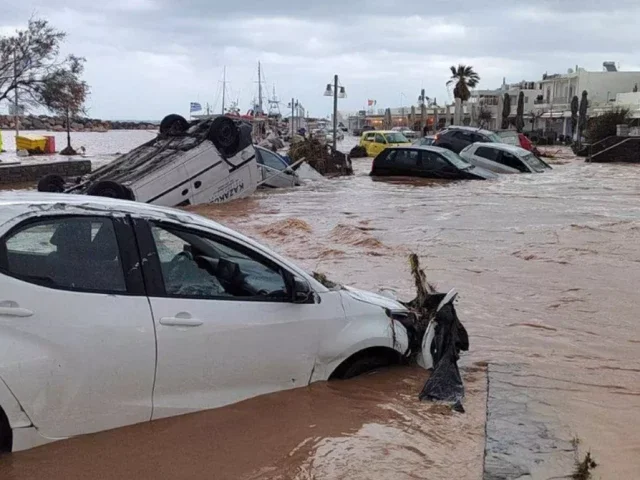
The severe weather has not been confined to Mylopotamos. Flooding has been recorded across Chania, Rethymno and Heraklion, where roads have been covered in water and mud, and in some communities runoff has entered homes and surrounded vehicles. Firefighters have been responding to numerous calls to pump water from flooded properties.
In Sitia, particularly around Palekastro, large quantities of muddy water covered cars in a parking area. The Kalogeropotamos stream in the Agkathia region has swollen significantly, raising concerns among neighbouring districts. In Heraklion, flooding was reported in several parts of the city, with the Fire Service receiving calls for assistance.
Lasithi Plateau hit by record rainfall
The Lasithi Plateau has also been severely affected. Data from meteo.gr showed that Tzermiado recorded 174 millimetres of rain by Thursday morning alone. Authorities imposed a traffic ban across the Lasithi Plateau basin early Thursday after intense overnight rainfall raised safety concerns. Lasithi Plateau Mayor Giorgos Athanasakis urged residents to remain at home and to use the peripheral road only when necessary. He said the heavy rainfall had already caused significant damage to crops across the basin, but stressed that protecting residents remained the immediate priority.
Schools remain closed in Chania and Rethymno because of the dangerous weather, with lessons moving online. Classes have also been suspended at all primary and secondary schools and nurseries in Mylopotamos, and all schools and childcare centres in the Municipality of Minoa remain closed on Thursday.
A Region on the Front Line of Extreme Weather
Crete’s geography makes it particularly vulnerable to flash flooding. Steep mountain slopes, narrow ravines and densely built village centres can channel sudden rainfall into fast-moving torrents within minutes. The Mylopotamos area, where the current damage is most acute, sits in rugged terrain that has experienced similar events in recent years. The collapse of the Diskouri bridge underscores how quickly infrastructure can fail when streams that are normally modest swell beyond their banks.
The timing of the storm adds to the strain. October marks the start of the autumn rainy season in Greece, a period when the sea remains warm and the atmosphere unstable, creating conditions for intense thunderstorms. The Red Code mobilisation until Sunday reflects forecasts of further heavy rain, thunderstorms and strong winds, meaning the situation could deteriorate before it improves.
Economic and agricultural toll
Beyond the immediate danger to life and property, the floods threaten the local agricultural economy. The Lasithi Plateau is known for its potato and vegetable cultivation, and Mayor Athanasakis confirmed that crops have already suffered significant damage. Rethymno and Heraklion are also important agricultural regions. For farmers, the timing is especially painful: autumn is a key period for planting and harvesting, and waterlogged fields can delay work for weeks.
Tourism, a pillar of the Cretan economy, may also be affected. Although October is shoulder season, the island still receives visitors, and the 112 alerts specifically addressed “residents and visitors.” Travel restrictions and road closures in mountainous areas could disrupt itineraries and force authorities to reassess safety protocols for popular routes.
Emergency Response and Public Safety Measures
Authorities have emphasised that, so far, there have been no reports of people trapped or other situations posing an immediate risk to human life beyond the injured couple in Livadia. Municipal crews remain on standby, with the main priority being to secure safe access to affected areas. The 112 alerts have been repeated as conditions evolve, and residents are being advised to avoid unnecessary travel, particularly through mountainous districts, flood-prone roads and areas where fast-moving water is carrying debris.
The scale of the response reflects lessons learned from previous disasters in Greece, where coordinated alerts and pre-emptive road closures have been credited with reducing casualties. The use of the 112 emergency system, which sends location-based warnings to mobile phones, has become a standard tool during severe weather events. Still, the collapse of a bridge and the inundation of homes show that infrastructure and preparedness face limits when rainfall is this intense.
What to expect next
With the Red Code in effect until Sunday, further heavy rain, thunderstorms and strong winds are forecast. Rivers and streams that are already swollen could rise again, and saturated ground increases the risk of landslides and rockfalls. Authorities are likely to keep schools closed in the most affected areas and may extend traffic bans if conditions worsen. Recovery crews will continue clearing debris and restoring power, but full assessments of damage may have to wait until the weather improves.
For now, the priority is safety. Residents and visitors in Crete are urged to follow official guidance, avoid flooded roads and stay away from areas where landslides or bridge damage have been reported. As the island braces for more rain, the coming days will test both emergency services and communities that have already endured a punishing start to the autumn storm season.
Comments