
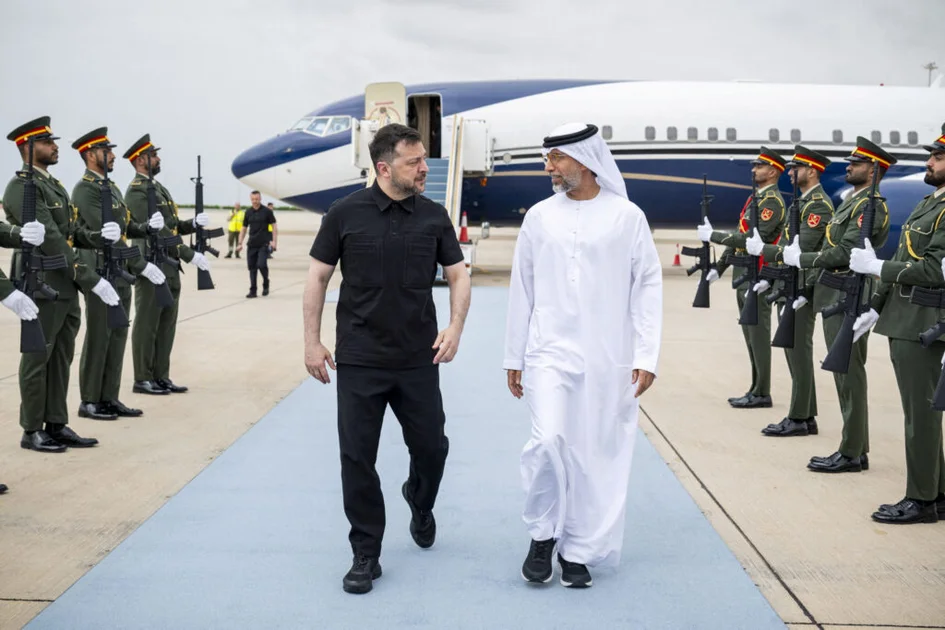
Zelensky Under Fire From Poland Over Controversial Military Unit Decree
Ukrainian President Volodymyr Zelensky is facing a major diplomatic rift with key ally Poland after signing a decree that named a Special Operations Forces unit after the Ukrainian Insurgent Army (UPA), a World War II-era formation. Polish President Karol Nawrocki has signaled he may strip Zelensky of Poland’s highest state honor, the Order of the White Eagle, in response.
According to reports from Warsaw, Nawrocki has already consulted the council of the order and will decide whether to revoke the award “in due course.” The decree, issued late last month, has drawn condemnation from across Poland’s political spectrum — from far-right to left-wing groups — with Nawrocki calling it “glorification of bandits and killers.”
The UPA fought for Ukrainian independence against the Soviet Red Army and Nazi Germany, and many Ukrainians regard its members as national heroes. However, Poland accuses the UPA of carrying out a genocide of ethnic Poles in Volhynia between 1943 and 1945, in which an estimated 100,000 Poles were murdered. The naming of the unit has reopened a painful chapter that threatens to undermine the strong bilateral ties built since Russia’s full-scale invasion.
Many in Poland feel Ukraine is ungrateful for the support Warsaw has provided, including opening its borders to millions of Ukrainian refugees and sheltering nearly a million displaced people. The diplomatic row comes at a delicate time when Ukraine can ill afford to lose allies.
Honoring Drone Troops As War Strategy Shifts
On a more positive domestic note, Zelensky signed a decree on June 10 establishing June 11 as the official “Day of Unmanned Systems Forces” in Ukraine. In a Telegram post, the president said Ukraine is the first country in the world to create a dedicated military branch for unmanned systems, crediting drone operators with transforming the battlefield.
The new holiday honors troops who have inflicted an estimated $40 billion in damage on Russian targets over the past year while reducing Ukrainian soldier casualties. “It is Ukrainians who have proven that thanks to technology, thanks to their creativity and courage, we can change the war,” Zelensky wrote.
Ukraine’s Unmanned Systems Forces have used aerial and maritime drones to hit Russian military logistics across the full depth of occupied territory, including targets previously beyond drone range. The shift toward remotely operated, AI-supported vehicles has allowed Kyiv to offset Russia’s advantages in manpower and conventional firepower.
Royal Diplomacy and Peace Feelers
Amid these developments, Zelensky also met King Charles III at Windsor Castle for private talks, thanking the UK for its “ironclad” support. The Ukrainian president revealed plans to invite the monarch for an official state visit to Ukraine as early as this year. The meeting followed a joint statement by the leaders of Ukraine, the UK, France and Germany calling for a “just and lasting” deal to end the war with Russia.
In an unexpected diplomatic maneuver, Zelensky has also confirmed that he met Russian oligarch Roman Abramovich in late May in Kyiv, asking the billionaire — a former owner of Chelsea Football Club — to test Vladimir Putin’s appetite for direct talks. Abramovich, who has acted as a go-between since the start of the invasion, reported that the Russians “want to understand what we are ready to do.” Zelensky conveyed that he is open to a face-to-face meeting with Putin “at any time.”
Moscow has not denied the existence of this backchannel, with Putin acknowledging meeting “one of the representatives of our business circles” but insisting the businessman was not acting in an official capacity. Abramovich was present at the first peace talks in Turkey in 2022 and has since helped broker grain deals and prisoner swaps.
Broader Implications
Zelensky is navigating a complex web of diplomacy, warfare, and history — all at once. While the drone forces holiday underscores Ukraine’s innovative approach to modern warfare and its ability to adapt under pressure, the dispute with Poland shows how historical grievances can resurface even among the closest of allies. The timing is particularly sensitive: with Russia continuing its assault and peace talks still hypothetical, Ukraine needs every friend it can get.
The Abramovich backchannel, meanwhile, suggests that despite public posturing, both Kyiv and Moscow may be probing for an off-ramp. But with Putin ruling out a meeting for now, and Poland’s president considering a symbolic slap, the path ahead remains uncertain. What is clear is that Zelensky’s leadership — whether on the battlefield, in royal palaces, or in negotiating rooms — continues to face tests on multiple fronts.
Comments