
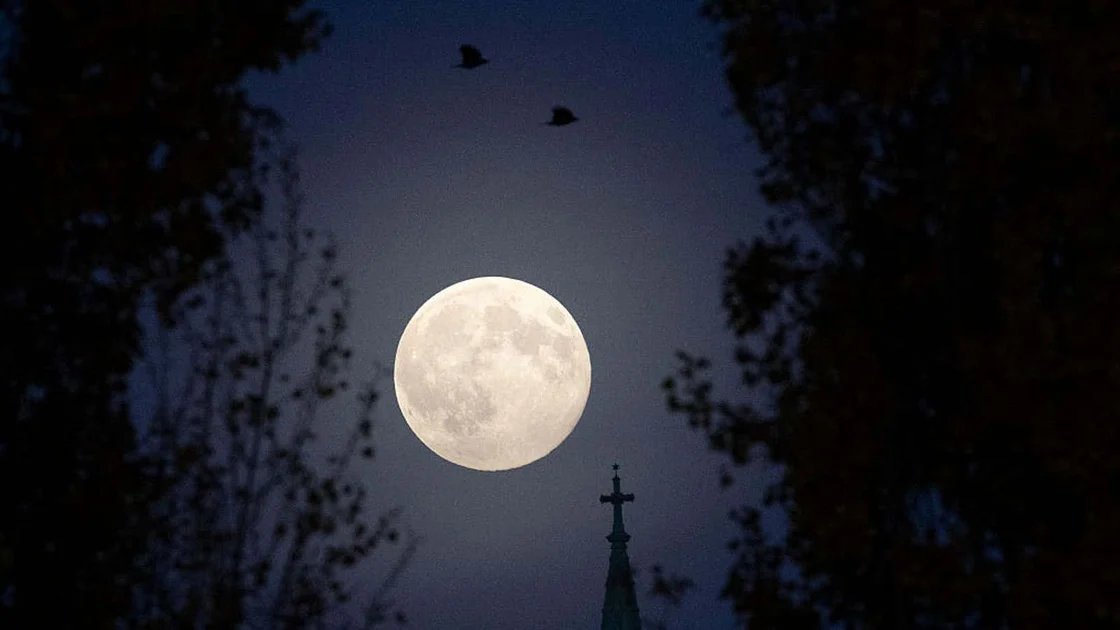
Beaver Supermoon Rises This Thanksgiving Week
The full moon known as the Beaver Moon will reach peak illumination on Tuesday, November 24, 2026, at 8:53 a.m. Eastern Time (9:53 a.m. ET according to some sources), according to NASA. Because the moon will be below the horizon for North American observers at that moment, skywatchers are advised to look up after sunset on Monday, November 23, or Tuesday, November 24, for the best views. The event is noteworthy not only because it is a full moon but also because it is a supermoon—the first in a series of four consecutive supermoons that will stretch into February 2027.
A supermoon occurs when a full moon coincides with perigee, the point in the moon's elliptical orbit when it is closest to Earth. This proximity makes the moon appear slightly larger and brighter than an average full moon, though the difference can be subtle to the naked eye. According to NASA, supermoons typically occur three to four times per year and always in consecutive order. This month's Beaver Moon will be followed by supermoons on December 24, January 22, and February 20, according to AstroPixels.com.
Why Is It Called the Beaver Moon?
The November full moon's name comes from the Old Farmer's Almanac, which notes that late fall is when beavers begin to take shelter in their lodges for the winter. It is also historically the prime time for trapping beavers when their pelts are at their thickest. The name is one of many traditional full moon monikers, alongside the Strawberry Moon, Blue Moon, and others that have gained popular traction in recent years.
A Run of Supermoons Not Seen in Years
The current series of supermoons is particularly notable because it includes the closest full moon to Earth since 2018. The December 24 supermoon—sometimes called the Cold Supermoon—will be the closest of 2026, at approximately 221,668 miles from Earth. By comparison, November's Beaver Moon will be about 224,171 miles away, January's will be 222,230 miles, and February's will be 225,748 miles. Under the stricter definition used by some astronomers—requiring the moon to be within about 223,694 miles of Earth—February's full moon might not qualify as a supermoon, highlighting that "supermoon" is not an official astronomical term.
NASA and the Royal Observatory Greenwich define a supermoon as a full moon occurring within 10 percent of perigee. Under this broader definition, all four upcoming full moons qualify. The differences in distance may seem small—a few thousand miles—but they affect how the moon appears from Earth. A supermoon can appear up to 14 percent brighter and 30 percent larger than the faintest full moon of the year, which occurs at apogee, the farthest point in the moon's orbit. However, the variation is often imperceptible without direct comparison.
When and How to Watch
For observers in North America, the best time to view the Beaver Moon is after sunset on November 23 or November 24. The moon will appear full on both nights and will rise in the eastern sky shortly after sunset. While the supermoon effect is most pronounced when the moon is near the horizon—a phenomenon known as the moon illusion—the moon will remain bright and impressive throughout the night. No special equipment is needed, though binoculars or a telescope can enhance the view of lunar craters and maria.
What This Means for Skywatchers and Science
The back-to-back supermoons offer a chance for the public to engage with astronomy and perhaps start a new holiday tradition. The December 24 supermoon, in particular, will be a rare Christmas Eve spectacle—the closest full moon to Earth on that date in recent memory. Such events often spark public interest in lunar science and may encourage more people to look up and appreciate the night sky.
While the term "supermoon" is not officially recognized by the International Astronomical Union, its popularity has grown since it was coined by astrologer Richard Nolle in 1979. Astronomers like those at NASA use the term to communicate about full moons that occur near perigee, but they caution that the visual differences are modest. Nevertheless, the psychological impact of a bright, large moon can be profound, especially during the holiday season when people are already inclined to gather and celebrate.
Looking Ahead
After February's supermoon, the next series of supermoons will not occur until late 2027. In the meantime, skywatchers can look forward to other celestial events, including meteor showers and planetary conjunctions. For those interested in astronomy, events like the supermoon series provide an accessible entry point to learning about lunar phases and orbital mechanics. As we close out 2026, the Beaver Moon and its successors remind us that even in a world of constant news cycles, there is still wonder to be found by simply looking up.
For more on seasonal traditions and notable figures, see our coverage of Bo Derek and John Corbett adopting Gene Hackman's dog Bear. And for those following the gaming world, check out the GTA 6 Chapter 2 mission list.
Comments