
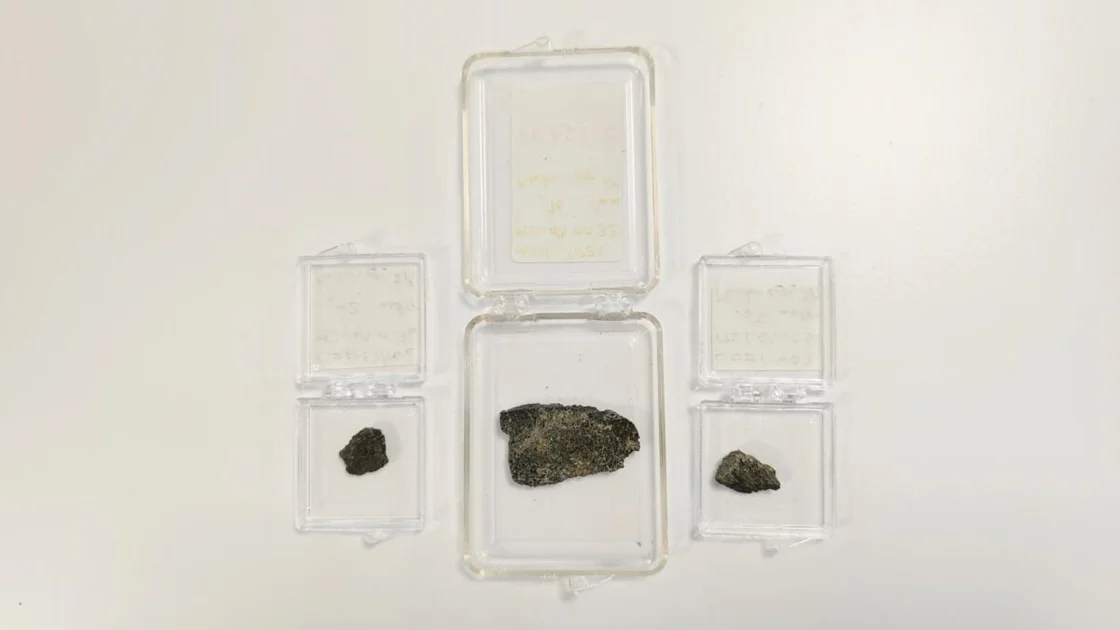
The Unexpected Discovery Rocking Planetary Science
In a finding that is equal parts alarming and clarifying, researchers from the University of the Basque Country in Spain have detected traces of ballpoint pen ink inside processed samples of Martian meteorites — materials that had been handled and prepared by NASA's Johnson Space Center. The study, published in the peer-reviewed journal Applied Geochemistry on April 15, 2026, has sent ripples through the planetary science community, not because it invalidates decades of research, but because it exposes a gap that scientists can no longer afford to ignore.
The ink, to be absolutely clear, did not originate on Mars. It was not deposited by ancient Martian civilizations, nor did it arrive via some cosmic accident. It came from Earth — specifically, from the laboratory processes used to prepare these extraordinarily rare samples for analysis. The implications, however, reach far beyond a simple housekeeping failure.
What the Researchers Actually Found
The University of the Basque Country team analyzed six slices of post-processed Martian meteorites, all collected between 2001 and 2014. These samples had already undergone a battery of preparation techniques designed to strip away the outer crust that forms when a meteorite enters Earth's atmosphere — procedures including ultrasonic cleaning, cutting with diamond saws, and soaking with solvents and polymer lubricants. Despite these precautions, the researchers identified residual contaminants that should not have been there. Among the most striking: ink consistent with that used in ballpoint pens.
Also detected were traces of polyester, another material with no business being inside a rock from Mars. Both substances are believed to have been introduced during the sample preparation process, likely through contact with laboratory tools, writing instruments used to label samples, or other handling materials.
Why This Matters: The Fragility of Extraterrestrial Samples
Martian meteorites are among the rarest and most scientifically valuable objects on Earth. They arrive here after being ejected from the Martian surface — typically by asteroid impacts — and spending millions of years drifting through space before falling through Earth's atmosphere. By the time a researcher in a laboratory holds a slice of one, that rock has already been through an extraordinary journey. The contamination challenge begins the moment it lands.
"When rock samples pass through the Earth's atmosphere, they undergo changes — usually caused by high temperatures and pressures — which generally result in a sort of crust forming on them," explained Leire Coloma, one of the study's co-authors and an analytical chemist at the University of the Basque Country. That altered outer crust must be removed before scientists can study what lies beneath, but the removal process itself introduces new risks.
A Patchwork of Protocols
One of the central concerns raised by the new study is the lack of standardization across institutions when it comes to sample preparation. Different laboratories use different cleaning techniques, different cutting tools, different solvents — and there is no universally agreed-upon protocol that all institutions follow. The University of the Basque Country team noted in their paper that this diversity in preparation methods "underscores the lack of standardized, contamination-aware preparation protocols," and warned that this inconsistency subsequently complicates efforts to determine whether any interesting chemical signature found in a sample is genuinely Martian in origin or simply an artifact of how the sample was handled on Earth.
This is not merely an academic concern. When scientists are scanning meteorite samples for organic compounds or biosignatures — chemicals that could hint at the past or present existence of life on Mars — a stray molecule of ballpoint pen ink could, in a worst-case scenario, muddy the waters considerably. The study does not argue that past research has been invalidated, but it does argue forcefully that the scientific community needs to come together around cleaner, more transparent, and more unified preparation standards.
The Broader Stakes: Sample Return Missions Are on the Horizon
The timing of this study is particularly significant. Space agencies around the world — including NASA and the European Space Agency — are actively planning or executing missions designed to bring Martian material back to Earth in a controlled, documented manner. NASA's Mars Sample Return campaign, which involves the Perseverance rover caching rock and sediment samples in Jezero Crater for eventual retrieval, represents one of the most ambitious and expensive planetary science endeavors in history.
If the handling of meteorite samples that have already been on Earth for years can result in ballpoint pen ink contamination, the question naturally arises: how will mission planners ensure that freshly collected Martian samples — brought back specifically to search for signs of ancient life — remain uncontaminated from the moment of collection to the moment of analysis?
"As planetary sample return missions continue to advance, the challenge of designing contamination-aware preparation protocols becomes increasingly important," the research team wrote in their paper. That sentence reads less like a cautious scientific hedge and more like a direct call to action.
Perseverance Adds a New Layer of Urgency
The contamination discovery comes at a moment when excitement about Martian science is already running high. Separately, findings published in Nature Communications by researchers at Purdue University describe how NASA's Perseverance rover has detected unusually high levels of nickel in ancient bedrock at Neretva Vallis, a 3-billion-year-old river inlet within Jezero Crater. Nickel concentrations reached up to 1.1% by weight in some rocks — the highest ever measured in Martian bedrock — and appeared alongside iron sulfide minerals and sulfates. On Earth, similar mineral formations are sometimes associated with microbial activity in low-oxygen environments, though scientists are careful to note that purely chemical processes could also explain them.
The juxtaposition of these two stories is instructive. On one hand, Perseverance is identifying chemical signatures on Mars that are, at minimum, worth investigating as potential biosignatures. On the other hand, the new contamination study serves as a sobering reminder that the integrity of any future analysis depends entirely on how carefully those samples are handled. The science of finding life — or ruling it out — on Mars is only as good as the protocols surrounding it.
What Needs to Change: The Case for Unified Standards
The University of the Basque Country study stops short of accusing NASA's Johnson Space Center of negligence. The researchers are explicit that contamination during sample preparation is an inherent challenge, not a failure unique to any one institution. What they are advocating for is a systemic shift: a move away from a fragmented landscape of institutional protocols toward a shared, rigorous, and transparent standard that all laboratories handling extraterrestrial materials would be expected to follow.
This would involve not just cleaning procedures, but documentation. If every step of the preparation process is recorded in a standardized way — which solvents were used, which tools made contact with the sample, under what environmental conditions the work was done — then any anomalous chemical finding can be cross-referenced against the preparation history. Ink from a ballpoint pen would not slip through unnoticed if researchers knew to look for it in the first place.
The call for standardization also has implications beyond Mars. Samples from asteroids, the Moon, and eventually other planetary bodies all face the same fundamental challenge: they arrive on Earth changed, and every subsequent handling step carries the risk of further alteration. The contamination problem is not a Martian problem. It is a planetary science problem.
A Field Maturing Under Pressure
What the ballpoint pen ink discovery ultimately reveals is a field of science that is maturing rapidly — and grappling honestly with its own limitations. The fact that this study exists, that it was published in a peer-reviewed journal, and that it is being widely discussed is itself a sign of scientific health, not dysfunction. The researchers are not hiding the contamination; they are broadcasting it.
That transparency is particularly important at a moment when public trust in scientific institutions is under scrutiny across multiple domains. Just as researchers in medicine and nutrition are increasingly expected to disclose methodology, funding sources, and potential confounding variables, planetary scientists are now being asked to apply the same rigor to the literal handling of their samples. The ink in the meteorite is an embarrassment, yes — but it is also a data point, and the scientific community is treating it as one.
For a field that is racing toward one of the most profound questions in human history — whether life ever existed beyond Earth — getting the procedural details right is not a bureaucratic afterthought. It is the foundation on which any meaningful answer will have to be built. A unified, contamination-aware protocol framework may not be as headline-grabbing as the discovery of Martian biosignatures, but it is arguably just as important. Without it, even the most exciting finding could be dismissed as noise.
The red planet has spent billions of years keeping its secrets. The least scientists can do is make sure a ballpoint pen doesn't get in the way of uncovering them.
Comments