
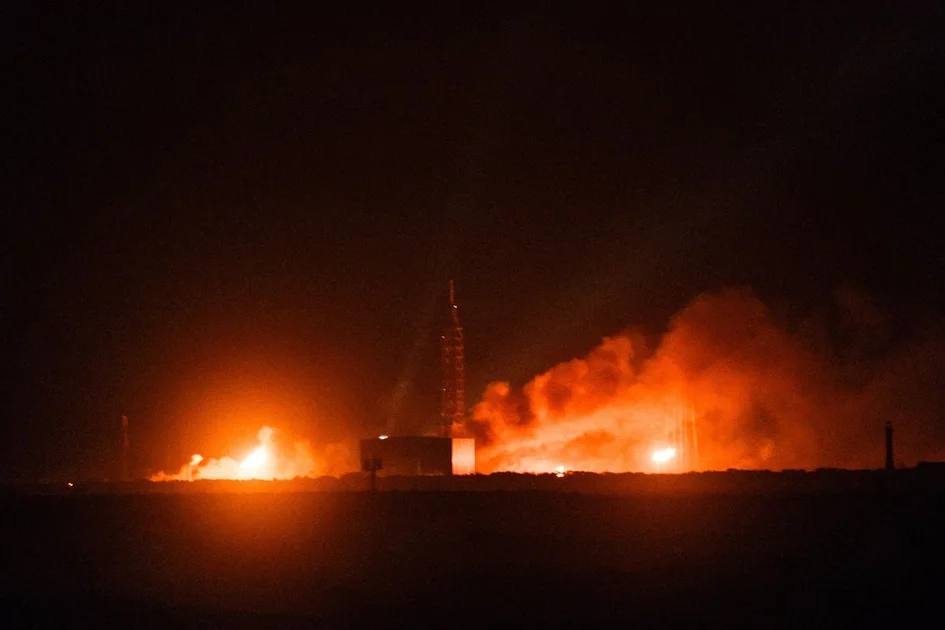
Massive Explosion Destroys New Glenn Rocket During Static Fire Test
A towering inferno lit up the night sky over Cape Canaveral, Florida, on Thursday evening as Blue Origin's New Glenn rocket suffered a catastrophic explosion during a pre-launch static fire test. The 188-foot-tall first stage became engulfed in flames around 9 p.m. EDT, with the 86-foot upper stage tilting and collapsing moments later before the entire vehicle detonated in a massive fireball visible for miles.
Blue Origin confirmed the incident on X (formerly Twitter), stating that all personnel are accounted for and safe. Company founder Jeff Bezos called it a “very rough day” but vowed to rebuild. The Federal Aviation Administration (FAA) acknowledged the event, noting there was no impact to air traffic, while the U.S. Space Force Eastern Range confirmed no injuries or fatalities among emergency responders.
The explosion occurred as Blue Origin was counting down to a brief firing of the seven methane-fueled BE-4 first stage engines at Launch Complex 36. The rocket was fully fueled for the test, which contributed to the intensity of the blast — one of the largest rocket explosions in U.S. history. The company has not yet identified a root cause, describing only an “anomaly.”
Initial video footage from Spaceflight Now and NASASpaceFlight.com showed the erector-gantry used to move the rocket from its hangar to the pad was destroyed in the blast. One of two tall lightning towers at the launch site was also no longer visible after the explosion.
What Was at Stake: Amazon Satellites, NASA Artemis Missions, and Pentagon Contracts
Thursday’s failure comes at a critical juncture for Blue Origin, which had been planning up to 12 New Glenn launches in 2026. The rocket was designed to compete directly with SpaceX’s Falcon 9 and Falcon Heavy, targeting commercial satellite launches, national security missions, and a key role in NASA’s Artemis program to return humans to the Moon.
The next scheduled launch was set for June, carrying a batch of Amazon “Leo” internet satellites into orbit. Those satellites were not on board during the test, but the loss of the launch vehicle will likely delay the deployment of Amazon’s broadband constellation, which relies heavily on New Glenn for its initial buildout.
Further, NASA Administrator Jared Isaacman stated the agency would work with Blue Origin to assess near-term mission impacts, including the company’s role in the Artemis Moon Base program. Blue Origin was highlighted by NASA earlier this week as a critical partner for lunar cargo delivery and crewed lander services. The timeline for those missions remains uncertain pending the investigation.
Blue Origin was also pursuing certification from the U.S. Space Force for national security launches. The explosion will push back those efforts and likely require a prolonged grounding of the New Glenn fleet while engineers analyze telemetry and pad video.
Industry Reaction: Musk Offers Condolences, SpaceX Recalls 2016 Pad Explosion
Elon Musk, founder of SpaceX and a frequent rival of Bezos, responded publicly on X: "Most unfortunate. Rockets are hard. I hope you recover quickly." The reply mirrored a message of solidarity Musk posted after a Blue Origin New Shepard abort in 2022.
The incident evokes memories of the September 2016 explosion of a SpaceX Falcon 9 on nearby Launch Complex 40. That failure, which also destroyed the rocket and payload during a fueling operation, was later traced to a high-pressure helium tank rupturing inside the upper stage’s liquid oxygen tank. SpaceX returned to flight 3.5 months later — a relatively fast recovery compared to many large-scale rocket failures.
However, New Glenn is a more complex, methane-fueled vehicle with seven engines that must fire in precise synchronization. Analysts expect the investigation and subsequent redesign — if a systemic flaw is found — could delay the program by 6 to 12 months or more.
The Road Ahead: Investigation, Rebuild, and a Harsh Reckoning for Blue Origin
Blue Origin has not disclosed a timeline for determining the root cause. The company is expected to establish a joint investigation team with the FAA and the U.S. Space Force.
The immediate damage extends beyond the rocket itself. Launch Complex 36, newly refurbished for New Glenn, suffered severe damage, including the apparent destruction of the erector-gantry and lightning protection towers. Rebuilding the pad could take months and cost tens of millions of dollars.
Another unresolved question is the production status of flight-ready New Glenn boosters. Blue Origin has built at least two full vehicles, but if the root cause affects the design as a whole — such as the first-stage propulsion system, avionics, or tank structure — subsequent rockets may require modifications before they are cleared to fly.
In parallel, the company continues to operate its New Shepard suborbital tourism vehicle, which resumed flights in 2024 after a previous in-flight abort incident in 2022. That program is unaffected by the New Glenn explosion.
Broader Implications: The Cost of the Space Race and the Fragility of Second-Place
The New Glenn explosion underscores the difficulty of building large orbital rockets, even for a company with billions in funding from Jeff Bezos. Blue Origin has spent over a decade developing the vehicle, with initial launch targets slipping from 2020 to 2024 to a successful debut in early 2025. The company had hoped to ramp up quickly in 2026, but this failure resets the clock.
The event also highlights the strategic fragility of relying on a single heavy-lift rocket for commercial, civil, and defense missions. Amazon will likely turn to SpaceX, United Launch Alliance, or other providers to carry Leo satellites while Blue Origin resolves the New Glenn grounding.
For the broader U.S. space industry, the timing is awkward. NASA is pressing forward with Artemis missions, and the Pentagon is keen to certify multiple launch providers for national security payloads. The loss of New Glenn’s near-term capacity leaves fewer options at a time when demand for launch services is surging.
What Comes Next: Can Blue Origin Bounce Back?
Blue Origin has a history of bouncing back from adversity. After the 2022 New Shepard abort, the company completed a 15-month investigation, implemented corrective actions, and returned to flight. The same diligence will be applied to New Glenn, but the stakes are higher.
Bezos has signaled a long-term commitment: "We’ll rebuild whatever needs rebuilding and get back to flying. It’s worth it." The company has deep pockets and a large workforce, but the explosion tests investor patience and customer confidence.
Meanwhile, other players in the space sector continue to advance. For example, AI-driven innovation in the defense and satellite industry has seen companies like Palantir Stock Jumps 8% as Drone News and Bucket Hat Hype Fuel Rebound, indicating that the market for space-based and data-driven technology remains robust even as launch vehicles face setbacks.
Conclusion: A Setback, Not an Ending
The New Glenn explosion is arguably the worst failure in Blue Origin’s 26-year history. It will delay launches, cost hundreds of millions of dollars, and force a reset of the company’s most ambitious program. But in an industry where failure is an accepted part of the learning curve, the real test lies in the investigation and return to flight.
If Blue Origin can identify the defect, fix it, and demonstrate reliability on future flights, the explosion could become a footnote — a painful but necessary step toward mastering heavy-lift rocketry. If not, the company risks falling further behind in a race where second place has never been less forgiving.
NASA, Amazon, and the Pentagon will be watching closely. So will the rest of the space world.
Comments