
Hong Kong's First Astronaut Joins Tiangong Crew in Historic Launch
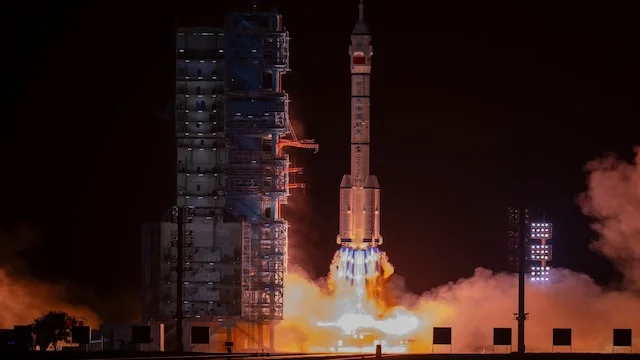
Three Chinese astronauts docked with the Tiangong space station on May 25, 2026, marking the first time a Hong Kong citizen has reached orbit and setting the stage for China's most ambitious human spaceflight endurance test yet. The Shenzhou-23 spacecraft lifted off from the Jiuquan Satellite Launch Center in the Gobi Desert at 11:08 p.m. Beijing time on May 24, carried by a Long March 2-F rocket. Approximately three and a half hours later, it successfully berthed at the Tianhe core module's radial port.
A Milestone for Hong Kong
Payload specialist Lai Ka-ying—also known as Li Jiaying—is the first astronaut from the Hong Kong Special Administrative Region to travel to space. A 43-year-old former police superintendent and mother of three, Lai holds a doctorate in computer forensics from the University of Hong Kong. She was selected during China's fourth astronaut recruitment round in 2024, beating out roughly 120 other Hong Kong candidates through a rigorous three-stage selection process. Her training compressed what typically takes years into just over twelve months, including a 72-hour sleep-deprivation test and extended desert survival exercises. Lai's inclusion has been hailed by Hong Kong Chief Executive John Lee as a "historic" moment for the city. Speaking before the launch, Lai told state broadcaster CCTV: "How high our Chinese spacecraft flies, that's how high we can hold our heads high." She becomes China's fourth female astronaut, following Liu Yang, Wang Yaping, and Wang Haoze.
The Crew and the Handover
Commander Zhu Yangzhu, a 39-year-old space engineer who previously flew on the Shenzhou-16 mission in 2023, leads the three-person crew. Pilot Zhang Zhiyuan, also 39, is a former People's Liberation Army Air Force officer making his first spaceflight. Together, they were welcomed aboard Tiangong by the outgoing Shenzhou-21 crew—Zhang Lu, Wu Fei, and Zhang Hongzhang—marking the eighth in-orbit crew gathering in Chinese spaceflight history. The Shenzhou-21 astronauts are scheduled to return to Earth on May 29, capping a mission that extended to 204 days due to an earlier spacecraft safety incident involving the Shenzhou-20 vehicle. That incident, caused by suspected debris damage to a viewport window, forced the Shenzhou-20 crew to return on Shenzhou-21 and prompted the emergency launch of an uncrewed lifeboat, Shenzhou-22. Shenzhou-23 now features reinforced viewport windows with three layers of anti-ablation glass, up from the original single layer, reflecting lessons learned from that close call.
The Year-Long Mission: Pushing Human Endurance in Orbit
One of the Shenzhou-23 crew members—either Zhu Yangzhu or Zhang Zhiyuan—is slated to remain aboard Tiangong for approximately 12 consecutive months, a first for China's human spaceflight program. The specific astronaut has not yet been publicly named; the China Manned Space Agency (CMSA) said the decision will depend on mission progress and scientific requirements. If successful, the mission would be among the longest single-duration stays in space, though still short of the 14-and-a-half-month record set by Russian cosmonaut Valery Polyakov aboard the Mir station in 1995.
Scientific Goals of the Extended Stay
The year-long habitation is designed primarily to study the effects of prolonged microgravity on the human body—bone density loss, muscle atrophy, cardiovascular changes, and psychological adaptation. These data are considered essential for planning future deep-space missions, especially a crewed lunar landing that China aims to achieve by 2030. The Shenzhou-23 mission also includes a broad suite of experiments in materials science, biology, and Earth observation. The extended duration allows researchers to observe physiological changes over a full annual cycle, something not possible during the standard six-month rotations that previous Tiangong crews have followed.
A Seat for an International Partner
There is another notable element in the mission architecture: the year-long stay creates an opportunity for an international astronaut to visit Tiangong. One of two Pakistani astronaut candidates currently training in Beijing is expected to fly to the station on Shenzhou-24 later this year, spend several days aboard, and then return to Earth in the Shenzhou-23 spacecraft, taking the seat of the crew member who remains behind. This would mark the first visit of a foreign national to China's three-module space station, which was completed in late 2022. The arrangement underscores China's growing willingness to engage in bilateral space cooperation, even as its broader relationship with the United States remains competitive and, at times, adversarial.
Context: China's Accelerating Lunar Ambitions and the U.S. Race
The Shenzhou-23 launch comes at a pivotal moment in the global space race. China has publicly committed to landing astronauts on the moon by 2030, a deadline that puts the program under significant pressure to develop heavy-lift launch vehicles, lunar landers, and surface habitat technologies. The U.S. space agency NASA, meanwhile, is aiming for a crewed lunar landing in 2028—two years ahead of China—as part of the Artemis program. In April 2026, four NASA astronauts made a historic trip around the moon on the Artemis II mission, the first human lunar flyby in over half a century. Additionally, Elon Musk's SpaceX conducted a largely successful, uncrewed test flight of its next-generation Starship rocket in May 2026, a vehicle designed to support more frequent moon missions and, eventually, human exploration of Mars.
Political and Strategic Dimensions
The competition carries significant geopolitical weight. U.S. officials have warned about what they allege are Beijing's plans to colonize and mine lunar territory and resources—allegations China has strongly rejected. Beijing frames its space program as a peaceful endeavor aimed at scientific discovery and international collaboration, though analysts note that the program also serves national prestige and military interests. The Chinese government has invested heavily in its space infrastructure over the past decade, including the completion of the Tiangong station, the successful landing of robotic rovers on the Moon and Mars, and the development of the Long March 9 super-heavy rocket intended for lunar missions.
Lessons from the Shenzhou-20 Incident
The current mission also benefits from hard-won operational experience. The Shenzhou-20 spacecraft, which was originally meant to transport a crew to Tiangong, suffered debris damage to its viewport window while docked. That prompted a complex emergency response: the Shenzhou-20 crew returned to Earth on Shenzhou-21, while an uncrewed Shenzhou-22 was launched as a replacement lifeboat. The Shenzhou-21 crew then stayed an extra month beyond their planned six-month rotation to manage the handover. The incident, while resolved without injury, caused changes to spacecraft design—Shenzhou-23's viewport now includes three layers of anti-ablation glass. It also highlighted the risks posed by orbital debris, a growing concern as satellite constellations and space traffic increase.
Perspective: What This Mission Changes for China and the World
The Shenzhou-23 mission represents a convergence of several important trends in human spaceflight. First, it demonstrates China's ability to execute complex, multi-crew operations with increasingly long durations, a capability that only Russia and the United States have previously mastered. Second, the inclusion of a Hong Kong astronaut symbolizes Beijing's efforts to integrate the territory more fully into national projects, particularly after years of political tension following the 2019 protests and subsequent national security legislation. Third, the planned visit of a Pakistani astronaut signals a shift toward more explicit international partnerships, potentially opening the door for other countries to send astronauts to Tiangong in the future.
A Stepping Stone to the Moon
If the year-long mission succeeds, it will provide China's space medical researchers with a wealth of data that could help refine countermeasures against the health effects of long-duration spaceflight—countermeasures that will be critical for a months-long journey to the moon and back, and eventually for Mars. The mission also tests the reliability of Tiangong's life-support systems, radiation shielding, and power generation over an extended period. China has not yet announced a detailed timeline for its crewed lunar landing, but the Shenzhou-23 mission is widely seen as a key preparatory step.
Broader Implications for Global Space Governance
China's growing presence in orbit also raises questions about the future of space governance. The country is not a participant in the U.S.-led Artemis Accords, a set of non-binding agreements that outline principles for lunar exploration and resource use. Instead, China and Russia have jointly proposed the International Lunar Research Station, a rival framework for cooperation on the moon. As more nations and private entities gain access to space, the absence of a unified regulatory regime could lead to disputes over territory, spectrum allocation, and debris mitigation. Meanwhile, China's space program continues to inspire domestic pride. As Lai Ka-ying said before her launch: "This is a rare chance. Why not try?" Her journey, and the year-long stay that one of her crewmates will attempt, may well determine how high China's aspirations can rise—and how quickly the world finds its footing in the next phase of space exploration.
Comments