
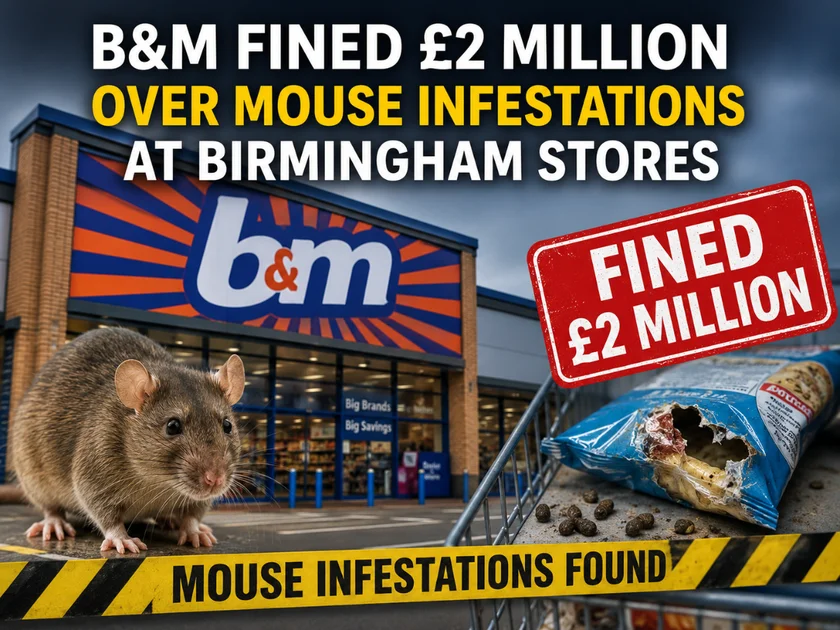
B&M Hit with £2 Million Fine After Mouse Infestations in Birmingham Stores
Discount retailer B&M Retail Ltd has been fined £2 million after pleading guilty to multiple food hygiene offences linked to widespread mouse infestations at three of its Birmingham stores. The penalty, handed down at Birmingham Magistrates' Court on July 13, 2026, follows an investigation by Birmingham City Council’s Environmental Health Service that uncovered rodent droppings, gnawed food products, and urine contamination across the affected locations.
In addition to the fine, the company was ordered to pay £18,104 in prosecution costs and a £2,000 victim surcharge, with 28 days to settle the total bill. The three stores — located at St Andrews Retail Park, Priory Square Shopping Centre, and The Fort Shopping Park — were all shut immediately after inspectors served Hygiene Emergency Prohibition Notices citing serious risks to public health.
What Inspectors Found Inside the Stores
The investigation began in November 2024 after members of the public reported pest problems at the St Andrews Retail Park branch. During the initial inspection on November 11, 2024, environmental health officers found "significant evidence of mouse activity," including mouse droppings and gnawed food products still being offered for sale. A Hygiene Emergency Prohibition Notice was served on the spot, forcing the store to close.
A second inspection took place at the Priory Square Shopping Centre on January 22, 2025, following a complaint from a shopper who reported seeing a mouse inside the store. Officers found evidence of an active mouse infestation, including gnawed food items, mouse droppings, urine contamination on food packaging and shelving, inadequate cleaning standards, and structural defects that allowed rodents to enter and move freely around the premises. That store too was closed immediately.
The final inspection occurred on October 27, 2025, at the B&M store at The Fort Shopping Park in Erdington, after another complaint alleging a mouse infestation. Officers reported widespread evidence of mouse activity throughout the premises, with droppings found on the shop floor, in storage areas, and critically, in close proximity to children’s toys on display. The council described the conditions as posing a serious risk to public health, and a third prohibition notice was served.
A Pattern of Neglect: From Complaints to Courtroom
The case highlights a troubling pattern of hygiene failures at one of the UK’s most popular discount retailers. B&M operates hundreds of stores across the country, but the Birmingham probes revealed that standard pest-control and food safety procedures were either inadequate or ignored altogether.
Birmingham City Council’s Environmental Health Service launched its investigation after receiving multiple complaints from shoppers who observed pests inside the stores. The council’s findings painted a grim picture: mouse activity was not isolated but widespread, with contamination reaching food products and even children’s items.
Why These Findings Matter for Public Health
Rodent infestations in retail food environments carry serious public health implications. Mice can transmit diseases such as salmonellosis, hantavirus, and leptospirosis through their droppings, urine, and saliva. Contaminated food packaging poses a direct risk to consumers who may unknowingly handle or consume affected products. The presence of droppings near children’s toys at The Fort Shopping Park was particularly alarming, as young children are more vulnerable to infection and may put toys in their mouths.
Birmingham City Council’s Licensing and Public Protection Committee Chair, Councillor Sam Forsyth, said the conditions found were "unacceptable" and required "immediate intervention to protect the public." She added that the £2 million penalty "reflects the seriousness of the offences and sends a clear message that businesses must take their responsibilities seriously."
B&M Accepts Responsibility, But Questions Remain
In court, B&M did not contest the facts and pleaded guilty to the food hygiene offences. The company issued a statement expressing regret: "We are deeply sorry for the failings identified in the three stores and have taken full responsibility."
The retailer admitted that while food safety and pest-control procedures technically existed at each site, "those procedures were not followed," adding, "That should not have happened."
A B&M spokesperson said the firm has since taken "comprehensive action to strengthen controls across" its operations. However, the company has not publicly detailed the specific measures implemented at other stores, leaving some shoppers questioning whether similar problems could exist elsewhere.
Stores Now Reopened After Deep Cleaning
All three affected stores were closed for several days or weeks following the prohibition notices while deep cleaning, pest eradication, and structural repairs were carried out. The stores have since reopened, and Birmingham City Council confirmed that follow-up inspections found compliance with hygiene standards. However, the case has damaged the retailer’s reputation, particularly given the severity of the violations.
Broader Implications: Retail Hygiene Under Scrutiny
The B&M case is not an isolated incident. In recent years, several major UK retailers have faced fines for hygiene breaches, reflecting increased scrutiny from councils and consumers alike. The public is becoming more vigilant about food safety, and social media amplifies complaints quickly — in this instance, customer reports directly triggered the investigation.
The Cost of Cutting Corners
For discount retailers, the pressure to keep prices low can sometimes lead to cost-cutting in areas like cleaning, pest control, and maintenance. B&M’s £2 million fine — plus legal costs and lost revenue from store closures — serves as a stark reminder that neglecting hygiene can be far more expensive than investing in proper procedures.
Retail analysts point out that consumer trust is hard to rebuild once broken. While B&M has apologised and taken corrective action, the case may prompt shoppers to scrutinise store conditions more closely, and could lead to tighter enforcement by local authorities across the country.
Regulatory Landscape May Tighten
The B&M prosecution also raises questions about whether current penalties are sufficient to deter non-compliance. The £2 million fine, while substantial, represents a fraction of the company’s annual revenue. Some consumer groups have called for tougher sanctions, including automatic closure orders for repeat offenders and higher penalties for hygiene violations that endanger public health.
For context, similar cases in the past have seen fines ranging from tens of thousands to a few million pounds, but consumer advocates argue that when public health is at risk, the consequences should be more severe. The B&M case may become a benchmark for future prosecutions.
What This Means for Shoppers and the Industry
The B&M infestation case is a wake-up call for the entire discount retail sector. Shoppers should feel confident that the food they buy is safe, and that stores are clean and well-maintained. When that trust is broken, the damage can be lasting.
Steps Consumers Can Take
Shoppers who visit any retail store and notice signs of pests — such as droppings, gnawed packaging, or a strong smell of urine — should report it immediately to the store manager and the local council’s environmental health department. Many councils offer anonymous reporting systems, and such reports can prevent outbreaks before they escalate.
For parents, the discovery of mouse droppings near children’s toys at The Fort Shopping Park is a particular concern. Experts recommend inspecting any unpackaged toys or soft items before giving them to children, especially if there is any suspicion of contamination.
Industry-Wide Reaction
The retail industry has taken note. Trade bodies such as the British Retail Consortium have reiterated the importance of robust food safety management systems, and many large chains have reviewed their pest-control contracts in recent weeks. However, critics argue that without consistent enforcement and meaningful penalties, some businesses will continue to take shortcuts.
For B&M, the road to rebuilding trust will require not just paying the fine but demonstrating a sustained commitment to hygiene across all its stores. The company says it has strengthened controls, but only time — and future inspections — will tell whether the changes are permanent.
Conclusion: A Warning That Should Not Be Ignored
The £2 million fine imposed on B&M Retail Ltd is one of the largest ever handed down for food hygiene offences in the UK. It underscores the seriousness with which courts and councils view failures that endanger public health. The case also highlights the vital role that customer complaints play in identifying problems — without the shoppers who reported seeing mice, the infestations might have continued unchecked.
As Birmingham City Council’s Sam Forsyth stated, residents rightly expect businesses to maintain high standards. The B&M case proves that when they do not, the consequences can be severe — not just in financial penalties, but in lost reputation and consumer confidence.
For now, the three Birmingham stores have reopened and passed subsequent hygiene checks. But the shadow of the infestation, and the image of mouse droppings near children’s toys, will take much longer to erase.
Related coverage: In other recent regulatory actions, Warren Revives Student Loan Bill to Crack Down on Colleges Over Debt Crisis highlights how authorities are increasingly using financial penalties to enforce compliance across sectors. Meanwhile, a Little Fire Explodes to 700 Acres Near Pleasanton, Forces Evacuations of Ruby Hill shows how public safety emergencies — whether environmental or retail-related — demand swift official response.
Comments