
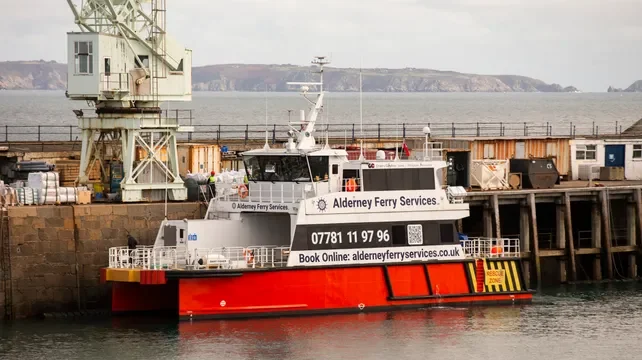
Alderney Rejects All Ferry Tender Bids Over Resilience Concerns
The States of Alderney has declared its latest ferry tender process a failure, rejecting all bids for a subsidised seasonal inter-island service due to concerns over reliability and resilience. The Economic Development Committee (EDC) concluded that none of the applicants could provide sufficient assurance that they could deliver a consistent and dependable service for the 2026 season.
Committee Chair Stuart Clark described the decision as difficult but necessary, stating that the investment of public funds required concrete evidence of operational capacity. “We are not satisfied that the tender criteria were met in order to provide us with the required assurances to warrant such an investment of public funds,” Clark said in a statement.
As a direct consequence, Alderney Ferry Services Ltd—the incumbent operator and one of the unsuccessful bidders—announced it will raise its ticket prices by £15 per person each way, including for infants, starting immediately. The family-run company had previously relied on the States grant to keep fares lower. Owners Dan and Charlie confirmed they will continue running their scheduled services to Guernsey and Cherbourg despite the setback, emphasising their commitment to maintaining the vital sea link.
No Subsidy Awarded for 2026 Season
The tender process was initiated to appoint a preferred ferry provider for a subsidised seasonal service between Alderney and Guernsey. The EDC reviewed all applications but determined it was “not in a position to award a subsidy” after finding that the proposals lacked the necessary evidence to guarantee a resilient service. The committee stressed that the decision was not taken lightly but was driven by the need for fiscal responsibility and operational certainty.
Why the Tender Failure Matters for Island Connectivity
The failure leaves the Alderney–Guernsey route without a subsidised operator for the upcoming season, raising concerns about affordability and reliability for residents and visitors. The States of Alderney has historically provided financial support to ensure stable fares and consistent scheduling, recognising the route’s importance for tourism, healthcare access, and supply chains.
Without the subsidy, Alderney Ferry Services has been forced to implement immediate fare increases. The company’s owners acknowledged the impact on passengers: “We understand that even the smallest increase can impact the decision to travel.” The price hike could discourage some travellers, potentially reducing passenger numbers and further straining the operator’s finances.
Background: A History of Service Disruptions
This is not the first time the Alderney ferry service has faced uncertainty. In October 2025, the operator ended its season early due to bad weather, and earlier in the year the States had expressed hope of extending the service after a successful berthing trial. The tender failure marks another chapter in a protracted struggle to secure a long-term, sustainable ferry solution for the island.
Broader Implications for Island Ferry Services
The Alderney tender collapse fits a broader pattern of challenges facing small-scale ferry operators, particularly those serving remote island communities. Rising fuel costs, stringent regulatory requirements, and the need for investment in vessel maintenance have made it increasingly difficult for small companies to meet tender criteria without significant public subsidy.
Lessons from Other Regions
Comparable situations have emerged elsewhere. In Western Australia, the state government recently called for tenders to build two new Swan River ferry terminals as part of a $107 million expansion project. That initiative, however, is backed by substantial federal investment and aims to transform urban connectivity rather than sustain a lifeline service. The contrast highlights how larger, better-funded projects can afford to set high resilience standards, while smaller routes struggle to attract viable bids.
The Resilience Standard Debate
Alderney’s EDC insisted on rigorous resilience criteria, including demonstration of capacity to handle weather disruptions, mechanical failures, and crew shortages. Critics argue that such high standards may be unrealistic for small operators in a seasonal market. Supporters, however, contend that public money must not be spent on services that risk frequent cancellations, which can leave passengers stranded and damage the island’s reputation.
Impact on Tourism and Local Economy
The fare increase is expected to affect the tourism sector, which relies heavily on affordable ferry access. Restaurants, hotels, and local attractions in both Alderney and Guernsey may see reduced visitor numbers if the cost of travel becomes prohibitive. The States of Alderney has not yet announced alternative measures to mitigate the impact, but the EDC said it will continue to investigate various options.
What This Changes for Passengers and Operators
For passengers, the immediate effect is higher travel costs. The £15 per-person surcharge applies each way, meaning a family of four would pay an additional £120 per round trip. This could make day trips or short breaks less attractive, potentially shifting demand toward privately chartered boats or air travel.
For operators, the failed tender sends a signal that the States of Alderney is unwilling to compromise on resilience requirements. Future bidders will need to present more robust operational plans, possibly including backup vessels, crew redundancy, and weather contingency protocols. This may favour larger companies with greater resources, potentially reducing competition in future tenders.
Alderney Ferry Services’ Committed Stance
Despite the setback, Alderney Ferry Services remains committed to the route. Owners Dan and Charlie expressed gratitude to passengers for their continued support and stressed their determination to keep the service running. “We remain committed to providing this vital sea link between the islands,” they said. Their decision to continue without subsidy demonstrates the deep-rooted importance of the connection for the local community.
The Search for Long-Term Solutions
The States of Alderney has indicated it will keep exploring options, including potential partnerships with other providers or revised subsidy models. The EDC’s statement expressed confidence that the range of providers competing in the market will ensure ongoing connectivity. However, without a clear timeline for a new tender or alternative arrangement, uncertainty lingers.
Broader Trends in Public Ferry Procurement
The Alderney case reflects wider tensions in public transport procurement, where authorities must balance cost, quality, and resilience. Similar debates have erupted in other jurisdictions, including the UK’s Outer Hebrides ferry services and Canada’s coastal routes. The trend is toward tighter contractual requirements, but this can price out smaller operators and reduce service diversity.
Technology and Innovation as Potential Solutions
Some regions are exploring innovative solutions to improve resilience. Electric ferries, such as those being developed for Perth’s Swan River expansion, promise lower operating costs and reduced downtime. However, initial capital investment remains high. For Alderney, the small scale of the route may not justify such expenditure without substantial external funding.
The Role of Whistleblowers in Tender Processes
While unrelated to ferries, the recent case of CBSE whistleblower Sarthak Sidhant—who exposed irregularities in India’s tender process for on-screen marking software—underscores the importance of transparency and accountability in public procurement. Sidhant, a self-taught programmer who learned coding from age six, demonstrated how individual scrutiny can hold systems to account. His story, covered in an interview with Hindustan Times, shows that tender processes can fail when criteria are not met or when oversight is lacking.
For Alderney, the EDC’s refusal to award a subsidy despite the absence of an alternative provider suggests a commitment to integrity over expedience. Whether that decision proves wise will depend on the private operators’ ability to maintain connectivity without public support.
Looking Ahead: A Crossroads for Alderney’s Ferry Future
As the 2026 season approaches, Alderney faces a test of its maritime connectivity. The immediate focus is on whether Alderney Ferry Services can sustain its schedule with higher fares and no subsidy. Longer term, the States must decide whether to revise its tender criteria, seek new partners, or invest in its own infrastructure to reduce reliance on external operators.
In a separate development, the ongoing Nottingham attacks inquiry has highlighted the consequences of systemic failures in public service provision. While that inquiry’s findings relate to police and NHS shortcomings, the principle applies equally here: when critical services break down, the impact on vulnerable communities can be severe.
A Call for Collaborative Solutions
Industry observers suggest that a collaborative approach—involving the States, operators, and community representatives—may yield better results than repeated tender failures. Co-designing service specifications, sharing operational data, and exploring blended funding models could help bridge the gap between what bidders can offer and what authorities require.
For now, passengers must brace for higher costs and hope that resilience concerns do not translate into service cancellations. The EDC has wished all operators a safe and prosperous season, but without the safety net of a subsidy, the next few months will be a proving ground for the island’s ferry future.
Comments