
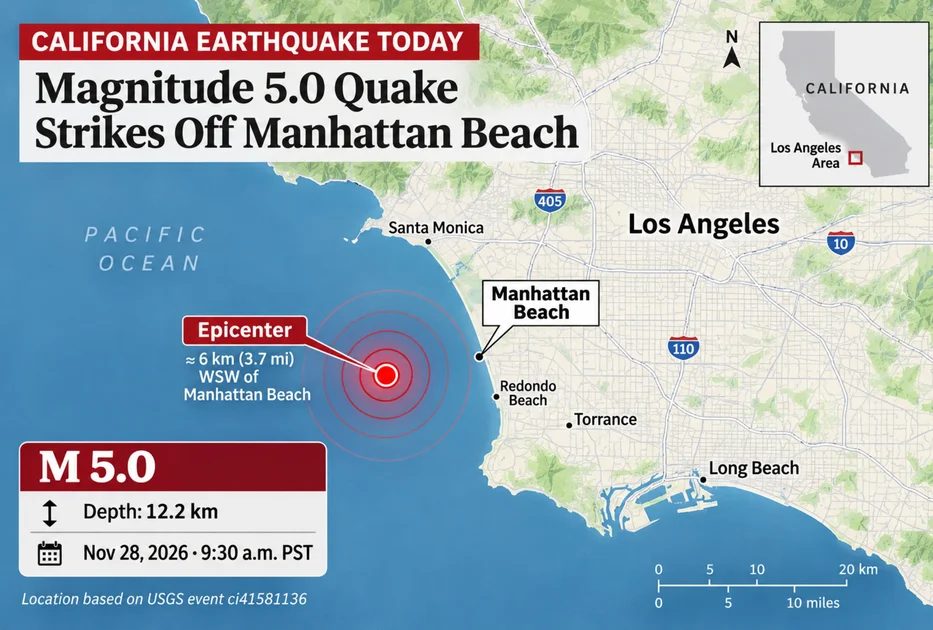
Magnitude 5.0 Quake Strikes Off Manhattan Beach, Shakes Wide Swath of Southern California
A magnitude 5.0 earthquake struck near Manhattan Beach in Los Angeles County at 9:30 a.m. Saturday, according to the U.S. Geological Survey, sending tremors across a region stretching from San Diego to Santa Barbara and as far inland as Bakersfield and Victorville. The quake was initially reported as a 5.2 but was later downgraded to 5.0. Its epicenter was approximately 4 miles west-southwest of Manhattan Beach at a depth of 8 miles.
The National Tsunami Warning Center in Palmer, Alaska, issued a Tsunami Information Statement confirming there is no tsunami danger from the event. The quake occurred roughly 105 miles northwest of San Diego and 20 miles southwest of Los Angeles.
Aftershocks Follow Initial Jolt
At least five notable aftershocks rattled the same offshore area within minutes of the mainshock. According to USGS data, a magnitude 3.0 quake hit 4.3 miles west-southwest of Hermosa Beach at 9:34 a.m., followed by a 2.5 near Manhattan Beach at 9:34 a.m., a 2.4 at 9:35 a.m., a 2.3 at 9:35 a.m., and a 2.2 at 9:40 a.m. All were centered within a few miles of the main epicenter.
The USGS categorized the event as a Green Alert, indicating a low likelihood of casualties and damage. The agency has collected 972 online "Felt" reports from residents describing light to moderate shaking in cities including Hemet, Ontario, Oxnard, Irvine, and Chatsworth. No immediate reports of damage or injuries were received.
Context: A Seismically Active Week
The Saturday morning quake is the latest in a series of seismic events to affect Southern California in recent days. Just two days earlier, a magnitude 3.6 earthquake was recorded at 11:20 p.m. Wednesday, 11 miles east of Mount Laguna in eastern San Diego County. That quake, which struck near Alpine and San Diego Country Estates, also produced no reports of damage or injuries.
The Manhattan Beach event follows two smaller quakes in the region over the past week: a 3.4 magnitude tremor near Newport Beach on Nov. 23 and a 3.2 magnitude quake near Hermosa Beach on Nov. 22. The earthquake also comes on the heels of a 6.7 magnitude event in Russia on Friday, though the two are not believed to be related.
Saturday's quake is the largest to hit the Los Angeles area since 2014, when a 5.1 magnitude earthquake struck near La Habra. That event caused millions of dollars in damage and injured several people. The USGS noted that recent earthquakes in the Manhattan Beach area have caused secondary hazards such as landslides and liquefaction that might have contributed to losses in the past, but no such effects were reported on Saturday.
Preparedness and Building Standards
The USGS structure information summary indicates that the population in the affected region resides in structures that are highly resistant to earthquake shaking, though some vulnerable structures exist. The predominant vulnerable building types are unreinforced brick masonry and reinforced masonry construction. The agency's Green Alert designation suggests that overall, the built environment performed as expected for an event of this magnitude.
Perspective: A Reminder of Regional Risk
While Saturday's earthquake caused no significant damage, it serves as a reminder of the seismic risks facing Southern California. The region sits atop a complex network of faults, and moderate earthquakes like this one are a regular occurrence. The widespread shaking felt from San Diego to Santa Barbara underscores how far the effects of even a moderate offshore quake can reach.
The event also highlights the importance of rapid public alerts and tsunami evaluations. Within minutes of the shaking, the National Tsunami Warning Center issued a statement confirming no tsunami threat, helping to prevent unnecessary panic. The USGS's "Did You Feel It?" program collected nearly 1,000 reports within hours, providing valuable data for seismologists.
As Southern California continues to experience frequent seismic activity, residents are encouraged to remain prepared. The USGS recommends securing heavy furniture, identifying safe spots in each room, and having an emergency kit ready. For those who felt Saturday's quake, reporting it through the USGS Felt Report form helps scientists better understand the region's seismic behavior.
Saturday's earthquake is a stark reminder that while the damage was minimal this time, the potential for larger events remains. The last major earthquake to strike the Los Angeles area—the 1994 Northridge quake—was a 6.7 magnitude event that caused billions in damage and dozens of deaths. Saturday's quake, while far weaker, is a timely nudge to review preparedness plans.
For now, residents across Southern California can breathe a sigh of relief as no injuries or major damage have been reported. But the event is a reminder that in earthquake country, vigilance is a way of life.
Comments