
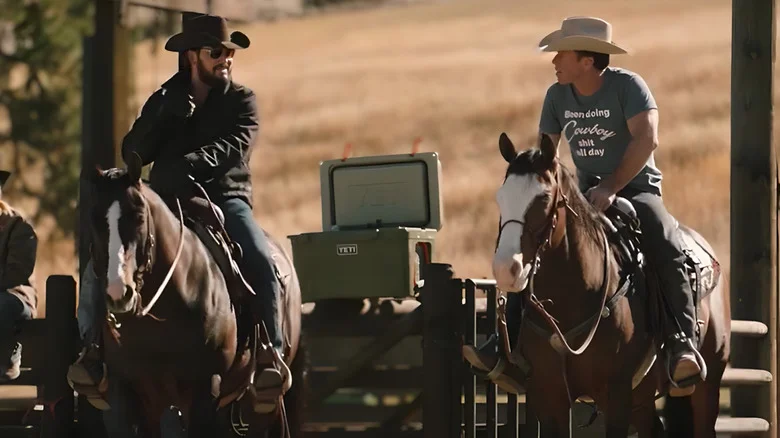
Taylor Sheridan Accused of Stealing 'Yellowstone' in New Copyright Lawsuit
A federal lawsuit filed on Friday, August 21, 2026, accuses Taylor Sheridan of stealing the idea for his hit series "Yellowstone" from writer Lauren J. Salkin. The complaint, filed in California, names Sheridan, his production companies, 101 Studios, Paramount, and Elevate Entertainment as defendants. Salkin alleges that her 2016 pitch for a series called "Sovereign Nation" was rejected by Sheridan's team, only for "Yellowstone" to be greenlit months later with striking similarities to her work.
According to court documents obtained by Variety, Salkin submitted her pilot script and pitch deck for "Sovereign Nation" to Elevate Entertainment in February 2017. She received an email stating, "Taylor thanks you very much for your interest. Unfortunately, he's unavailable for TV projects." The lawsuit argues that this rejection was misleading, as "Yellowstone" was greenlit at Paramount shortly thereafter, with its first episode airing on June 20, 2018.
The lawsuit details specific "expressive choices" that it claims were copied, including a tribal casino as the center of political power, a confrontation in the tribal chairman's office over expansion beyond reservation boundaries, and the use of trust land, zoning exemptions, and a 99-year lease structure as a mechanism for land development. Salkin also notes that she proposed actors Danny Huston and Gil Birmingham for her project; both later appeared in "Yellowstone" in roles that the lawsuit describes as "materially parallel" to her pitch.
Representatives for Sheridan, 101 Studios, Paramount, and Elevate Entertainment did not immediately respond to requests for comment from multiple outlets. As of this writing, Sheridan has not released a public statement regarding the lawsuit.
Why This Lawsuit Matters: The Stakes for Hollywood's Biggest TV Franchise
"Yellowstone" is not just a successful TV show; it is a cultural and economic juggernaut. Premiering in 2018, the series ran for five seasons and starred Kevin Costner, Kelly Reilly, and Luke Grimes, drawing millions of viewers and spawning a sprawling universe of prequels and spinoffs like "1883," "1923," and "The Madison." The franchise has been central to Paramount's streaming strategy and has made Sheridan one of the most powerful figures in television.
Salkin's lawsuit seeks not only an injunction against further infringement but also damages, including a share of "Yellowstone" profits. If successful, this could have massive financial implications for Paramount and Sheridan, who has built an entire content empire on the back of the Dutton family saga. The case also raises questions about how Hollywood treats unsolicited pitches and the fine line between inspiration and infringement.
This is not the first time Sheridan has faced controversy. Recently, he made headlines for his comments about retiring after "Yellowstone," only to stay active due to his purchase of the Four Sixes Ranch for $330 million. In a podcast interview, he revealed that the ranch purchase forced him to sign an exclusive deal with Paramount rather than retire. That deal, which runs through 2028, is now facing potential legal turbulence.
The lawsuit comes at a time when Sheridan is expanding his portfolio. He recently announced a move to NBCUniversal in 2029 after his Paramount deal ends, a shift that could complicate matters if the lawsuit progresses. The case also highlights the growing scrutiny on creators and the origins of their ideas, especially in an era where intellectual property is fiercely guarded.
A Closer Look at the Alleged Similarities
The lawsuit goes beyond vague claims of similar themes, cataloging specific elements that Salkin says were lifted from her copyrighted materials. Among the alleged similarities are:
- Tribal Casino as Institutional Center: Both "Sovereign Nation" and "Yellowstone" feature a tribal casino as the central hub of political and economic power for a Native American tribe.
- Land Development Mechanism: The use of trust land, absence of zoning restrictions, and a 99-year lease structure to enable expansion beyond reservation boundaries is a key plot point in both narratives.
- Character Parallels: Salkin pitched her series with actors Danny Huston and Gil Birmingham in mind. In "Yellowstone," Birmingham plays tribal chairman Thomas Rainwater, who is deeply involved in casino negotiations, while Huston appears as a character with connections to development deals.
- Visual and Thematic Elements: The lawsuit mentions recurring master-plan imagery that dramatizes the struggle for territorial control, a visual motif that appears throughout "Yellowstone."
Salkin, a Virginia-based journalist and screenwriter, claims she spent over a decade developing "Sovereign Nation," with the project copyrighted as early as 2010 and a specific pilot script registered in 2016. The lawsuit asserts that "When the works are objectively compared, the same coordinated design repeatedly appears," arguing that the similarities are too specific to be coincidental.
The Legal Landscape: Copyright Infringement in Hollywood
Copyright lawsuits are not uncommon in Hollywood, but they often face an uphill battle. To prove infringement, a plaintiff must show that the defendant had access to the copyrighted work and that there is substantial similarity in protectable elements. Salkin's case hinges on the timeline: her pitch was submitted directly to Sheridan's management company, which provides clear access. The question then becomes whether the similarities are substantial enough to constitute copying.
Legal experts note that themes like "land disputes" and "family drama" are not protectable, but specific expressions—such as the unique combination of casino politics, trust land mechanics, and character archetypes—could be. The lawsuit's detailed list of alleged similarities suggests Salkin's legal team is prepared to argue that Sheridan did not just draw inspiration but lifted specific, creative choices.
This case also arrives in the broader context of intellectual property disputes involving major franchises. In recent years, creators have become more willing to challenge studios over credit and compensation, especially when projects achieve massive success. The outcome of this lawsuit could set a precedent for how studios handle unsolicited pitches and how much weight to give to early concept work.
Sheridan's Career and the Stakes for His Empire
Taylor Sheridan's ascent in Hollywood has been remarkable. After acting in shows like "Sons of Anarchy," he pivoted to screenwriting, earning an Academy Award nomination for "Hell or High Water" (2016). He created "Yellowstone" in 2018, which became Paramount Network's highest-rated series and spawned multiple spinoffs, including "1883" and "1923." His production company has also expanded into other genres, with shows like "Lioness" and "Mayor of Kingstown."
However, Sheridan's reputation has faced scrutiny beyond this lawsuit. Earlier this year, real-life Lioness operatives criticized his series "Lioness" for what they called an "appropriation" of their experiences, as reported in Real Lioness Operatives Slam Taylor Sheridan's 'Lioness' as 'Appropriation'. That controversy, while less legally consequential, shows that Sheridan's creative choices are often under a microscope.
The "Yellowstone" lawsuit adds a new layer of complexity to his legacy. If the case gains traction, it could not only affect his finances but also his standing as one of television's most prolific creators. Moreover, the timing is delicate: Sheridan is preparing to transition to NBCUniversal in 2029, and legal entanglements could complicate negotiations or damage his reputation with new partners.
What This Means for the Industry and Audiences
The lawsuit underscores a persistent tension in Hollywood between original ideas and the collaborative nature of development. Writers often submit pitches to production companies without strong legal protections, relying on trust and industry norms. When a pitch is rejected and a similar project later appears, the resulting legal battle can be prolonged and costly.
For audiences, the case may cast a shadow over "Yellowstone" and its spinoffs. While the show remains beloved, fans may begin to question the originality of a story they have invested in for years. That could affect viewership and streaming numbers, though the show's loyal fan base may also view the lawsuit as just another Hollywood dispute.
The broader implications are significant. If Salkin wins, it could lead to more frequent lawsuits against showrunners and studios, potentially chilling creativity and making producers more cautious about accepting unsolicited submissions. It might also encourage more rigorous documentation of pitch processes. Conversely, if Sheridan prevails, it could reinforce the difficulty of proving copyright infringement in cases where similarities are based on common tropes rather than specific expression.
In the meantime, the industry will be watching closely. The case is in its early stages, and Sheridan has yet to respond formally. As the legal process unfolds, more details about the development of "Yellowstone" may come to light, offering a rare glimpse behind the scenes of one of television's biggest hits. For now, the lawsuit serves as a reminder that even the most successful creators are not immune to claims that their ideas may not be entirely their own.
This article will be updated as more information becomes available.
Comments