
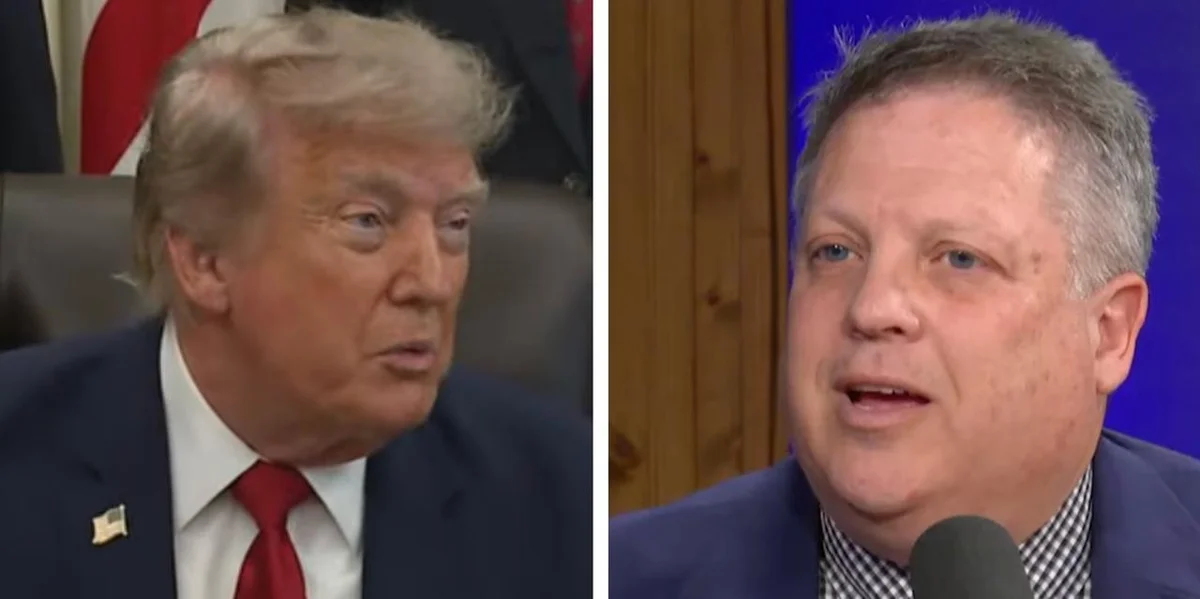
Trump Fires Court-Appointed U.S. Attorney Rogoff Within 54 Minutes, Setting Up Legal Clash
President Donald Trump fired Roger Rogoff, the newly appointed U.S. attorney for the Western District of Washington, less than an hour after federal judges swore him in Wednesday morning, escalating a constitutional standoff over who controls federal prosecutorial appointments. Rogoff, a former King County Superior Court judge and Democrat-backed official, received a termination notice from the White House personnel office at approximately 8:34 a.m., just 54 minutes after taking the oath of office at the U.S. District Courthouse in Seattle.
Rogoff was appointed by the district’s 17 sitting federal judges under a rarely invoked federal statute that authorizes the judiciary to fill a U.S. attorney vacancy when the president fails to formally nominate a candidate and the Senate does not confirm one within 120 days. The judges had been seeking a replacement for Neil Floyd, whom the Trump administration appointed as interim U.S. attorney last October but never formally advanced to the Senate for confirmation. Rogoff, who recently resigned as director of Washington state’s Office of Independent Investigations—a body created to probe police use-of-force incidents—said he was waiting in the courthouse lobby to meet with Floyd when a text message notified him of his dismissal.
“We are working on legal action right now,” Rogoff told The Seattle Times shortly after his firing. He has retained the national firm HKM Employment Attorneys LLP and is expected to sue the Trump administration and the Department of Justice, arguing that the president lacks unilateral authority to remove a judicially appointed U.S. attorney without Senate consent. The White House’s termination letter, confirmed by Justice Department spokeswoman Emily Covington, stated that Trump acted “pursuant to his authority under 28 U.S.C. 541(c) and Article II of the Constitution.” Rogoff dismissed that rationale, telling Bloomberg Law: “The president gets to choose his U.S. attorney, but only with the advice and consent of the Senate. We have a situation that is untenable, not constitutional, and not legal.”
A Pattern of Rapid Dismissals
Rogoff’s firing is not an isolated incident but part of a broader pattern by the Trump administration to assert control over U.S. attorney appointments, even when judges exercise their statutory authority to fill vacancies. In February, the White House fired Donald Kinsella, who had been appointed by a panel of federal judges to serve as U.S. attorney for the Northern District of New York, within hours of his swearing-in. Then-Deputy Attorney General Todd Blanche publicly declared at the time: “Judges don’t pick U.S. Attorneys, @POTUS does,” citing Article II of the Constitution to justify the removal. The New York State Bar Association condemned the ouster as “an insult to separation of powers and the administration of justice.”
Earlier, in 2025, the Trump administration fired Tessa Gorman, another court-appointed prosecutor for the Western District of Washington, who was replaced by Floyd. Those earlier dismissals did not result in litigation, but Rogoff’s case may prove different. Influential lawyers in Seattle had been strategizing for months about the need for the court to select a candidate willing to sue the administration if fired. Sources told Bloomberg Law that the seven active district judges in Western Washington—all appointed by President Joe Biden—viewed Rogoff’s appointment as a necessary test of judicial authority after the administration bypassed Senate confirmation by installing Floyd as “first assistant” while he continued running the office.
Chief U.S. District Judge David Estudillo outlined the court’s rationale in a July 8 letter to acting Attorney General Todd Blanche, who is currently undergoing his own Senate confirmation hearings to become permanent attorney general. Estudillo described the appointment as a routine gap-filling measure to keep the office staffed, noting that the court had opened an application process, empaneled a merit selection panel, and interviewed all candidates. “I write to inform you that the District Court for the Western District of Washington will appoint Mr. Roger Rogoff on Wednesday July 15, 2026, to serve as the United States Attorney for the Western District of Washington until his replacement is confirmed,” the judge wrote.
Why This Matters: The Stakes of a Constitutional Standoff
The Rogoff firing tests a rarely litigated provision of federal law that grants district courts the power to appoint U.S. attorneys when the executive branch fails to act. Under 28 U.S.C. § 546(d), if a U.S. attorney vacancy occurs and the president does not nominate a successor within 120 days—and the Senate does not confirm one—the district court may appoint an interim U.S. attorney to serve until the vacancy is filled. Congress included this provision to prevent prolonged vacancies from crippling federal law enforcement, but the Trump administration has argued that the president’s Article II removal power allows him to fire any U.S. attorney at will, regardless of how they were appointed.
Legal experts are divided on whether the statute can withstand a direct constitutional challenge. The Trump administration has consistently taken the position that the president’s appointment and removal powers under Article II supersede any statutory limits Congress may impose. Acting Attorney General Blanche, who oversaw the earlier firings of Kinsella and Gorman, has been a vocal advocate of this view. Blanche appeared before the Senate Judiciary Committee on Wednesday, the same day Rogoff was fired, and faced sharp questions from Democrats about the department’s politicization, including its investigations into Trump’s perceived foes and its handling of the Jeffrey Epstein files. The confirmation hearings come amid broader concerns about the independence of the Justice Department under Trump’s second term.
Rogoff’s legal team is expected to argue that the president’s removal power is not absolute when Congress has provided a statutory mechanism for judicial appointments. They may cite precedent from the U.S. Supreme Court’s 2020 decision in Seila Law LLC v. Consumer Financial Protection Bureau, which affirmed that Congress can limit the president’s removal power for independent agencies but left open questions about inferior officers. If the case reaches the courts, it could clarify the boundaries of executive authority over the federal prosecutorial corps.
The Seattle Context: A Long-Running Feud
The standoff in Washington’s Western District has been brewing for months. Floyd, a former immigration judge with a reputation for tough rulings, was appointed by Trump last October after the administration failed to nominate him formally. Instead, the Justice Department installed Floyd as an interim U.S. attorney and later as “first assistant,” a move that critics said was designed to circumvent Senate confirmation. Senator Patty Murray, a Democrat from Washington, opposed Floyd’s appointment, and immigration advocates criticized his record on asylum cases. The district’s judges, frustrated by what they saw as an end run around the confirmation process, began seeking an alternative candidate in January.
Rogoff emerged as a consensus pick. A veteran prosecutor who served as a King County Superior Court judge after being appointed by former Democratic Governor Jay Inslee, he also led the state’s Office of Independent Investigations, an innovative agency tasked with removing police from the practice of investigating themselves in cases of officer-involved killings or injuries. His background made him a polarizing figure: supporters praised his independence and integrity, while conservative commentators like Seattle Red’s Jason Rantz criticized the appointment as “17 unelected judges boxing out the president’s pick.”
For a brief period earlier this year, it appeared that tensions between the administration and the judiciary might ease. In March, New Jersey’s chief judge reached an agreement with Blanche to appoint a veteran assistant U.S. attorney to lead the office there, avoiding a confrontation. But the Rogoff firing suggests that détente was temporary. “The Seattle developments Wednesday indicate the harmony in New Jersey may have been a one-off,” Bloomberg Law reported.
Broader Implications: What This Changes for Executive Power and Judicial Independence
The Rogoff case represents more than a localized dispute over a single prosecutor’s office. It is the latest flashpoint in a broader struggle between the Trump administration and the federal judiciary over separation of powers, a conflict that has intensified since Trump returned to office in 2025. The administration has taken aggressive steps to assert executive authority, including firing career DOJ officials, installing temporary U.S. attorneys without Senate confirmation, and challenging court rulings that limit presidential power. Rogoff’s decision to sue, if it proceeds, could provide a landmark test of how far the president can go in overriding statutory limits on his appointment and removal powers.
Hundreds of former federal prosecutors, including some who worked alongside Blanche, have urged the Senate to deny his confirmation as attorney general, citing concerns about the department’s politicization. The Senate Judiciary Committee’s hearing on Wednesday highlighted those fears, as Democratic senators pressed Blanche on his role in overseeing investigations into Trump’s political opponents and his handling of the Epstein records. The controversy over Rogoff’s firing is likely to add to the pressure on Blanche and on Republican senators who must decide whether to confirm him.
For the Justice Department, the outcome of this standoff could reshape how U.S. attorney vacancies are filled nationwide. If the courts side with Trump, it would effectively nullify the judicial appointment provision in 28 U.S.C. § 546(d), handing the president unchecked power to remove any U.S. attorney—even one appointed by a court—and replace them with an interim pick of his choosing. That would erode one of the few checks Congress built into the appointment process, potentially allowing the executive to bypass Senate confirmation for months or years at a time.
Conversely, if Rogoff prevails, it would reaffirm Congress’s authority to create alternative appointment mechanisms and limit the president’s removal power over inferior officers. Such a ruling could have ripple effects beyond U.S. attorneys, potentially affecting other federal positions where Congress has provided for judicial or agency-based appointments.
A New Front in the Judicial-Executive Battle
The Rogoff firing also underscores the growing willingness of federal judges to push back against executive overreach. The Western District of Washington’s unanimous selection of Rogoff, despite knowing the president would likely fire him, signals that at least some judges are prepared to test the limits of their authority. Sources told Bloomberg Law that Seattle attorneys had been strategizing for months about selecting a candidate willing to litigate, marking a shift from the passive approach taken in earlier dismissals in New York and Virginia.
Meanwhile, the practical consequences for the Western District of Washington remain uncertain. With Rogoff fired and Floyd continuing to run the office as first assistant, the district’s federal law enforcement operations will proceed under an acting U.S. attorney whose status is legally contested. The judges could appoint another candidate, inviting another round of firing, or they could await the outcome of Rogoff’s expected lawsuit before deciding their next move. In the meantime, the standoff has already drawn attention from both sides of the political spectrum, with critics of the administration decrying what they see as a power grab, and supporters of Trump arguing that the president has the constitutional right to choose his own prosecutors.
As Rogoff’s legal team prepares to file suit, the case will likely become a high-profile test of whether the judicial branch can effectively counter an executive branch determined to consolidate control over federal law enforcement. For now, the former judge remains unbowed. “We are considering all of our legal options,” he told reporters, adding that the situation is “not constitutional, and not legal.”
The White House, for its part, shows no signs of backing down. With Blanche’s confirmation hearing underway and the administration’s broader deregulatory and anti-immigration agenda advancing, the Rogoff firing appears to be just the opening salvo in a longer legal war over the boundaries of presidential power.
Comments