
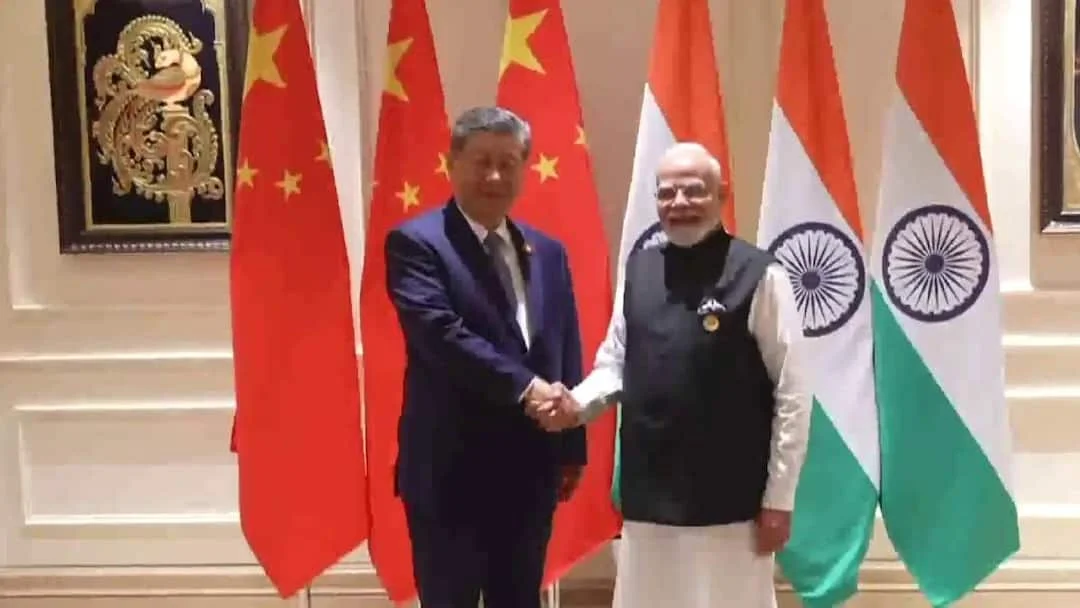
Xi and Modi Pledge to Resolve Border Dispute at BRICS Summit
Chinese President Xi Jinping and Indian Prime Minister Narendra Modi met on Saturday in New Delhi on the sidelines of the BRICS summit, agreeing to work toward a resolution of their long-standing border dispute. It was Xi's first trip to India in seven years, marking the most significant step yet in a cautious thaw between the nuclear-armed rivals.
The two leaders expressed commitment to a "fair, reasonable and mutually acceptable resolution of the boundary question," according to India's foreign ministry. Modi emphasized the need for both sides to observe existing agreements on border issues. They also pledged to strengthen cultural, business, and transport links, and addressed economic concerns including trade imbalances and supply chain issues.
Xi described the relationship from a strategic and long-term perspective, noting that institutional exchanges are gradually being restored, cooperation areas are expanding, and bilateral trade has reached new highs. The meeting comes six years after a deadly military clash along the disputed border, with ties improving through restored flights, visas, and high-level talks.
Altman: Trump-Xi AI Deal Would Merit Nobel Peace Prize
In a separate development, OpenAI CEO Sam Altman said in an exclusive interview with Fortune on Friday that Presidents Donald Trump and Xi Jinping would both win the Nobel Peace Prize if they could agree on shared standards for AI development. Altman argued that even a basic agreement on testing and risk thresholds would be a "wonderful accomplishment."
He suggested that a notional U.S.-China pact on AI isn't hard to accomplish and could be laid out in a one-page document. The key, he said, is having guardrails to prevent catastrophic risks. Altman added that a ban on recursive self-improvement—AI that can continuously upgrade itself—probably would not be sufficient on its own.
Altman's comments come amid growing global concerns about AI's destructive potential, including its use in warfare. President Trump has long expressed a desire for the Nobel Peace Prize but has yet to receive it. A U.S.-China agreement on AI safety could provide a pathway.
Context: Stakes High for India-China Relations and Global AI Governance
The Xi-Modi meeting is significant because it signals a potential reset in India-China relations after years of tension. The 2020 border clash in the Galwan Valley resulted in casualties on both sides and led to a prolonged military standoff. Since then, both countries have engaged in diplomatic and military talks to de-escalate. The BRICS summit provides a neutral platform for dialogue, and the agreement to resolve the boundary question could pave the way for broader cooperation.
Meanwhile, the U.S.-China AI competition has intensified, with both nations racing to develop advanced artificial intelligence. Altman's proposal highlights the need for global governance in AI, especially as risks of an arms race grow. A bilateral agreement on AI safety could set a precedent for international cooperation, but achieving it requires overcoming deep mistrust.
The BRICS summit, attended by leaders such as Russia's Vladimir Putin and Iran's Masoud Pezeshkian, underscores the group's role in promoting multipolarity. However, the summit is overshadowed by ongoing wars in Ukraine and the Middle East, making the India-China bilateral meeting a rare positive development.
Perspective: A Fragile Thaw and the Road Ahead
The Xi-Modi meeting could lead to reduced tensions along the border and increased economic ties, benefiting both countries. However, resolving the boundary dispute will require sustained diplomatic efforts and compromises. The agreement to address trade imbalances and supply chain issues indicates a willingness to deepen economic cooperation, which could stabilize the region.
Altman's suggestion, while optimistic, faces significant hurdles. The U.S. and China have clashed over technology, trade, and human rights, and agreeing on AI standards would require unprecedented trust. Nevertheless, the idea of a Nobel Peace Prize for such a deal underscores the potential impact of AI governance on global peace.
As the BRICS summit concludes, the world watches whether these diplomatic gestures translate into concrete actions. The coming months will test whether the India-China thaw holds and whether the U.S. and China can find common ground on AI—a challenge that could define the next decade of international relations.
Comments