
Six Teams Clinch World Cup Knockout Berths as Round of 32 Nears
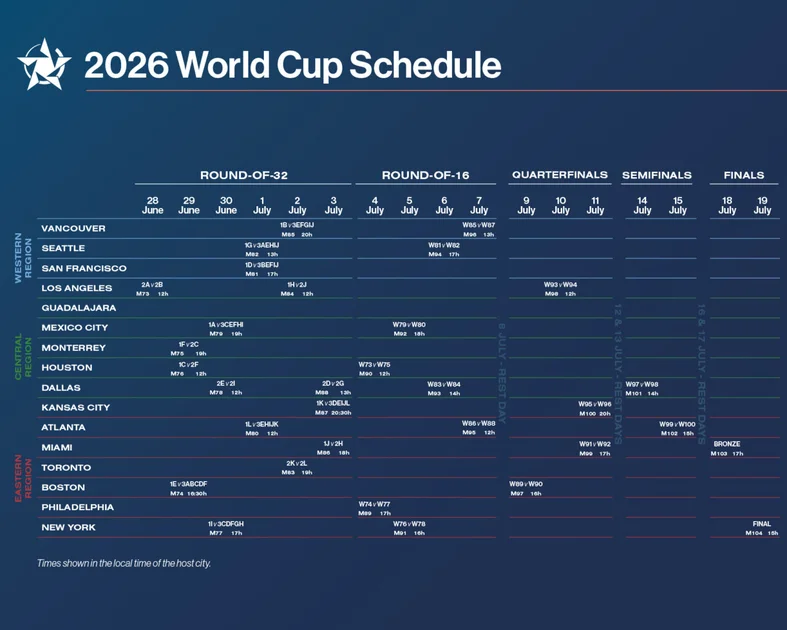
The 2026 FIFA World Cup knockout stage is rapidly crystallizing after the second matchday of the group phase. France, Argentina, Germany, the United States, Mexico, and Norway have all secured their places in the Round of 32, with several high-profile teams still fighting to join them. The expanded 48-team tournament, co-hosted by the United States, Canada, and Mexico, introduces a new 32-team knockout round, doubling the number of elimination games compared to previous editions. This structural shift has made the path to the July 19 final more complex—and more enticing.
As of June 24, 2026, the United States and Mexico have clinched their respective groups. The U.S. defeated Paraguay and Australia to win Group D, earning a home knockout tie against a third-place team from Groups B, E, F, I, or J on July 1 at Levi's Stadium in Santa Clara, California. Mexico posted clean sheets against South Africa and South Korea to top Group A, securing a Round of 32 match at Estadio Azteca in Mexico City against a third-place side from Groups C, E, F, H, or I. Germany won Group E with consecutive wins over Curaçao and Ivory Coast, while Argentina topped its group after beating Austria. France and Norway also progressed, setting up a potential blockbuster clash between France’s Kylian Mbappé and Norway’s Erling Haaland later in the tournament.
Forecasting the Most Exciting Knockout Ties
With the bracket beginning to solidify, several tantalizing matchups are on the horizon. According to The Athletic’s forecasting tools, a France vs. Germany Round of 32 showdown is possible if France wins Group I and Germany secures one of the eight best third-place spots. That game would pit two European powerhouses against each other far earlier than usual. Another potential gem: Brazil facing Japan, who stunned the Seleção less than a year ago. Mexico vs. England looms as a possible quarterfinal if both teams hold their positions, while Argentina vs. Belgium could produce a tactical battle between Lionel Messi’s final tournament and Belgium’s golden generation. The Athletic also highlights a Sweden vs. France tie, which would see Arsenal teammates William Saliba and Viktor Gyökeres face off. Sweden’s speedy front line of Gyökeres and Alexander Isak could test France’s center-backs, though France’s depth—led by Mbappé—remains formidable.
For England, the route is still uncertain. Thomas Tuchel’s side has work to do after a draw with Ghana. They are on course to top Group L but face a tricky Round of 32 opponent, likely one of the more dangerous third-place teams. The new format means 12 third-place teams compete for eight spots, making the math more forgiving but the bracket more volatile.
How the Expanded Bracket Changes the Stakes
The 2026 World Cup marks a significant departure from the 32-team format used from 1998 to 2022. With 48 teams, the schedule has ballooned from 64 matches to 104, and the knockout phase now includes a Round of 32 before the traditional Round of 16. This doubles the number of elimination games, increasing the potential for Cinderella runs and early giant-killings. The eight best third-place teams advancing means that even teams who lose one group game can still progress, adding strategic depth to group-stage tactics.
Tiebreaker rules remain similar to previous tournaments: head-to-head points, goal difference, goals scored, and—if still tied—team conduct scores and FIFA rankings. Several teams have already been eliminated: Haiti, Turkey, Tunisia, and Jordan cannot advance. Meanwhile, Portugal, led by Cristiano Ronaldo, is in a must-win situation in Group K. Ronaldo underlined his legacy with a brace against Uzbekistan, and Joao Cancelo defended both Ronaldo and Neymar amid criticism. Portugal’s path to the knockout stage remains open, but they face stiff competition from Uzbekistan and others.
Weather could also play a role. A severe thunderstorm watch has been issued for multiple U.S. regions, potentially delaying matches in the eastern U.S. Knockout games are scheduled across three countries, with venues ranging from Los Angeles to Mexico City to Toronto. The tournament’s logistical complexity—three time zones, multiple weather patterns, and massive crowds—adds another layer of unpredictability.
Broader Implications: A New Era of World Cup Drama
The expanded knockout stage fundamentally alters the tournament’s dynamics. Under the old 32-team format, the Round of 16 was the first elimination round, meaning every group game carried immense weight. Now, with 32 of 48 teams advancing, group-stage matches are less do-or-die for top teams but more critical for seeding and avoiding dangerous bracket paths. For fans, this means more matches, more potential upsets, and a longer, more dramatic journey to the final.
For co-hosts, the stakes are enormous. The U.S. and Mexico have already clinched, but Canada still needs a result against Switzerland to secure its spot. Host nations benefit from playing at home in the knockout stages, but the pressure is intense. The U.S., for instance, faces a potentially easier path if they top Group D, but a slip in the third-place tiebreaker could send them into a bracket heavy with former champions.
The new structure also rewards depth. Teams like France and Germany, with deep benches, can rotate in the group stage to avoid injuries while still advancing. Smaller nations like Cape Verde, currently favored to advance from Group H, see the expanded field as a chance to make history. The 2026 World Cup is not just a tournament—it’s a test of how football adapts to growth, and the knockout stage will be its proving ground.
For viewers in the UK, every match is available live on BBC iPlayer. As the Round of 32 kicks off on June 28, the world will watch to see whether the expanded format produces chaos or coronations.
Comments