
Ukrainian F-16 Crashes While Intercepting Russian Air Targets; Pilot Ejects Safely
Ukraine’s air force confirmed Wednesday that one of its U.S.-made F-16 fighter jets crashed during a frontline mission aimed at intercepting Russian airborne targets. The pilot ejected safely and was taken for medical treatment after the aircraft suffered what officials described as a “malfunction” while on active duty. Experts have been dispatched to examine the crash site to determine the exact cause of the incident.
The downed jet marks a significant operational loss for Kyiv, which only began receiving the coveted fourth-generation fighters from NATO partners, including the Netherlands and Denmark, in recent months. While the airframe itself is a major asset, the fact that the pilot survived will be viewed as a relief by Ukrainian commanders, who have invested heavily in training a small cadre of F-16 aviators.
Pilot Safe After ‘Malfunction’ on Combat Patrol
Military sources said the aircraft was on a standard patrol mission to defend against Russian missile and drone barrages when the mechanical issue forced the pilot to eject over friendly territory. The incident underscores the high operational tempo and wear-and-tear on Western-supplied hardware in Ukraine’s grueling air war. It is the first publicly acknowledged loss of an F-16 in Ukrainian service since deliveries began, though Kyiv has previously lost other Soviet-era jets and drones in combat.
The Ukrainian air force did not specify whether the malfunction was mechanical or electronic, but the crash comes as Russia continues to launch waves of Shahed drones and cruise missiles at Ukrainian infrastructure. The loss of even a single F-16 reduces Ukraine’s already limited air-to-air capability, making every remaining sortie more critical for defending the front line and cities.
Russian Drone Company Chief Shot Near Moscow; Oil Refineries Blitzed
In a separate but equally dramatic development, the director and founder of a Russian drone manufacturing firm was shot and wounded early Wednesday in what prosecutors have called an “attempted murder.” Andrei Cherezov, head of the Russian Air Transport Laboratory — the company behind the “Ovod” family of combat drones — was attacked by an unknown assailant outside his home in Tula, roughly 150 kilometers south of Moscow.
Cherezov was returning from work at around 1 a.m. when the incident occurred. The attack has not been officially attributed, but it comes amid a wave of Ukrainian intelligence operations targeting Russian defense-industry figures and military logistics. The “Ovod” drones are used extensively by Russian forces for reconnaissance and strike missions against Ukrainian positions.
Night Strikes on Two Major Refineries Deepen Economic Pain
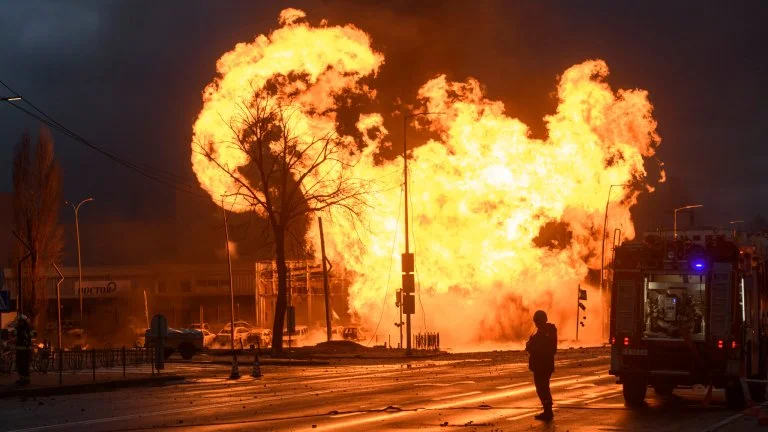
Simultaneously, Ukrainian forces struck two of Russia’s largest oil refineries overnight Tuesday, in what military officials described as precision long-range drone attacks. The first target was a Lukoil-operated refinery in the Perm region, more than 1,500 kilometers from the Ukrainian border. The second was a refinery in Ryazan, about 400 kilometers from the frontier. Both facilities have a combined annual production capacity of around 220 million barrels of oil, according to Ukrainian intelligence.
The strikes are part of an intensifying campaign by Ukraine’s security service (SBU) and military general staff to disrupt Russia’s domestic fuel production and reduce its ability to finance the war. The Ryazan refinery is critical for supplying fuel to Russian military units operating in central and western Russia. The Perm facility is one of the largest in the Urals region and processes crude for export markets.
The attacks follow a pattern of deep-penetration drone raids that have become a hallmark of Ukraine’s asymmetric warfare strategy. By hitting targets far from the front line, Kyiv aims to impose direct economic costs on Russia and sow discontent among its industrial and business elite.
Sberbank Loans in Turmoil as Retail Giants Feel the Heat
The financial ripple effects of the drone campaign are becoming increasingly visible. Russia’s largest lender, Sberbank, is scrambling to restructure loans and cover lending losses after Ukrainian drone attacks targeted the online retailer Wildberries. The bank said the credit quality of online retailers and vendors had deteriorated sharply, with about 300 companies seeking to restructure their loans in recent days.
Wildberries evacuated employees from a facility in Ryazan following the refinery strikes, adding to the sense of dislocation. Sberbank also extends credit to Ozon, Wildberries’ main competitor, whose facilities have not yet been targeted in this wave. The situation is a stark reminder that the war is no longer confined to the battlefield: entire sectors of the Russian economy are now feeling the strain of sustained Ukrainian strikes.
Battlefield Update: 201 Russian Vessels Struck in Three Weeks
In the maritime domain, a senior Ukrainian military official revealed that Ukrainian units have struck 201 Russian vessels over the past three weeks in the Black Sea and Sea of Azov. The tally includes both naval ships and civilian or auxiliary vessels used for military logistics. Notably, the count does not include smaller boats or those hit by Ukrainian naval drones that did not sink or require immediate recovery.
The strikes have effectively challenged Russian naval dominance in the region, forcing Moscow’s fleet to operate from safer ports further east and disrupting supply lines to occupied Crimea and southern Ukraine. Ukraine has used a combination of aerial drones, maritime drones, and long-range missiles to target Russian ships, often releasing dramatic combat footage to underscore its successes.
This maritime campaign is part of a broader effort to choke off Russian trade and military resupply routes, while also protecting the export corridor Ukraine has established for grain and other commodities. The ability to strike vessels at sea has given Kyiv a strategic lever that it lacked in the first years of the war.
Currency and Economic Fallout: Ruble Slides Further
The economic pain is also reflected in the weakening Russian ruble. The currency dropped another 1.9% against the U.S. dollar on Wednesday, hitting its lowest level since April 3. Since May 20, the ruble has fallen by 14% against the dollar and has also weakened against the Chinese yuan, which has become Russia’s most traded foreign currency as Moscow pivots east.
The depreciation is driven by a combination of factors: lower energy revenues due to Western price caps, increased military spending crowding out civilian investment, and the mounting costs of the war, including repairing or replacing infrastructure damaged by Ukrainian strikes. The ruble’s slide makes imports more expensive for Russian consumers and businesses, fueling inflation and eroding living standards.
Deep Drone Campaign and Refinery Strikes: A Strategy of Attrition
The coordinated attacks on refineries, e-commerce logistics, and financial stability suggest that Ukraine is pursuing a sophisticated strategy of economic attrition. Rather than focusing solely on territorial gains, Kyiv is seeking to degrade Russia’s ability to sustain its war machine over the long term. The Ukraine drone blitz on Russian oil refineries deepens domestic fuel crisis, with analysts warning that repeated strikes could force Russia to ration fuel or divert supplies from civilian to military use, further alienating the population.
Ukrainian officials have made clear that these operations will continue, targeting not only military assets but also the industrial and commercial infrastructure that supports the Kremlin’s war effort. The attack on the drone company chief, while still under investigation, fits this pattern by aiming directly at Russia’s ability to develop and produce advanced weapons.
Strategic Implications: Changing the Nature of the War
The events of July 29-30, 2026, illustrate how the conflict has evolved into a multi-domain campaign with no clear frontline. The loss of an F-16 is a tactical setback but one that Ukraine can absorb if pilot training programs keep pace. The simultaneous strikes on economic targets, however, point to a strategic shift: Ukraine is now able to project power deep inside Russia on a regular basis, undermining the idea that Russian territory is a sanctuary.
This changes the calculus for Moscow. The Kremlin must now defend its domestic industrial base, energy infrastructure, and even its corporate headquarters from attack. It also raises questions about the sustainability of Russia’s defense production, especially as key figures like Cherezov become targets. The psychological impact on Russia’s business elite should not be underestimated: no factory, refinery, or office building can be assumed safe.
From a global perspective, the F-16 crash and the continued success of Ukraine’s drone offensive will likely feature heavily in discussions at NATO headquarters and within Western defense ministries. Allies will be watching closely to see whether Ukraine can maintain its current tempo of operations through the remainder of 2026, and whether Western-supplied systems can survive the harsh conditions of frontline combat.
For now, the war enters Day 1,618 with no sign of a ceasefire. The F-16 pilot is recovering, the refinery fires are burning, and the ruble is falling. In Moscow, a drone company founder is in a hospital bed. Across the Black Sea, Ukrainian commanders are counting the ships they have struck. The conflict grinds on, increasingly fought as much in the boardroom and the financial market as on the muddy fields of the Donbas.
Comments