
UK's Most Dramatic Solar Eclipse Since 1999: What You Need to Know for August 12
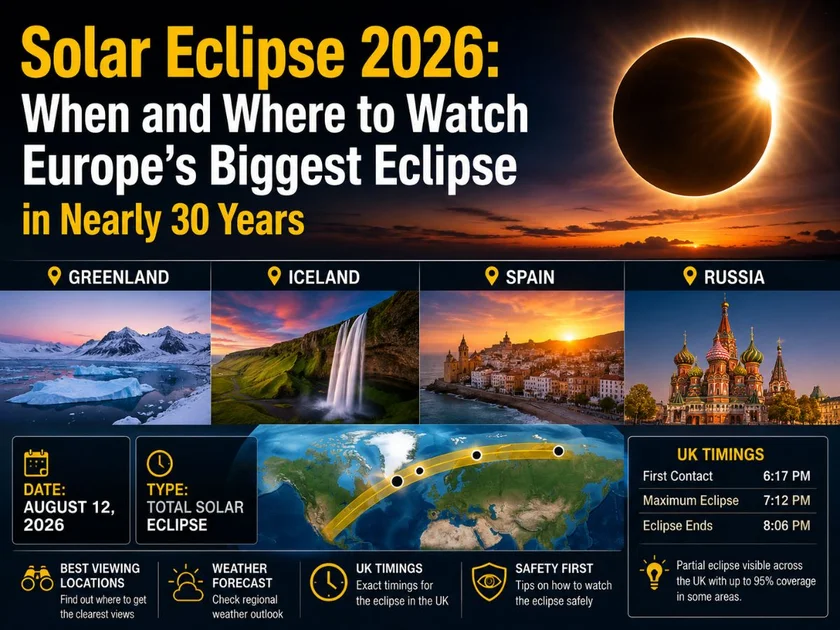
Skywatchers across the UK are counting down to a celestial spectacle not seen in over a quarter of a century. On Wednesday, August 12, 2026, the Moon will pass directly between the Earth and the Sun, creating a deep partial solar eclipse that will darken skies from Cornwall to Scotland. With up to 96.5% of the Sun obscured in the far southwest, this will be the most dramatic eclipse visible from Britain since the memorable total solar eclipse of August 11, 1999.
Unlike a total eclipse, where the Sun is completely hidden, the UK will experience a partial phase — but the sheer depth of coverage makes this event exceptionally rare. In London, Manchester, and Bristol, around 90% of the Sun will be blocked, while the Isles of Scilly and western Cornwall could see up to 96.5%. Astronomers have confirmed there will not be a better eclipse visible from the UK until 2090, making this a once-in-a-lifetime opportunity for many.
The eclipse will unfold during the early evening, with the Moon taking its first "bite" out of the Sun from around 6:08 pm in Scotland to 6:17 pm in London. Maximum coverage will occur between approximately 7:10 pm and 7:14 pm, depending on location, with the event concluding by just after 8:00 pm. Because the eclipse occurs so close to sunset, the Sun will sit only about 12 degrees above the west-northwest horizon, meaning an unobstructed view to the west is absolutely crucial.
Exact Times Across UK Cities
London, Bristol, Cardiff
For those in the capital and the southwest, the eclipse begins at 6:17 pm BST. The peak—when around 90% of the Sun is covered—will be at 7:13 pm in London, with the event ending at 8:06 pm. The entire sequence lasts roughly one hour and 49 minutes, giving ample time to witness the changing light and temperature.
Manchester and Liverpool
Further north, the eclipse starts slightly earlier at 6:13 pm. Maximum coverage of about 91.3% occurs at 7:10 pm, and the event ends at 8:03 pm. Spectators in these cities will also enjoy deep partial phases, but the low Sun requires a clear western horizon.
Scotland and the West Country
In Scotland, the eclipse begins earlier still, around 6:08 pm, with maximum coverage slightly lower but still impressive. The West Country, however, is the crown jewel: Isles of Scilly and western Cornwall will see up to 96.5% coverage at the peak at approximately 7:14 pm, with the event wrapping up just after 8:00 pm. Southern Ireland will see the deepest partial phase in the British Isles, but the UK's southwest runs a close second.
Why 90% Coverage Still Doesn't Mean 'Safe to Look'
One of the most critical messages from astronomers and eye specialists is that partial solar eclipses are far riskier to view than total ones. During a total eclipse, the Sun’s corona is briefly visible without protection, but during a partial eclipse, the Sun's surface is never completely hidden. Looking directly at the Sun without certified eclipse glasses can cause permanent retinal damage or blindness, even if the Sun appears dimmed.
The only safe way to observe the partial eclipse directly is with solar viewing glasses that meet the ISO 12312-2 safety standard. Standard sunglasses, smoked glass, or photographic filters are not safe. Alternatively, viewers can use indirect methods such as a pinhole projector or a solar telescope with a certified filter.
Many public events are planned across the country, with free certified glasses distributed at some venues, such as Platt Fields Park in Manchester. However, supplies are limited, so attendees are urged to arrive early or bring their own certified equipment.
Best Places to Watch the 2026 Solar Eclipse
South West England: The UK's Prime Viewing Spot
For the deepest partial phase in mainland Britain, head to Cornwall, Devon, or the Isles of Scilly. Land's End offers unobstructed Atlantic views and is expected to be a magnet for eclipse chasers. Falmouth Bay, Pendennis Castle, and Gyllyngvase Beach are also prime locations, with public events planned. In Somerset, Wells Cathedral Green and Beckford Tower in Bath are recommended by local astronomy groups. Exmoor National Park and the Norman Lockyer Observatory in Devon provide elevated positions with clear western horizons.
Bristol and Beyond
In Bristol, The Downs, Sea Walls Viewpoint, Victoria Park, and Brandon Hill (including Cabot Tower) are excellent choices. In Wiltshire, Avebury Stone Circle adds a mystical element to the experience, while Cley Hill and Barbury Castle offer elevated vantage points. Gloucestershire's Cleeve Hill and Robinswood Hill in Gloucester are also popular spots.
London and the South East
Londoners can view from any open park with a clear western aspect, such as Greenwich Park, where a public event is often held. However, the city's skyline may obstruct the low Sun, so seeking an elevated location is advised.
A Bonus for Stargazers: The Perseid Meteor Shower
As if a deep solar eclipse wasn't enough, the night of August 12 also coincides with the peak of the annual Perseid meteor shower. Once the eclipse ends and darkness falls, skywatchers who stay out may be rewarded with a brilliant display of shooting stars, with up to 60 meteors per hour expected under a largely moonless sky. The combination of a historic eclipse and a meteor shower makes this an unforgettable evening for astronomy enthusiasts.
How to Prepare for the Big Day
Beyond safety and location, preparation is key. Since the Sun will be very low in the west-northwest, choose a spot with an unobstructed view of the horizon—free from trees, buildings, and hills. Check the weather forecast in advance; clear skies are essential. In case of clouds, consider watching a live stream from a location with better conditions, such as Spain or Iceland, where a total eclipse will be visible.
For those planning to photograph the eclipse, use a solar filter on your camera lens or smartphone—pointing a lens directly at the Sun without a filter can damage both the camera sensor and your eyes. Many astronomy clubs are hosting guided events with telescopes equipped with solar filters, providing a safe and educational experience.
The August 12, 2026 eclipse is a reminder of the dynamic nature of our solar system. While the UK will see a partial phase, the event is a powerful draw for tourism and education. In the broader context of 2026's busy celestial calendar, this eclipse stands out as the headline event for British skywatchers. Future deep partial eclipses are not expected until 2090, so Wednesday's show is a not-to-be-missed moment in the UK's astronomical history.
Comments