
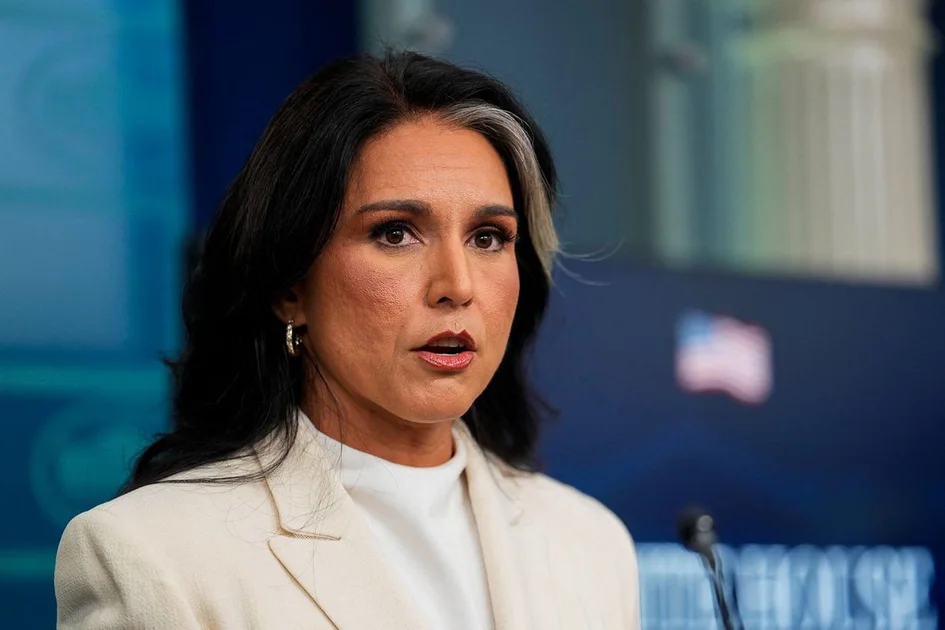
Tulsi Gabbard resigns as director of national intelligence, citing husband's cancer diagnosis
Tulsi Gabbard resigned on Friday as President Donald Trump’s director of national intelligence, saying she needed to step away as her husband battles an extremely rare form of bone cancer. The resignation, which takes effect June 30, makes her the fourth Cabinet official to depart during Trump’s second term.
“Unfortunately, I must submit my resignation, effective June 30, 2026,” Gabbard wrote in her resignation letter, which she posted on X. “My husband, Abraham, has recently been diagnosed with an extremely rare form of bone cancer.” Her husband, Abraham Williams, is a cinematographer and former Democratic staffer.
Gabbard, a combat veteran and former Democratic congresswoman from Hawaii, told Trump of her intent during an Oval Office meeting on Friday, according to Fox News Digital. In a post on his Truth Social platform, Trump said Gabbard had done “a great job” but that “she, rightfully, wants to be with him, bringing him back to good health as they currently fight a tough battle together.”
Trump named Principal Deputy Director of National Intelligence Aaron Lukas as acting director effective immediately.
Departure follows months of tension over Iran
Sources familiar with the matter told Reuters that Gabbard had been forced out by the White House. She had held the DNI role for about 18 months after a rocky confirmation process that saw even some Republicans express doubts about her foreign policy views.
Gabbard built her political brand on her opposition to foreign wars, a stance that created an awkward position when the U.S. joined Israel in launching attacks on Iran on Feb. 28. During a March congressional hearing before the Senate Intelligence Committee, she repeatedly dodged questions about whether the White House had been warned of potential fallout from the conflict, including Iran’s effective closure of the Strait of Hormuz.
“It is not the intelligence community’s responsibility to determine what is and is not an imminent threat,” she told lawmakers when pressed on whether the administration had ignored warnings.
Trump has previously hinted at differences with Gabbard on Iran, saying in March that she was “softer” than him on curbing Tehran’s nuclear ambitions. In written testimony to the Senate, Gabbard stated there had been no attempt by Iran to rebuild its nuclear capability after U.S. attacks “obliterated” its program — a claim that contradicted Trump’s assertions that the war was necessary to counter an imminent threat.
Why Gabbard's departure matters
The resignation comes as Trump’s national security team faces renewed scrutiny over the administration’s handling of the Iran conflict and broader foreign policy. Gabbard is the fourth Cabinet-level official to leave, following the ouster of Homeland Security Secretary Kristi Noem in March, the resignation of Attorney General Pam Bondi over frustrations with the Justice Department’s handling of certain files, and the resignation of National Counterterrorism Center Director Joe Kent in March.
Kent, a former Trump loyalist, resigned with a public statement saying he “cannot in good conscience” back the war with Iran. His departure, combined with Gabbard’s, signals that anti-war advocates within Trump’s orbit are quickly losing ground.
Gabbard’s departure is also likely to reshape U.S. intelligence priorities. While in office, she focused on counterterrorism but also faced internal criticism for allowing the National Counterterrorism Center (NCTC) to languish amid staff turnover and shifting priorities. A report from Intelligence Online noted that Gabbard’s main tool, the NCTC, “is still reeling from a year of upheavals” as the intelligence community pivoted toward counternarcotics and Latin America at the expense of traditional counterterrorism.
The broader shake-up in Trump’s cabinet
Her exit is part of a broader pattern of instability in Trump’s second-term cabinet. The Homeland Security Department saw its leadership turmoil multiply after Noem’s ouster, which was amid mounting criticism over her handling of the administration’s immigration crackdown and disaster response. Bondi’s resignation similarly stemmed from a lack of confidence in how the Department of Justice managed high-profile investigations.
The uncertainty extends beyond the intelligence community. Acting Navy Secretary Hung Cao has been navigating complex weapons sales to Taiwan, and U.S. relations with Iran remain strained after the Feb. 28 attacks. In a related development, Secretary of State Marco Rubio said the U.S. “stands ready” to step into Ukraine peace negotiations, while also warning that America and its allies need a “plan B” if Iran refuses to reopen the Strait of Hormuz.
What Gabbard's exit changes
Gabbard’s resignation underscores the growing tension between Trump’s hawkish foreign policy instincts and the more cautious, noninterventionist views that once defined his administration. Trump has doubled down on the Iran conflict, describing it as necessary to prevent the Islamic Republic from obtaining nuclear weapons, but the intelligence community’s own assessments — at least under Gabbard — appeared to conflict with that narrative. Now, with acting DNI Aaron Lukas in place, Trump may install a more pliable intelligence chief who aligns fully with the White House’s approach to Tehran.
Additionally, Gabbard’s departure removes one of the few former Democrats in Trump’s inner circle. Once seen as a potential bridge to disaffected voters from the left, her influence had waned as Trump moved toward a more confrontational foreign policy. Her absence could further consolidate power among hardliners who favor an aggressive posture toward Iran and China.
For the intelligence community, the transition to a new permanent director — possibly someone from the military or a Trump loyalist without deep intelligence experience — could accelerate a shift in analytical priorities. Under Gabbard, the ODNI had already begun refocusing resources on Latin America and counternarcotics, as noted in an Intelligence Online analysis. The next director may push even harder in that direction, or may instead pivot back toward counterterrorism and China as the Iran war evolves.
The resignation also raises questions about how the U.S. will handle war-related intelligence in the coming months. The Strait of Hormuz closure has caused global energy markets to tighten, and the intelligence community’s ability to provide accurate threat assessments will be critical if the conflict escalates. Emergency Landings Dominate Headlines: United, Air India, Small Craft Incidents Raise Safety Concerns highlights the increased risk in the region, though it is focused on aviation incidents.
A politically charged departure
The timing of Gabbard’s resignation — announced on a Friday afternoon — is a classic D.C. tactic to limit media focus, but it has already generated intense speculation. Some supporters see it as a principled exit over a war she could not support; critics argue she was pushed out for being out of step with Trump’s agenda.
Trump allies have downplayed the rift, with the president himself praising Gabbard’s service. But her public disagreements with the White House on Iran, combined with the earlier resignation of Joe Kent, suggest that a bloc of Trump administration officials who opposed the Iran intervention was systematically sidelined.
Gabbard’s next steps remain unclear, but her resignation letter leaves the door open to a return to public life. As a former congresswoman and 2020 Democratic presidential candidate, she retains a national following and could reenter politics, possibly as an independent or Republican, though she has not signaled that intention.
For now, the intelligence community will operate under acting leadership with a major foreign conflict underway, adding one more variable to an already turbulent geopolitical environment. The Pentagon’s recent release of new UFO videos and an officer’s account of “chasing orbs” — covered in Pentagon releases new UFO videos and officer's account of 'chasing orbs' — is an unrelated but noteworthy distraction, though it underscores how the ODNI’s portfolio continues to expand into unconventional areas.
Ultimately, Gabbard’s departure is both a personal story of family care and a political signal: The Trump administration’s second term will continue to be defined by swift changes, internal conflicts, and a foreign policy path that diverges sharply from the anti-war roots of many of its early hires.
Comments