
Pentagon releases new UFO videos and officer's account of 'chasing orbs'
The Pentagon on Friday released its second batch of declassified UFO files, including more than 50 videos and a striking first-hand account from a senior intelligence officer who described seeing "two large orbs" flare up near his helicopter — only to later watch those same orbs appear to chase nearby fighter jets. The release, ordered by President Donald Trump in an executive order earlier this year, adds to a growing trove of once-secret material that has drawn more than a billion hits to the Pentagon's UFO website since the first batch was uploaded two weeks ago.
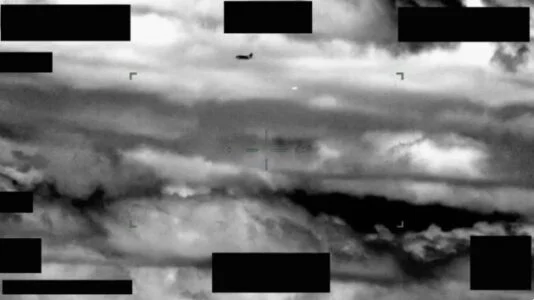
The new tranche, uploaded to the Pentagon's All-domain Anomaly Resolution Office (AARO) website, consists of six PDF files, seven audio files and 51 video files. Many of the clips show the familiar grainy infrared footage of unidentified anomalous phenomena (UAP) captured by military aircraft sensors. One video appears to show a fighter jet shooting down an unidentified object over Lake Huron in 2023 — though later reports suggested the object may have been a hobbyist balloon. Another video, labeled "Syrian UAP instant acceleration," shows a mysterious object racing away at seemingly impossible speed over Syria in 2021. A Coast Guard infrared sensor captured footage in April 2024 of an object flying near a plane over the southeastern U.S.
The most compelling document in this release is a narrative written by a currently serving senior intelligence officer describing an encounter in late 2025. The officer wrote that while investigating earlier UFO sightings from a military helicopter, he and the crew experienced "a series of close UAP encounters lasting over an hour." They first saw "two large orbs flare up" that were "oval-shaped, orange with a white or yellow center, and emitted light in all directions." Fighter jets scrambled to intercept, but when the officer looked again, "the same orbs we had encountered were now 'chasing' the fighters." The officer wrote that the orbs "flared up and down around us for several minutes, forming a distinct triangle before vanishing." After landing, he spoke with the pilots: "We were virtually speechless after these observations."
What the new files contain
The 51 videos in this batch span encounters from 2018 to 2023, many captured in the U.S. Central Command's area of responsibility, including over the Persian Gulf. A 2022 video shows multiple spherical objects entering and exiting the water near a submarine. An October 2022 clip from an undisclosed location shows a "cigar shaped or fast spherical UAP" flying over a residential street. The Pentagon notes that many of these materials "lack a substantiated chain-of-custody" and that descriptions note when and where they were likely taken.
The documents include historical files from the FBI, Department of Energy reports — including one from the Pantex nuclear weapons facility in Texas — and a 116-page file detailing 209 sightings of "green orbs," "discs," and "fireballs" near a military base in Sandia, New Mexico, between 1948 and 1950. The Pentagon says witnesses reported UAP "maneuvering, flying out of sight, disappearing, or exploding." Traces of residual copper powder were found in some areas where sightings occurred.
AARO found no evidence of extraterrestrial origin — but many cases remain unresolved
The Pentagon's AARO has investigated these incidents and stated repeatedly that it has found "no evidence" that any of them are of extraterrestrial nature. Yet military officials admit that many of the cases remain "unresolved" and cannot be explained by conventional means. The Pentagon's press release notes that the public "can ultimately make up their own minds about the information contained in these files." Friday's release constitutes the second tranche of what the Pentagon says will be a continuing series of disclosures.
Why this release matters: the stakes and political context
This latest batch of files arrives amid a surge of public and political interest in UAPs that shows no sign of abating. President Trump's executive order mandating the declassification and public release of UAP-related records was a key campaign promise, and the White House has embraced the topic as a populist issue. The first batch of 162 files, released on May 8, drew more than a billion hits to the newly created Pentagon website — an extraordinary level of public engagement that underscores how deeply the mystery of UFOs resonates in American culture.
The release comes at a time when UAPs have moved from the fringes to the mainstream of U.S. politics. Congressional hearings on the topic — featuring testimony from former intelligence officials and military pilots — have become a recurring feature in Washington. House lawmakers specifically requested the footage found in this batch in March, and the Pentagon complied. The All-domain Anomaly Resolution Office, created in 2022, is now a permanent office within the Defense Department with a mandate to investigate UAP encounters across all domains — air, sea, space, and undersea.
The intelligence officer's account: a turning point?
The account of the senior intelligence officer who described being left "virtually speechless" after watching orbs chase fighter jets is significant because it comes from a credentialed, currently serving intelligence professional — not a retired pilot or a civilian enthusiast. The officer's detailed narrative, written in late 2025 and declassified as part of this release, provides a level of granularity that earlier reports often lacked. The officer describes the orbs' color, shape, behavior, and the tactical response of the fighter jets, and he explicitly notes that the encounter lasted over an hour — far longer than the fleeting glimpses that characterize many UAP reports.
This account echoes other recent testimony from military personnel. In a [hushed but compelling moment during a House subcommittee hearing last month](Rumer Willis Reveals Bruce Willis’ ‘Tenderness’ as She Opens Up About Single Motherhood), a Navy pilot testified that he had encountered UAPs that exhibited "no visible means of propulsion" and "acceleration beyond known physics." The Pentagon's AARO director told Congress that while "the vast majority" of UAP cases are eventually identified as ordinary objects — weather balloons, drones, satellites, or sensor glitches — a small but persistent fraction remain unexplained.
Broader implications: what this changes
The steady drip of declassified UAP files from the Pentagon is reshaping how the public and policymakers think about the phenomenon. For decades, UFOs were the domain of tabloids and conspiracy theorists — a cultural backwater that serious people avoided. That has changed dramatically. The Pentagon now has a dedicated office, a public website, and a mandate to release files. The White House treats UAP disclosure as a priority. Congress holds hearings. The New York Times, CNN, and other major outlets cover the topic regularly.
Cultural and strategic significance
From a cultural standpoint, the Trump administration has turned UAP disclosure into a high-stakes reality show: each new batch of files draws millions of viewers, generating engagement that rivals major sporting events. The Pentagon website's more than a billion hits in two weeks is a staggering number — larger than the population of many countries. It suggests that the public appetite for information about UAPs is not a niche curiosity but a mass phenomenon.
Strategically, the release of these files has implications beyond popular culture. If UAPs represent advanced technology — whether foreign, domestic, or something else — understanding them is a national security imperative. The fact that many of these videos come from U.S. Central Command, the Persian Gulf, and areas where U.S. forces operate in contested environments suggests that adversaries may also be interested in these phenomena. The Pentagon has acknowledged that some UAP sightings may represent rival nations' surveillance or drone technology, though no evidence has been presented to confirm that.
Transparency versus spectacle
Critics argue that the releases are becoming a form of spectacle rather than genuine transparency. The Pentagon has repeatedly stated that none of the videos or documents provide evidence of extraterrestrial life, and that the vast majority of cases are resolved without any mysterious conclusion. Yet each new batch is hyped as if it might contain the smoking gun. The "Syrian UAP instant acceleration" video, for example, shows an object moving extremely fast — but without telemetry data or multiple sensor perspectives, it is impossible to rule out a sensor artifact or a conventional object moving at high speed.
Proponents of disclosure, however, see the releases as incremental progress. The intelligence officer's account, they argue, is exactly the kind of testimony that has been hidden from the public for decades: a trained observer, in a military aircraft, describing something that defies conventional explanation. The fact that the Pentagon released it at all — with the officer's name and unit redacted but the narrative intact — represents a shift in institutional willingness to acknowledge the phenomenon.
The road ahead
The Pentagon has indicated that more releases are coming. Spokesperson Sean Parnell said Friday that the Pentagon and other agencies are "actively working" on another release, which will be announced "in the near future." The next batch could include additional intelligence community documents, more videos from naval and air force platforms, and possibly the results of ongoing investigations into specific incidents.
The ultimate question — whether any of these files prove the existence of extraterrestrial or non-human intelligence — remains unanswered. But the conversation has evolved from "are UAPs real?" to "what is the government not telling us?" The Pentagon's own words — "many remain unresolved" — ensure that speculation will continue. The officer's final sentence, "We were virtually speechless after these observations," captures the mood of a public that, after years of denials, is now being given a glimpse into the unknown — but still not enough to fully understand it.
For those who remain skeptical, the Pentagon's AARO website offers direct access to all released files, allowing the public to examine the evidence themselves. The next tranche, expected within weeks, will likely deepen the mystery rather than resolve it.
Comments