
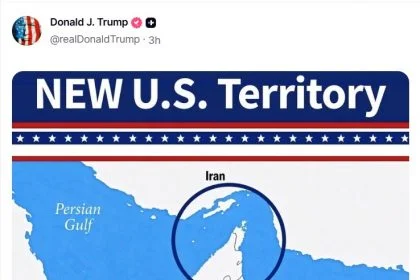
Trump Declares Strait of Hormuz 'American Territory' Amid Blockade and Rising Oil Prices
President Donald Trump on Friday described the Strait of Hormuz as "American territory" during a campaign rally in South Carolina, doubling down on his administration's aggressive posture toward Iran as the US naval blockade of Iranian shipping approaches its sixth month. The comment, which drew laughter from the crowd, came as Trump mused about bombing Iran "a little bit more" and recited his favored poem 'The Snake,' a recurring motif in his speeches on immigration.
"We don't even know if we won, because I view the Strait of Hormuz as an American territory right now," Trump said, addressing supporters in Myrtle Beach. The president was campaigning for Darline Graham, sister of the late Senator Lindsey Graham, who is running to permanently fill her brother's seat. Later in his remarks, he further stoked tensions: "What the hell do I have to do? Go back and bomb Iran a little bit more?"
The announcement is the latest escalation in a standoff that has roiled global energy markets and raised fears of a broader conflict. The US has imposed a naval blockade targeting all Iran-linked ships, and Central Command reported that 68 commercial vessels have been redirected to comply with the measure. In response, Iran has declared the waterway closed to any ship that does not seek Tehran's approval before transit, effectively creating two parallel routes: an Iranian northern corridor and a US-protected Omani southern corridor.
The Stakes: A Vital Chokepoint for Global Oil
The Strait of Hormuz is one of the world's most critical maritime chokepoints, carrying roughly one-fifth of global seaborne oil supply daily. Bordering Iran and Oman, the strait links the Persian Gulf to the Gulf of Oman and the open ocean, making it indispensable for energy exports from Saudi Arabia, the UAE, Kuwait, Iraq, and Qatar, as well as Iran itself.
Trump's latest comments follow his threat last week to formally declare the strait a US territory. During a speech at a New York police academy, he stated: "Essentially, that's what it is. We have the blockade. No ships get through unless we want them to." He later told reporters, "We control it with the blockade, and I like the idea of declaring it a territory," and posted a map on social media labeling the waterway as a "new U.S. territory."
Iran's deputy foreign minister, Kazem Gharibabadi, dismissed Trump's statements as "delusions," but the reality on the water is far more complex. Data from maritime intelligence firm Kpler reveals that between August 1 and August 19, 112 vessels carrying crude oil, liquefied petroleum gas, and liquefied natural gas passed through the strait. Of those, 21 openly used the Iranian route, while only two formally used the Omani route. The remaining 89 vessels — more than 80% — did not formally declare a route, often navigating the central corridor that predates the conflict.
This data challenges Trump's claim of complete control. Despite the US naval presence, the majority of tanker traffic continues to move without officially aligning with either side, suggesting a gray zone where commercial operators are attempting to avoid provoking either power. Meanwhile, oil prices have surged to near one-month highs, with Brent crude settling at $93.78 a barrel and West Texas Intermediate at $87.83, as traders factor in the persistent risk of disruption.
Escalation and Diplomacy Failures
The current crisis began six months ago when the US launched a military campaign against Iran, triggering what has become an open-ended conflict. The war has claimed thousands of lives and drawn in regional proxies, while efforts to negotiate a peace deal have repeatedly failed. The Trump administration has shifted to economic warfare, aiming to squeeze Iran's finances by restricting its access to the strait, cutting off oil revenue, and imposing "draconian sanctions."
On Thursday, Trump threatened to bomb Oman, a US ally, to dissuade Muscat from striking a deal with Tehran to jointly manage the strait. This move has alarmed Gulf states and raised questions about the reliability of American security guarantees in the region. Oman's geographic position makes it a co-riparian state with Iran, and any joint management arrangement would undermine Washington's blockade strategy.
This week, former CENTCOM commander General Joseph Votel urged the US to intensify economic pressure, calling for a crackdown on Iran's banks, oil smuggling networks, and "gray zone" operations. "We have to demonstrate the ability to virtually go after every dollar that is supporting the regime," Votel said on 'The Story.' "This means we have to be prepared to go after banks and businesses and governments that are providing the support." He emphasized addressing oil smuggling, currency swaps, cash transfers, and ship re-flagging schemes that help Tehran circumvent sanctions.
The Battle for Control: Iranian vs. Omani Routes
Before the war, the Strait of Hormuz functioned as a single waterway with established traffic separation schemes, and ships navigated based on port calls, charter terms, and safety rather than military allegiance. That has drastically changed. Tehran insists that the northern route, hugging Iran's coast near Larak and Qeshm islands, is the only legitimate passage, feeding directly into Iranian ports and terminals. The southern route, closer to Oman, is now the preferred corridor for US-protected commercial carriers, but it remains controversial given the threat of US strikes on Iranian targets near the strait.
The Kpler data indicates that while the Iranian route is used by a significant minority of oil and gas carriers, the majority are still operating without formally choosing sides. This ambiguity suggests that shippers are attempting to navigate a dangerous geopolitical landscape with minimal disruption to their schedules, but the risks are mounting. Several vessels have reported near-miss incidents with Iranian patrol boats, and there are unconfirmed reports of seizures by Iranian forces.
Broader Implications: A New Era of Maritime Coercion?
Trump's declaration that the strait is "American territory" is unprecedented in international law and has been dismissed by legal scholars as having no basis in the United Nations Convention on the Law of the Sea. The strait lies within the territorial waters of Iran and Oman, and any attempt to unilaterally annex it would likely be met with widespread international condemnation and possible retaliation.
However, the very fact that a US president would make such a statement reflects a broader trend of escalating brinkmanship in the region. The conflict has already drawn in Russia, which is using Iranian attack drones against Ukraine, creating an "axis of evil" that Ukraine's ambassador to Israel says unifies Moscow and Tehran against Western interests. This convergence of conflicts has global implications, as sanctions and shipping disruptions ripple through the world economy.
Oil prices are likely to remain volatile as long as the standoff persists. Analysts at Ritterbusch and Associates noted that new threats from Washington appear "unlikely to sway Iran into relinquishing their primary source of leverage, that being control of the Strait, absent major concessions from the U.S." They concluded, "So, the beat goes on with no resolution in sight that would spur a major decline in oil prices back to levels anywhere close to those prior to the war."
The situation also poses a challenge for the international community, which has largely remained silent amid the unfolding crisis. China and India, the largest buyers of Gulf oil, have not publicly opposed the US blockade but have reportedly requested exemptions for their tankers. Japan and South Korea are similarly dependent on the strait and have urged restraint.
Trump's rhetoric may be aimed at domestic audiences ahead of midterm elections, but the consequences are being felt worldwide. As the blockade enters its sixth month, the question is not whether the US or Iran controls the strait, but whether the global economy can afford a prolonged disruption to this vital waterway. The answer, for now, appears to be no.
What This Changes
The notion that a single nation can declare an international waterway "territory" signals a revival of gunboat diplomacy that many thought had ended with the age of imperialism. It may embolden other powers to assert unilateral control over strategic chokepoints, from the Suez Canal to the South China Sea, setting a dangerous precedent for maritime governance.
For the oil market, the heightened risk premium is already baked into prices, but a full closure of the strait could send prices to records. Meanwhile, the plight of commercial shippers caught in the middle highlights the fragility of global supply chains that depend on open seas.
Ultimately, this is a test of wills between Washington and Tehran, with Omani waters serving as the uneasy buffer. Whether Trump's "territory" rhetoric remains bombast or evolves into policy will depend on whether either side is willing to step back from the brink. For now, the ships continue to move, but the strait has become a geopolitical powder keg, and the world is holding its breath.
The conflict is also drawing in other nations. Ukraine's ambassador to Israel, Yevgen Korniychuk, recently linked the fight against Iran with the fight against Russia, saying, "We have been shot by the same Iranian-made drones that are currently being improved substantially by the Russians. So we feel that we've been fighting against the same enemy in different corners of the same battlefield."
As the war enters its seventh month, the international community faces a stark choice: accept the US blockade and territorial claims, or risk a wider conflagration. Neither option offers a clear path to peace, but in the meantime, the world's economy remains hostage to the waters of Hormuz.
This article is based on reporting from The Guardian, Al Jazeera, and Fox News.
Comments