
Take-Two Takes Down Major GTA 6 PC Port Network
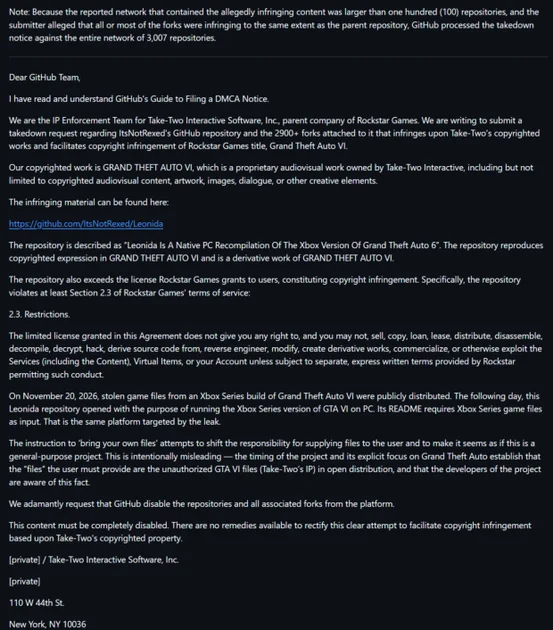
Take-Two Interactive has moved aggressively to stamp out unofficial attempts to bring Grand Theft Auto VI to PC, issuing a Digital Millennium Copyright Act (DMCA) takedown that disabled the most prominent community project, known as Leonida, and its entire network of 3,007 repositories on GitHub. The notice, published by GitHub on November 24, 2026, argues that the project—which described itself as a native PC recompilation of the Xbox Series version leaked by notorious leaker Cyberleek—is a derivative work built on stolen files and violates Rockstar's ban on reverse engineering.
The crackdown comes just days after GTA 6 launched on PlayStation 5 and Xbox Series X|S on November 19, 2026. With no official PC version announced, impatient gamers have turned to unauthorized ports, some of which have reportedly reached interactive gameplay. However, performance remains abysmal: community tracker PortWatch VI reports that the fastest builds achieve only 3 to 5 frames per second, with one clip showing the prologue running at 1 to 3 FPS on an RTX 5070 Ti and Ryzen 7 7800X3D. The top-ranked ZETTROX build manages just 2 FPS. Despite the legal pressure, development appears to be scattering into private groups, and other open-source projects outside Leonida's fork network remain publicly listed.
A Second Project Vanishes
The enforcement wave may be broader than initially reported. Another unofficial port, CGBJ, published a Windows x64 launcher and runtime on a public GitHub repository early on November 26, only for the repository and release page to return 404 errors later that day. The cause remains unconfirmed. The GTA VI PC Race tracker noted that GitHub had published no takedown notice naming CGBJ as of 00:21 UTC on November 27. PortWatchVI, which maintains a project history, says the code was public and was taken down temporarily, but whether the team made it private to avoid a DMCA notice or Rockstar's legal team acted is unclear. XDA Developers noted that GitHub DMCA notices typically take days to become public, and several forks of CGBJ were still active.
The Stakes: Billions on the Line
Take-Two's aggressive posture is hardly surprising. GTA 6 has already generated billions of dollars in revenue since its console launch, and a legitimate PC version could bring in billions more. The company has a long history of protecting its intellectual property, and the leak of the Xbox build has only intensified its efforts. In August, Take-Two asked a New York federal court to subpoena Microsoft and Discord for records that could identify Cyberleek, whose leaked executable helped fuel the porting efforts. Discord servers used to coordinate the work have also gone offline.
The takedown of Leonida—described by Take-Two as facilitating copyright infringement of Grand Theft Auto VI—underscores the legal risk for those attempting to reverse-engineer the game. While the project did not distribute game files, Take-Two's notice rejects that distinction, arguing that any recompilation based on stolen code is unauthorized. The company's IP Enforcement Team explicitly cited the repository and its 2,900+ forks as infringing on its copyrighted works.
Community Persistence Despite Legal Pressure
The enforcement action has not eliminated the effort. According to PortWatch VI, which monitors 35 projects, at least six builds have reached interactive gameplay. The most advanced have cleared Lucia's prison prologue and reached Jason's first mission, "Gone Fishing." Developers have achieved varying degrees of functionality for shader translation, textures, character models, and controller input, with ray-traced lighting reportedly working in at least one build. Yet serious technical hurdles remain: broken shadows, blown-out lighting, and frequent crashes are common.
Performance metrics circulating online have also raised questions. PortWatchVI notes that the original PortWatch tracker reported a 25 fps average on an NVIDIA system with 16 GB of VRAM and 8 GB of RAM, but the tracker provides no GPU model, test scene, or run length, and does not tie the measurement to the later public release. Notebookcheck later reported that those claims had yet to be independently verified. The discrepancy between 25 fps and the 1-5 fps observed in other tests highlights the instability of these early builds.
What This Means for the PC Port Landscape
The GTA 6 PC port saga reflects a broader trend: as AI tools lower the barrier to entry for reverse engineering and porting, publishers are facing a surge in unauthorized projects. Take-Two's swift DMCA action demonstrates that it will not tolerate such efforts, but it also pushes development underground, making it harder to monitor and potentially more difficult to shut down entirely. The cat-and-mouse game is likely to continue until Rockstar announces an official PC version, which, based on the company's history with GTA 5 and Red Dead Redemption 2, could be more than a year away.
For now, PC gamers are left with a choice: wait for an official release or risk legal consequences by experimenting with unofficial ports. The community's determination, combined with the technical challenges, suggests that the race to bring GTA 6 to PC will remain a contentious and closely watched story. As Take-Two's enforcement team continues to sweep GitHub, the question is whether the scattered private groups can make meaningful progress—or whether the legal and technical barriers will prove insurmountable. For a deeper look at how this race has evolved, see our previous coverage: GTA 6 PC Port Race Heats Up as Hackers and Modders Defy Rockstar.
Comments