
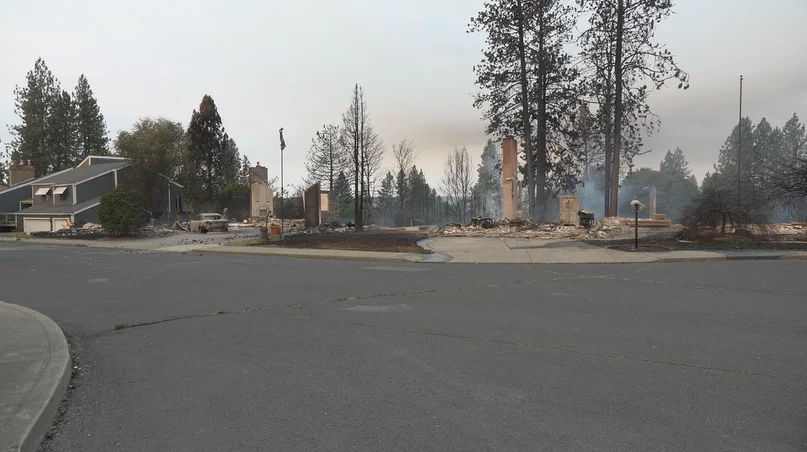
Spokane Complex Fire Forces Mass Evacuations, Destroys Hundreds of Structures
Wildfires raging across Spokane and Stevens counties in Washington state have forced roughly 60,000 people to evacuate and destroyed or damaged at least 700 structures, officials said Tuesday. The Spokane Complex Fire—comprising the Old Trails, Fairview, and Autumn Lane fires—has scorched more than 10,280 acres and remains 0% contained, according to the latest update from the Spokane County Sheriff's Office.
Cooler temperatures and increased humidity have given firefighters a slight edge this week, but the blazes, which ignited Saturday, continue to threaten densely populated neighborhoods. The destruction has drawn direct comparisons to California's catastrophic Palisades and Eaton fires of January 2025, with officials warning that the scale of residential damage is alarmingly similar.
"What we're hearing ... at scale, is this is at the same level of an Altadena Eaton Fire or a Palisades sort of event," said Benjamin Cossel, a spokesperson for the California Interagency Incident Management Team 7, which is assisting local crews. "We know we have more than 600 structures that have been destroyed, and we're very certain that that number will increase as firefighters are able to get into areas they couldn't before."
Key Numbers and Current Status
As of Tuesday, the three fires making up the complex stand at:
- Old Trails Fire: 3,619 acres burned, with 640 structures destroyed (as of Monday)
- Fairview Fire: 1,056 acres burned
- Autumn Lane Fire: 3,351 acres burned
No injuries have been reported, but authorities have cleared more than 200 missing person reports, with about a dozen still pending. The Spokane County Sheriff's Office said crews are methodically checking every reported missing person, prioritizing the most vulnerable residents.
Washington Governor Bob Ferguson declared a statewide emergency Saturday and issued a ban on most outdoor and agricultural burning. He spoke with President Donald Trump, who "expressed his support for what the people are going through," according to Ferguson. Washington Public Lands Commissioner Dave Upthegrove called the Pacific Northwest's current fire season "extraordinary," with thousands of personnel deployed statewide.
Why This Fire Is Different: A Suburban Crisis
Unlike remote forest fires that burn through wilderness, the Spokane Complex Fire has pushed directly into populated neighborhoods, consuming homes, businesses, and schools in a matter of hours. The blazes began Saturday amid a "historic weather event," as described by Senator Maria Cantwell, with north-northwest winds up to 35 mph and extremely dry conditions fueling rapid spread.
Spokane Mayor Lisa Brown called the fires "really the worst natural disaster our region has faced." Evacuees face an uncertain return: Brown said it "could be a week, could be weeks" before most residents can go home. The destruction is widespread, and officials have not yet determined how many of the damaged or destroyed structures are homes, businesses, or schools.
The fires have ignited during what federal and state agencies describe as an "extraordinary fire season" across the Pacific Northwest. Climate scientists point to a decade-long trend of hotter, drier summers that have extended fire seasons and made fires more intense. The fact that these blazes are occurring in a suburban setting—not just in remote forests—marks a new and dangerous pattern.
Evacuation Chaos and Community Response
The scale of the evacuation—65,000 within Spokane city limits alone, according to Monday's figures—has overwhelmed local shelters and road networks. Residents have been seen fleeing with pets, essential documents, and little else. The American Red Cross has opened multiple shelters, but many evacuees have been forced to stay with relatives or in hotels as far as 50 miles away.
Local businesses have stepped up, offering free meals and supplies to displaced families. Neighbors are using social media to check on one another, creating impromptu networks to reunite separated families and pets. But the emotional toll is heavy, as many residents watched their lifelong possessions go up in smoke from a safe distance.
The Old Trails Fire, which has caused the most structural damage, is believed to have started along a major transportation corridor, possibly from a vehicle or power line. Investigators are still determining the exact cause, but the rapid spread was exacerbated by gusty winds and tinder-dry vegetation that has not seen meaningful rain in weeks.
Comparing to Palisades and Eaton: The New Reality of Urban Wildfires
The comparison to the Palisades and Eaton fires is not hyperbole. The Palisades fire, which ignited in Pacific Palisades on January 7, 2025, burned 23,448 acres, destroyed 6,845 structures, and killed 12 people. While the Spokane Complex Fire is far smaller in acreage—10,280 acres—the destruction of over 700 structures in a compact urban area is proportionally similar.
Fire officials note that the Spokane area's layout, with homes nestled against wooded hillsides and open grasslands, makes it highly vulnerable to fast-moving fires. "This is the new reality for many Western communities," said Dr. Karenna Miller, a wildfire risk researcher at the University of Washington. "Development has pushed into the wildland-urban interface, and climate change is making fires burn hotter and faster."
The fire's status as the "top fire in the nation," as Senator Cantwell called it, highlights how quickly it overtook other blazes in the region. Federal incident management teams have taken over coordination, bringing in resources from as far as California. The California Interagency Incident Management Team 7, which has extensive experience with urban fires, is leading the response.
Federal and State Response
Governor Ferguson has requested an immediate FEMA declaration, which would unlock federal funds for firefighting and recovery. The statewide burn ban, which prohibits most outdoor and agricultural burning, is intended to prevent new ignitions while crews battle the existing fires.
President Trump's phone call to Governor Ferguson, while brief, signaled federal awareness of the disaster. Ferguson said the president "expressed his support for what the people are going through." However, no formal federal emergency declaration has been made yet, which would authorize direct federal aid for affected residents.
Meanwhile, local law enforcement has set up roadblocks to keep evacuated areas secure, preventing looting and ensuring only authorized personnel enter. The Spokane County Sheriff's Office has reported no serious incidents of civil unrest, but warns that the evacuation zone is dangerous due to downed power lines, gas leaks, and unstable structures.
Outlook: Cooler Weather Brings Hope, But Challenges Remain
Firefighters are optimistic that cooler temperatures and increased humidity will allow them to make "significant gains" in the coming days, as stated in Monday's news conference. The National Weather Service has forecasted a shift in weather patterns that could bring lighter winds and lower temperatures, aiding containment efforts.
However, containment remains at 0%, and officials caution that any change in wind direction could reignite fires or push them toward new areas. The fires have already burned through significant swaths of land, and the sheer complexity of the urban landscape—with its mix of homes, businesses, and vegetation—makes suppression difficult.
"We're not out of the woods yet," said Chief Cody Rohrbach of Spokane County Fire District 3. "The weather helps, but these fires are deeply entrenched. We need several days of favorable conditions to get a handle on this."
For the 60,000 evacuees, the wait is agonizing. Many have no idea if their homes survive. The city has set up a damage assessment hotline, but officials say it will be days before individual addresses can be checked. Insurance companies have set up mobile claims centers in parking lots, anticipating an avalanche of claims.
A Changing Landscape: What This Means for the Pacific Northwest
The Spokane Complex Fire is a stark reminder that wildfires are no longer confined to the rural West. As development expands into fire-prone areas, the risk of catastrophic urban fires grows. Washington state, which has seen several major fires in the past decade, is now facing what experts call a "new normal" of year-round fire danger.
The fires have also highlighted the need for better land-use planning, fire-resistant building codes, and more robust evacuation infrastructure. In the aftermath, there will likely be calls for increased funding for fire departments, expanded use of prescribed burns to reduce fuel loads, and a rethinking of how communities are built in the wildland-urban interface.
For now, the focus is on containing the fire and helping those displaced. The Red Cross has set up a donation portal, and local food banks are accepting supplies. Thousands of firefighters from across the country are expected to rotate in over the next week, bringing fresh forces to the front lines.
The coming days will be critical. If the weather holds, firefighters may be able to contain the blazes within a week. But even then, the road to recovery will be long. Rebuilding hundreds of homes, restoring infrastructure, and healing the psychological scars of a community uprooted in a single day is a process that takes years.
As Mayor Brown said, "This is a disaster that will define our region for a generation. We will get through it, but we will never be the same."
For broader context on how extreme weather events are becoming more frequent, see our coverage of UK 35C Forecast: Fifth Heatwave to Hit 11 Counties in August.
While sports may seem unrelated, the resilience of communities in times of crisis is mirrored in sports. Read how Tiafoe Aims to End Cilic Jinx at National Bank Open to see how athletes push through adversity.
Comments