
Michigan Ballot 2026: Voters Decide Key Senate, Governor Races as Early Turnout Surges
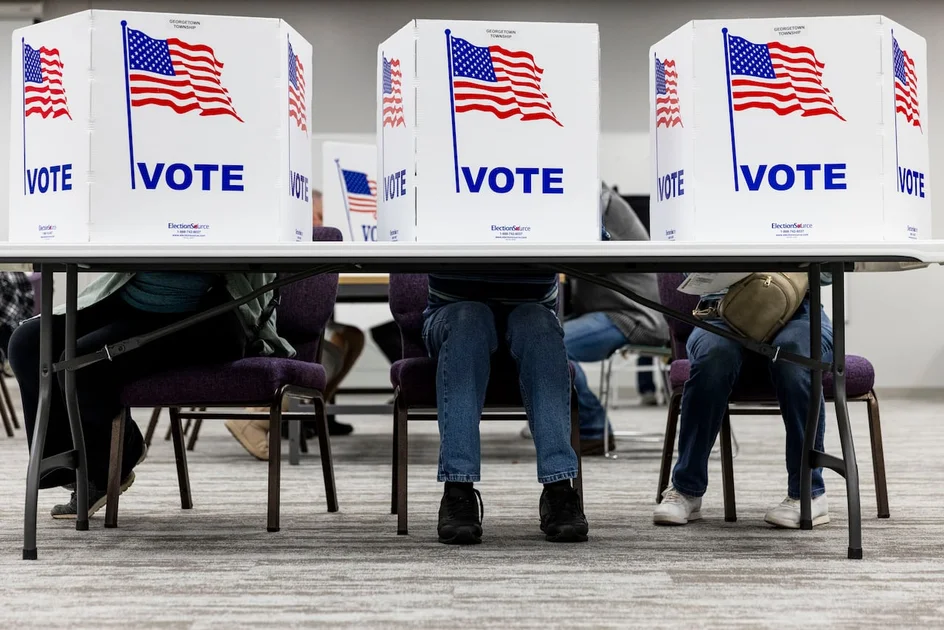
Michigan voters are casting ballots Tuesday in a midterm election that will determine control of the U.S. Senate, the governor's mansion, and a slate of down-ballot contests, with early voting already surpassing 2022 levels and both parties pouring resources into the battleground state.
Polls opened at 7 a.m. and close at 8 p.m. local time. As of Tuesday morning, more than 2.35 million mail-in and early in-person ballots had been cast, representing 28% of Michigan's 8.37 million registered voters, according to NBC News' Decision Desk. That figure already exceeds the final early-vote total from the 2022 midterms, a sign of heightened engagement in a state that has become a focal point of national political attention.
Key Races at the Top of the Ticket
The marquee contest is the U.S. Senate race between Democrat Abdul El-Sayed, a former Detroit health director, and Republican Mike Rogers, a former congressman. The race is rated Lean Democratic by NBC News and is critical to control of the chamber, where Democrats currently hold 34 seats and Republicans 31, with 50 seats needed to tie. The outcome could determine whether Democrats defend their narrow Senate majority or Republicans seize control.
In the governor's race, Democrat Jocelyn Benson, Michigan's secretary of state, faces Republican John James, a businessman and former Senate candidate. The contest is also rated Lean Democratic. Benson has emphasized her record on election administration and voting rights, while James has focused on economic issues and crime.
Other statewide races include secretary of state, where the candidates were not fully listed in early returns, and a series of U.S. House contests across Michigan's 13 congressional districts. Key battlegrounds include District 4, rated a toss-up between Democrat Sean McCann and Republican Bill Huizenga; District 7, Lean Democratic with William Lawrence facing Tom Barrett; and District 10, Lean Democratic with Christina Hines against Michael Bouchard. Democrats need a net gain of 218 seats to win a House majority, though no votes had been reported in those races as of early Tuesday.
Early Voting Surge and Party Dynamics
The early-vote numbers tell a nuanced story. According to NBC News, 51% of early voters are registered Democrats, 39% are Republicans, and 10% are other. Mail-in ballots requested followed a similar pattern: 52% Democrats, 37% Republicans, and 11% other. However, an analysis by On Point Politics, which models party affiliation where the state does not report it, shows Democrats leading the early vote by 33.7 percentage points—slightly above expectations but not necessarily decisive.
"No clear signal in the Michigan Senate race," the On Point analysis concluded, noting that the early-vote lead is within the range that could be offset by Election Day turnout. The tracker shows 1.63 million ballots cast as of Tuesday morning, with a pace 9.5% below 2022 levels—a discrepancy that may reflect differing reporting methods or the growing share of mail ballots counted later. Michigan does not publish the party of its early voters, so all party breakdowns are modeled.
The NBC data also shows that early voters are highly engaged: 84% of Democratic early voters participated in both the 2022 and 2024 elections, compared with 82% of Republicans. New voters make up only 4% of both groups, suggesting that the early electorate is largely composed of habitual voters rather than a wave of newcomers.
Detroit Sets Opening-Day Record
In Detroit, City Clerk Janice M. Winfrey announced that 2,305 residents voted across the city's eight early voting centers on the first day of early voting, setting a new opening-day record. The total surpassed the 1,897 ballots cast on the first day of early voting for the November 2024 presidential election—a notable feat given that midterm turnout typically lags presidential years.
The high early turnout in Detroit, a Democratic stronghold, could be a positive sign for El-Sayed and other Democrats, but it also raises questions about whether the party can sustain that enthusiasm through Election Day. Republicans have historically outperformed on Election Day itself, and the early-vote lead may narrow as in-person votes are counted.
The Stakes: Senate Control and Beyond
Michigan is one of a handful of states—along with Arizona, Georgia, Iowa, Nevada, Ohio, Pennsylvania, and Wisconsin—where polls close Tuesday and where Senate and gubernatorial races are expected to be competitive. The state's outcome will have national implications, particularly for the Senate, where Democrats are defending a slim majority.
The Senate race has been marked by a surprise endorsement: Democratic Congresswoman Haley Stevens, who previously ran for the Senate herself, endorsed Republican Mike Rogers, according to Fox 2 Detroit. The move stunned political observers and highlighted intraparty tensions among Democrats. Stevens' endorsement came as El-Sayed faced scrutiny over his past statements and policy positions, and some Democrats fear it could depress turnout among moderate voters.
On the Republican side, Rogers has sought to tie El-Sayed to national Democrats and portray him as too liberal for Michigan. El-Sayed, a progressive who ran for governor in 2018, has focused on economic populism and health care. The race has drawn national money and attention, with both parties viewing it as a must-win.
The governor's race, while rated Lean Democratic, has also drawn significant attention. Benson, who oversaw Michigan's 2020 and 2024 elections, is a prominent defender of voting rights and has been a target of Republican criticism over election administration. James, who lost a Senate bid in 2020 and a gubernatorial bid in 2022, is making his third statewide run. His campaign has emphasized small-business issues and public safety.
Ballot Proposals and Local Races
Beyond the top of the ticket, Michigan voters are deciding on several ballot questions, including funding for the Detroit Zoo and museums, according to Fox 2 Detroit. Oakland County voters will also weigh in on local proposals. These measures, while lower-profile, could have significant fiscal implications for cultural institutions and local governments.
In the U.S. House races, incumbents in several districts are seeking reelection. In District 1, Republican Jack Bergman faces Democrat Callie Barr; in District 2, Republican John Moolenaar faces Democrat Ben Ambrose; in District 3, Democrat Hillary Scholten faces Republican Terri DeBoer; in District 5, Republican Tim Walberg faces Democrat Christian Vukasovich; in District 6, Democrat Debbie Dingell faces Republican Heather Smiley; in District 8, Democrat Kristen McDonald Rivet faces Republican Thomas Smith; and in District 9, Republican Lisa McClain faces Democrat Ray Pooley. Results were not yet available early Tuesday.
Perspective: A Bellwether for 2028?
Michigan's 2026 midterms are being watched far beyond the state's borders. As a perennial swing state that flipped from Donald Trump in 2016 to Joe Biden in 2020 and back to Trump in 2024, Michigan often serves as a bellwether for national political trends. The outcome of Tuesday's elections could signal how voters are responding to the new administration and set the stage for the 2028 presidential race.
The early-vote surge, while encouraging for Democrats, is not a guarantee of victory. In 2022, Democrats outperformed expectations in Michigan and nationally, holding the Senate and minimizing House losses. But 2026 is a different political environment, with a Republican president in the White House and midterm dynamics historically favoring the party out of power—in this case, Democrats.
The Senate race, in particular, could hinge on turnout in Detroit and its suburbs, where Democrats need overwhelming margins to offset Republican strength in rural and exurban areas. El-Sayed's progressive base may energize young and minority voters, but Stevens' endorsement of Rogers suggests that some moderate Democrats may defect or stay home.
For Republicans, the path to victory runs through turning out their base in western and northern Michigan and cutting into Democratic margins in the suburbs. Rogers, a former FBI agent and congressman, has positioned himself as a moderate problem-solver, but his ties to Trump and national Republicans may complicate that pitch.
As polls close Tuesday night, all eyes will be on Michigan—not just for the results, but for what they reveal about the direction of American politics in the post-2024 era. With control of the Senate and governor's mansion at stake, the state's voters are poised to play a decisive role in shaping the national agenda.
For those following the broader midterm landscape, our US Midterm Elections 2026 coverage provides a national overview of the key races and themes shaping this election cycle.
Comments