
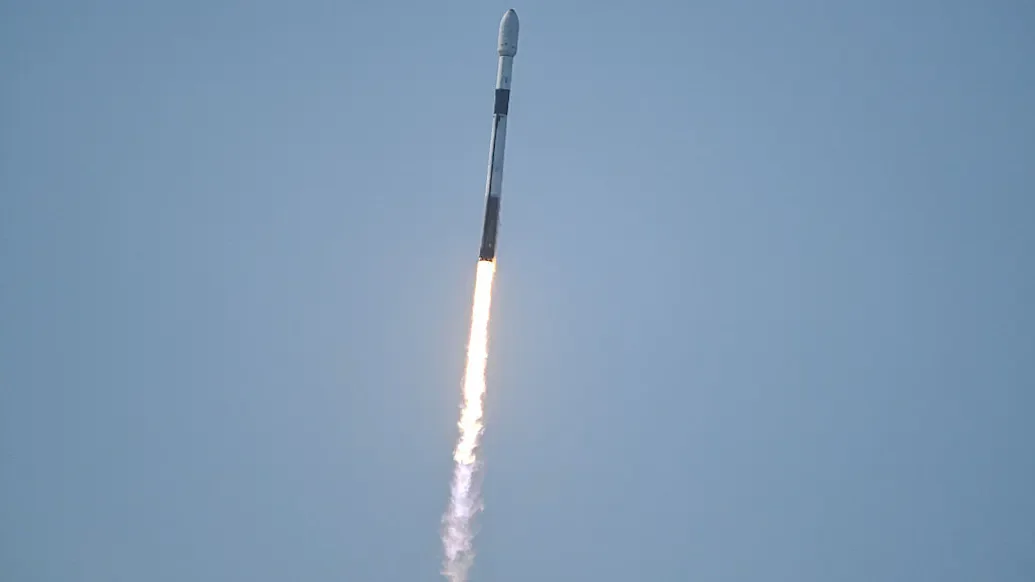
A Four-Ton Falcon 9 Stage Is on a Collision Course With the Moon
An uncontrolled piece of a SpaceX Falcon 9 rocket is set to slam into the Moon on Wednesday, August 5, 2026, at approximately 6:35 a.m. UTC (2:35 a.m. EDT). The four-ton upper stage, which has been drifting in space for over a year, will hit the lunar surface at a velocity of about 5,400 miles per hour (8,690 km/h) — nearly seven times the speed of sound. The impact will occur near the Einstein Crater on the western limb of the Moon's near side, an area that is often difficult to observe from Earth.
NASA has confirmed that the collision poses no danger to Earth, but it will leave behind a crater estimated to be up to 60 feet (18 meters) wide and 12 feet (4 meters) deep. The impact will also eject a plume of lunar dust and rock that, while not visible to the naked eye, may be detectable through sensitive telescopes for several minutes. The energy released is expected to be equivalent to about three tons of TNT, a purely kinetic event with no explosive charge.
The rocket stage is the second stage of a Falcon 9 that launched on January 15, 2025, carrying two private lunar landers: Firefly Aerospace's Blue Ghost and ispace's Resilience. Both landers successfully reached the Moon, but the spent upper stage remained in a chaotic orbit after exhausting its fuel. Since then, it has been tumbling under the gravitational influence of Earth, the Moon, and the Sun, until astronomers determined earlier this year that its trajectory ends in a direct lunar collision.
How the Unintentional Impact Was Predicted
Bill Gray, creator of the Project Pluto software used to track near-Earth objects and artificial satellites, was the first to calculate the impending crash. His analysis, later refined by NASA and other observatories, confirmed that the rocket body would hit the Moon's surface rather than pass by or burn up in Earth's atmosphere. The prediction was accurate enough that the impact time is now known within minutes, and scientists are preparing to observe the event from multiple platforms.
Why This Matters: A Growing Problem of Space Junk Around the Moon
The Falcon 9's collision is not an isolated incident. In March 2022, a Chinese Long March 3C rocket stage also struck the Moon accidentally, leaving a crater 29 meters wide. As lunar exploration accelerates, such impacts are expected to become more frequent. Several countries and private companies are planning uncrewed and crewed missions to the Moon in the coming decade, including NASA's Artemis program, which aims to establish a sustained human presence. The crash underscores a critical challenge: how to track and manage space debris in the cislunar region, a volume of space that is vastly larger and more complex than low Earth orbit.
Unlike satellites in low Earth orbit, which are routinely de-orbited to burn up in the atmosphere, rocket stages used for lunar missions often end up in highly elliptical orbits that can cross the Moon's path. With no atmosphere to slow them down, these objects either crash into the lunar surface or become long-term debris that active spacecraft must avoid. The Falcon 9 stage is just one of thousands of pieces of space junk in Earth's vicinity, but it is among the few known to be on a lunar impact trajectory.
A Rare Scientific Opportunity
While the crash is unintentional, it offers a unique research opportunity. NASA's Jimi Russell said the agency plans to collect lunar data from the event, including imaging the impact site before and after the collision. This data will help scientists better understand artificial impacts and their implications for future lunar infrastructure. The impact could also be used to test seismometers and to calibrate models of how high-speed objects interact with the lunar regolith. A preprint study released last month, co-authored by Bill Gray and others, highlighted the event as a chance to "test pipelines for measuring flash properties to locate impact events seismically, and to better understand the multi-modal hazards posed to future lunar infrastructure and astronauts from space debris impacting the Moon."
The impact flash itself is expected to last less than one second and may be relatively faint, because the rocket will strike an illuminated part of the Moon, where reflected sunlight can wash out the brief glow. Nevertheless, observers in the Americas, where the Moon will be well placed, may be able to spot the debris plume through a good telescope for a few minutes. For most viewers, however, the event will be invisible without professional equipment.
A Warning for Future Moon Bases
The Falcon 9 crash serves as a stark reminder that the Moon is not a passive, empty landscape. As nations and private companies race to build lunar bases — the United States with Artemis, China with its International Lunar Research Station — the risk of accidental impacts increases. A rocket stage hitting the surface near a habitat or a science outpost could be catastrophic. The impact energy of this collision, equivalent to three tons of TNT, is comparable to a large conventional bomb. A similar strike on a pressurized module would be devastating.
Building a lunar base is a multi-decade endeavor. NASA's first Artemis crewed landing is expected within the next few years, and the agency plans to construct habitats and research facilities thereafter. China has similarly announced a timeline for a permanent lunar outpost by the 2030s. These projects will require a shift from tracking debris primarily in low Earth orbit to monitoring the cislunar environment. Currently, there is no comprehensive system for cataloging objects in lunar orbit or on trajectories that intersect the Moon. The Falcon 9 impact is a wake-up call that such a system is urgently needed.
A History of Unintentional Lunar Impacts
This is not the first time a rocket part has met the Moon accidentally. In March 2022, a Chinese Long March 3C rocket’s upper stage crashed into the lunar far side, creating a crater about 29 meters wide. That impact was also predicted by astronomers, but at the time there was no international coordination to study it. The Falcon 9 event is different: NASA and other scientific bodies are proactively planning to observe the aftermath, which could provide a baseline for future studies. The added attention also reflects the growing public interest in lunar activities, as evidenced by the extensive media coverage of this week's event.
The Broader Implications: Regulating Lunar Space Traffic
As the number of missions to the Moon grows, so does the need for international rules on how to handle spent rocket stages and other debris. Currently, there are no binding regulations requiring agencies or companies to dispose of lunar-bound rocket stages in a safe manner. Most stages are left adrift, relying on random gravitational perturbations to eventually send them into the Sun or eject them from the system, but not always. The Falcon 9’s upper stage was never designed to return to Earth or enter a stable lunar orbit; it was simply abandoned after releasing its payload. This is standard practice for many missions, but as lunar traffic increases, such negligence becomes less acceptable.
The scientific community is calling for better tracking and, ideally, for future missions to intentionally de-orbit their upper stages into the Moon or into heliocentric orbits to avoid unintended collisions. The Falcon 9 crash could serve as a catalyst for new policies. For instance, the Artemis Accords, a set of principles for lunar exploration, include provisions for orbital debris mitigation, but they are not legally binding. A more robust framework, perhaps under the United Nations, would be needed to mandate safe disposal.
In the meantime, astronomers like Bill Gray continue to monitor the skies, often serving as de facto traffic cops for space junk. Gray's Project Pluto tools are used by researchers worldwide to track near-Earth objects and artificial satellites. The discovery of the Falcon 9 impact trajectory was a collaborative effort, highlighting the importance of open data and citizen science in space situational awareness.
For the general public, the crash is a spectacular reminder of the risks and realities of space exploration. It also offers a moment to reflect on the growing human footprint beyond Earth. As one expert noted, "These sorts of things are going to happen more and more often. And as we have more astronauts on the lunar surface, more lunar infrastructure habitats, we need to understand how impacts affect them." The crater left by the Falcon 9 will remain on the Moon for millions of years, a permanent mark of human activity — and a warning that our reach into the cosmos carries responsibilities we are only beginning to grasp.
What to Watch Next
The impact is scheduled for Wednesday morning UTC. NASA will attempt to image the site with its Lunar Reconnaissance Orbiter (LRO) before and after the crash, and may release before-and-after pictures to the public. Amateur astronomers with high-end equipment may capture the debris plume, and several observatories are planning to monitor the impact flash. Scientists will also use the event to test new tracking techniques, potentially improving our ability to predict future collisions.
As lunar exploration accelerates, the Falcon 9 crash will likely be cited in policy discussions about debris mitigation. It is a rare instance where a dangerous event is also a scientific gift, and the data collected could inform the next decade of lunar development. For now, the Moon gains another scar, and humanity gains a reminder that we are becoming a multi-world species — with all the mess that entails.
If you're interested in other current events, you might check our coverage of the Spokane wildfires or the latest in sports.
Comments