
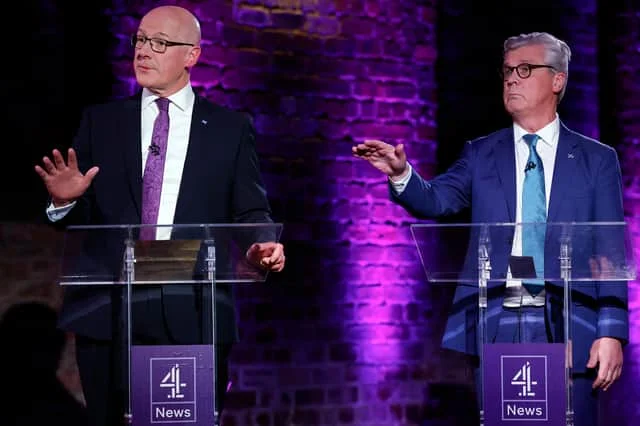
SNP Still Ahead But Majority Dreams Fade as Reform UK and Labour Battle for Second
With less than 24 hours until polling stations open across Scotland, the final Ipsos poll for STV News reveals a Scottish Parliament election that is anything but settled. The SNP remains the frontrunner, holding 35% of the constituency vote and 26% on the regional list, but its lead has narrowed significantly since the campaign began. The party's constituency vote share has slipped by four points compared to late March, while its regional list vote has dropped by three points — a trajectory that makes an outright majority look increasingly unlikely.
The real drama, however, is unfolding behind the Scottish National Party. The race for second place on the constituency ballot is now a statistical dead heat. Labour holds 20% of the vote, just two points ahead of Reform UK on 18%. For a party that did not exist in its current form at the last Holyrood election, Reform UK's surge represents a seismic shift in Scottish politics. The Conservatives, who secured second place in 2021, have slumped to 11%, tied with the Liberal Democrats.
On the regional list vote — the ballot used to top up constituency results and ensure proportional representation — Reform UK is in outright second place with 18%, narrowly ahead of the Scottish Greens on 17%. Labour trails in fourth with 15%, while the Conservatives languish in sixth position, behind the Liberal Democrats on 11%.
One in four voters say they may still change their mind before casting their ballot, according to the Ipsos survey conducted between late April and early May. That leaves an unusual degree of uncertainty hanging over Thursday's result. Turnout may also prove decisive, particularly for the Greens, whose support skews younger and is therefore more susceptible to non-voting.
The Strictly Come Dancing 2026 Lineup might dominate headlines in the entertainment world, but in Scottish politics all eyes are on whether the anti-immigration, anti-establishment message of Reform UK can translate into a parliamentary breakthrough that reshapes Holyrood's balance of power for years to come.
The Stakes: Holyrood's Agenda Hangs in the Balance
This election will determine who controls the Scottish Parliament for the next five years — and with it, the direction of health, education, policing, transport, and a significant portion of tax and welfare policy. While the SNP has been in government since 2007, the make-up of the parliament has rarely been so fragmented.
A strong SNP showing could allow First Minister John Swinney to continue pursuing his agenda: expanded childcare, caps on essential food prices in supermarkets, and continued efforts to tackle the cost of living crisis. But a weakened performance would leave the SNP dependent on the Greens or other parties to pass legislation, while a surge by Reform UK or a strong Labour showing could produce an opposition bloc that shifts the parliament's centre of gravity to the right for the first time in nearly two decades.
The polls suggest that no single party is on course to win the 65 seats needed for an outright majority. The SNP's vote share, though still the largest, is significantly below the 48% of the constituency vote and 40% of the regional list vote it won in 2021. The party's path to forming a government — whether a minority administration or a coalition — may depend on whether the Greens retain enough list seats to serve as potential partners.
Immigration has emerged as a dominant theme of the campaign, despite it being a reserved matter for Westminster. Reform UK's core message — "stop the boats", "secure and defend our borders", and "deport illegal migrants" — has resonated with a portion of the electorate that feels left behind by the political establishment. The party's Scottish leader, Malcolm Offord, has campaigned alongside Nigel Farage, and the party's presence on the regional list could deliver it a meaningful number of MSPs.
Scottish Labour leader Anas Sarwar has sought to position his party as the main challenger to the SNP, urging voters to "reject Reform, beat the SNP, change Scotland and vote Labour." But the polling suggests Labour is struggling to break through in a crowded field, particularly on the regional list where it trails both Reform UK and the Greens. The Conservatives, led by Russell Findlay, have urged pro-UK voters to use their regional ballot as a "secret weapon" to stop the SNP winning a majority, but the party's vote share has collapsed compared to 2021.
The Campaign's Final Day: Leaders Make Last Pleas
Wednesday marked the last day of campaigning, with party leaders criss-crossing the country in a final push to mobilize supporters and sway the undecided.
John Swinney focused his energy on the central belt, making stops in Hamilton, Glasgow, and Edinburgh. The SNP leader highlighted his party's record on public finances and its plans to tackle the cost of living crisis, while acknowledging that the campaign had been tough. "This shows I'm down with the kids," he joked when asked about his playlist, referencing Kendrick Lamar.
Anas Sarwar held his final rally in Glasgow, delivering an impassioned plea for tactical voting. "The choice is clear: you can vote for a party that will divide our communities, or you can vote for a Labour government that will deliver change," he told supporters.
Scottish Greens co-leader Ross Greer campaigned in Glasgow, framing a vote for his party as a "vote for hope" and a way to "keep Reform out of Holyrood." The Greens are standing candidates in only six constituencies but are expected to pick up a significant number of list seats if their voters turn out.
Alex Cole-Hamilton, the Scottish Liberal Democrat leader, appeared at an orchard in Edinburgh wearing a peach suit — a visual pun aimed at voters on the peach-coloured regional ballot paper. He predicted his party would return MSPs in double figures.
Russell Findlay, the Conservative leader, also campaigned in Edinburgh, urging voters to back his party on the regional list as the most effective way to deny the SNP a majority.
Reform UK's Thomas Kerr, standing in Glasgow, predicted the party would create "political shockwaves," declaring that "time is up for the more established parties."
The BBC's live coverage noted that many voters remain frustrated and disengaged, with some activists describing the campaign as having felt like "a six-week stag do without the alcohol." The challenge for all parties on Thursday will be turning intention into action.
The Immigration Debate: A Toxic Turn?
Perhaps the most striking feature of this election campaign has been the centrality of immigration to political debate. For decades, Scotland's political establishment — particularly the SNP — has positioned the country as a welcoming place for migrants, motivated by both progressive values and economic necessity.
As Jasmeen Kanwal wrote in The Guardian, Scotland's ageing and shrinking workforce means the country "desperately needs immigrants for its social security system to function." A 2025 report from the Improvement Service projected that population decline would hit Scotland harder than the rest of the UK, with lower birthrates compounding the problem. The report recommended creative local initiatives to attract and retain migrants, especially given Westminster's "hostile environment" policies.
During the SNP's long tenure, first under Alex Salmond and then Nicola Sturgeon, the Scottish government actively sought to differentiate itself from Westminster on immigration. Sturgeon's letter to EU citizens after the Brexit referendum, telling them they were "welcome here," became a symbol of that approach.
But Reform UK's rise has changed the conversation. The party's strong polling has forced other parties to respond. Labour, at Westminster, has adopted an increasingly hard line on immigration, and in Scotland, Anas Sarwar has been careful not to cede ground to Reform on border security. The SNP, while still rhetorically pro-immigration, has been quieter on the issue during this campaign than in previous years.
Kanwal argued that "Reform's toxic thinking has infected Scottish politics," warning that if the party's narrative is adopted by the mainstream, it "would be disastrous for Scotland." The election result on Thursday will provide the first real measure of how deeply that infection has taken hold.
What Happens Next: Coalition Scenarios and the Path to Government
With the polls showing no party on course for a majority, the days after the vote are likely to be dominated by negotiations. Under Scotland's additional member system, the 73 constituency seats are supplemented by 56 regional list seats, making it difficult for any single party to reach the 65-seat threshold.
If the SNP wins the most seats, as seems likely, John Swinney would be given the first opportunity to form a government. A minority SNP administration is the most probable outcome, potentially relying on ad hoc support from the Greens or Liberal Democrats on a vote-by-vote basis. A formal coalition with the Greens is possible but would require policy compromises on both sides.
Should Reform UK win more than a handful of list seats — a distinct possibility given its 18% on the regional poll — it would become a significant opposition force, potentially displacing the Conservatives as the main unionist voice in the chamber. The exact distribution of seats will depend on how votes translate into seats across Scotland's eight electoral regions, and the final count may not be known until late on Friday.
The wider implication is clear: Scottish politics is fragmenting. The SNP's dominance, which has defined the Holyrood era since 2007, is being eroded from multiple directions — by Labour on the centre-left, by Reform on the right, and by the Greens on the left. The result on May 7 will not only determine who governs Scotland for the next five years but also signal whether the country is moving toward a more volatile, multi-party future.
As voters prepare to cast their ballots, the only certainty is uncertainty. The polls close at 10 p.m. on Thursday, and the counting begins immediately. By Friday morning, Scotland will have a clearer picture of its political future — and the rest of the UK will be watching closely.
For readers following other major news, the Nationwide Fairer Share Payment 2026 continues to generate interest among consumers, while the Postcode Lottery Winners Revealed for April 2026 offers a lighter counterpoint to the political drama unfolding in Scotland.
Comments