
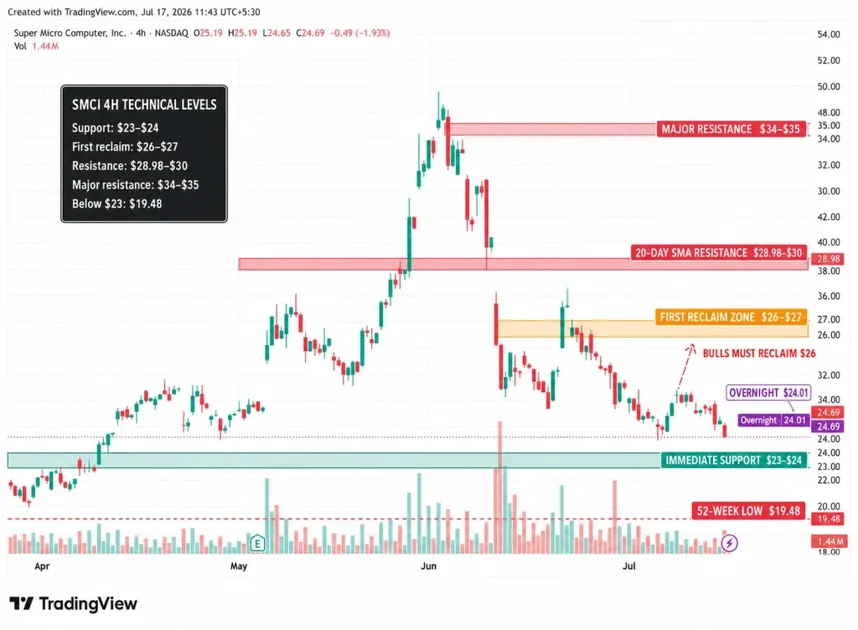
Super Micro Shares Slide as AI Stocks Retreat
Super Micro Computer (NASDAQ: SMCI) shares plummeted 9.1% in afternoon trading on Friday, Nov. 20, 2026, as a wave of negative sentiment swept through AI-linked stocks. The drop came as Anthropic slid more than 10% following its debut, failing to revive confidence in the sector's spending boom. Investors had hoped Anthropic's record $81.3 billion IPO and Nvidia's quarterly earnings beat under interim CEO Colette Kress would steady sentiment following Jensen Huang's resignation, but those hopes faded quickly.
The selloff was compounded by broader market jitters. Federal Reserve Governor Lisa Cook warned against delaying rate hikes ahead of an expected December increase, while President Donald Trump threatened penalties on overseas U.S. data-center builds. New Commerce Department export-licensing rules also weighed on chipmakers. The tech-heavy Nasdaq fell 5.28% on the day, with hardware and infrastructure names among the hardest hit: IonQ dropped 8.3%, Hewlett Packard Enterprise lost 9.4%, and Everpure fell 12.9%. Super Micro's decline was part of this sector-wide rout, but the company also faces company-specific headwinds that have amplified its losses.
A Stock Under Pressure
SMCI has shed roughly 34% over the past 90 days and approximately 25% over the trailing 30-day period, according to a valuation analysis published by the Foreign Policy Journal. The article noted that legal scrutiny and a Justice Department probe continue to suppress investor confidence. At $24.14, the stock trades far below its recent highs, though one community valuation model places fair value at $55.85, more than double the current price. The model incorporates deliberately conservative assumptions, including an 11.4% weighted average cost of capital and a 48% peak-to-trough collapse in AI capital expenditure, yet still arrives at a target well above the market price.
The Smuggling Scandal and Executive Turnover
Behind the recent stock weakness lies a sprawling $2.5 billion China smuggling case that has entangled Super Micro's leadership. In March 2026, co-founder Yih-Shyan "Wally" Liaw was arrested and indicted alongside two others in a sweeping scheme to divert Nvidia chips to China. Liaw has pleaded not guilty, while one co-defendant, Ting-Wei "Willy" Sun, has pleaded guilty. The scandal has cast a long shadow over the company and raised questions about oversight at the highest levels.
A shareholder lawsuit now alleges that Ying Cenly Chen, a former senior executive at Super Micro, managed a significant portion of the company's Nvidia chip purchases during the period when hardware was allegedly diverted. Chen, who is married to Nvidia's longtime sales chief Ajay "Jay" Puri, left Super Micro in late April to become CEO of ChronoScale, a datacenter developer that relies heavily on Nvidia chips. Chen disputes the lawsuit's account, telling Fortune that controlling customer allocations of Nvidia chips "was not part of my job responsibility" and that she accepted the ChronoScale offer nine days before the Liaw indictment was unsealed. Super Micro also denied that she controlled GPU distribution. The allegations remain unproven, but the timing of her departure and her family ties to Nvidia have drawn intense scrutiny, particularly as investigators examine whether former CEO Jensen Huang knew or turned a blind eye to potential diversions. Huang resigned on Nov. 11.
Earnings Offer a Silver Lining
Despite the legal and reputational turmoil, Super Micro's underlying business showed strength in its fiscal 2027 first quarter, reported on Nov. 3. Management raised its full-year revenue target to a range of $72 billion to $82 billion, about 12% higher than the prior quarter's guidance, citing accelerating server deployment schedules and sustained AI demand. The company also reported a 52-day improvement in its cash conversion cycle, from 149 days to 97 days, representing roughly $10 billion of working capital that would otherwise have been needed. Non-GAAP gross margin expanded 3.3 percentage points year over year to 12.8%, driven by broader adoption of its Data Center Building Block Solutions. CEO Charles Liang noted that demand remains "extremely strong" and highlighted proprietary liquid-cooling integration and domestic manufacturing capacity as structural advantages.
What It Means for Investors
The divergence between Super Micro's operational momentum and its battered stock price illustrates the tension defining the AI hardware trade in late 2026. On one hand, the company is winning orders and improving efficiency; on the other, a trust discount tied to legal risks and the broader pullback in AI names is weighing heavily on sentiment. Bears point to structurally thin margins, customer concentration, and the possibility that a single contract disruption could trigger a disproportionate selloff. Bulls argue that the current price already prices in a worst-case legal outcome, leaving room for multiple expansion if regulatory concerns recede. The stock's wild swings—it gained 7.85% earlier in the week before Friday's drop—underscore how headlines, rather than fundamentals, are currently driving trading. As the Justice Department probe continues and the smuggling case moves through the courts, SMCI is likely to remain volatile, caught between the promise of AI infrastructure demand and the shadow of a scandal that refuses to fade.
Comments