
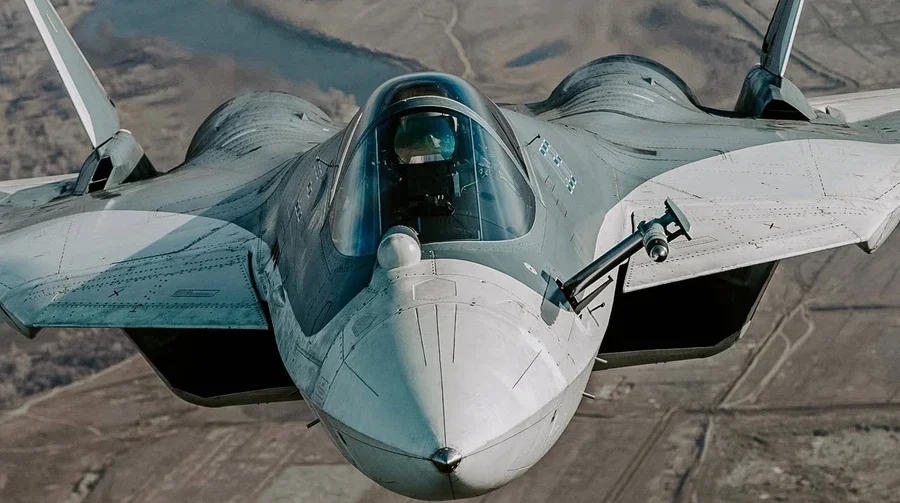
Su-57 Crash Near Moscow: What We Know on July 28
On July 23, 2026, a Russian Su-57 stealth fighter, the country’s most advanced combat aircraft, crashed in the Odintsovo district of Moscow Oblast, approximately 65 kilometers west of the capital. The pilot ejected safely and was not injured, and officials confirmed no casualties on the ground. The aircraft, a twin-engine fifth-generation fighter that officially entered service in 2020, was conducting a training flight near Zvenigorod when it went down around 13:50 local time.
The Russian Ministry of Defense, through state news agency TASS, issued a brief statement confirming the crash of a “combat trainer aircraft” during takeoff, attributing the incident to a preliminary “technical malfunction.” The ministry did not specify the aircraft type in its official communication. However, Russian Telegram channel Mash and local outlet Zven_Info published photos of a fire in a field near homes, identifying the wreckage as a Su-57 Felon.
Conflicting Explanations Emerge
Within hours of the crash, Russian milbloggers and independent sources offered starkly different explanations. While the Defense Ministry cited a technical failure, several influential pro-war bloggers pointed the finger at Russia’s own air defense systems. Romanov, a prominent milblogger, wrote that “a number of questions” should go to the crew of BARS-Moskva, a mobile air-defense group tasked with guarding the capital. Another channel, arrowsmap, suggested the jet was shot down by a shoulder-fired missile from its own air defense network. These claims remain unconfirmed by official sources, but they have fueled intense debate online.
Ukrainian long-range drones were active over Russian territory on the day of the crash, and Russian air defense units were engaging them with a wide range of weapons. This heightened alert status may have increased the risk of friendly fire incidents. Euromaidan Press and other outlets noted that Russian air defenders have been operating under extreme pressure, responding to frequent drone incursions, which could explain a misidentification of the Su-57 as a hostile target.
The Aircraft: Russia’s Premier Stealth Fighter
The Su-57 Felon is Russia’s only operational stealth fighter, designed to rival the American F-22 Raptor and China’s J-20 Mighty Dragon. It features low-observable airframe shaping, internal weapons bays, advanced avionics, and a twin-engine configuration. Production has been slow and plagued by delays. Most estimates place the total number of Su-57s in Russian service at fewer than 50 aircraft, with some sources suggesting as few as 30 operational units. Each loss, therefore, is a significant blow to the Russian Aerospace Forces (VKS).
Why This Loss Matters: The Stakes for Russia
The crash of the Su-57 is not an isolated incident. Russia has suffered a series of aviation losses throughout the war in Ukraine and its broader military operations. According to the open-source intelligence project Oryx, Russia has already lost at least one Su-57 on the ground during a Ukrainian drone strike in 2024. That aircraft was damaged at an airbase and may have been repairable, but the destruction of an operational Su-57 in a crash is a more definitive loss.
Strained Production and Rare Assets
The Su-57 is built by Sukhoi, part of the United Aircraft Corporation, but production lines have operated at low capacity due to sanctions, supply chain disruptions, and technical challenges. The aircraft is still in a developmental stage, with its engine and AESA radar yet to pass full bench testing. The WS-15 engine, intended to provide supercruise capability similar to the F-22, remains in development. As a result, initial production models rely on less powerful AL-41F1 engines. The loss of even a single airframe represents months of production output.
Friendly Fire: A Growing Pattern?
If confirmed, the friendly fire hypothesis would mark a troubling pattern for Russia. Reports from the war in Ukraine have documented numerous cases of Russian air defense systems engaging their own aircraft, including Su-34 and Su-35 fighters, due to poor identification protocols and the chaotic operational environment. The crash of the Su-57 near Moscow, under the watch of the BARS-Moskva group, underscores the risks of operating advanced stealth aircraft alongside dense air defense networks.
The Defense Ministry’s reluctance to release detailed findings or confirm the aircraft type has only deepened skepticism. Some analysts argue that the “technical malfunction” explanation is a standard cover for incidents that might embarrass the military or reveal operational weaknesses. The Su-57’s stealth characteristics were also called into question by the incident. As Global Defense Corp noted, if a Soviet-era Tor-M2 system could down a fifth-generation stealth fighter, it raises doubts about the aircraft’s low-observability claims.
Context: Russia’s Broader Aviation Woes
Since the start of the war in Ukraine in 2022, Russia has faced a steady drain on its tactical aviation fleet. Losses have come from multiple causes: Ukrainian drone strikes on airbases, accidents due to high sortie rates on aging airframes, and air-to-air engagements with Ukrainian F-16 fighters, which occurred as recently as earlier in July 2026. Each loss accelerates the depletion of a force that cannot quickly replace its aircraft.
Comparative Losses and Production Constraints
By mid-2026, the Russian Aerospace Forces have lost an estimated 120 to 150 fixed-wing aircraft of various types. The Su-57, as the most advanced, is the hardest to replace. Russian defense industry sources indicate that Sukhoi produces perhaps two or three Su-57s per year, far below the rate needed to sustain a modern air force. In contrast, China’s Chengdu Aircraft Industry Group has ramped up production of the J-20, with dozens operational and a second production line coming online. The J-20, as described in recent analysis, already fields advanced WS-10C engines and is expected to integrate the WS-15 soon, giving it a clear edge in numbers and capability.
The Su-57 crash also comes amid reports that Russia has been forced to conserve its most advanced aircraft for prestige missions and training, avoiding direct frontline deployment over Ukraine. This strategy has limited combat experience but has not prevented accidents in the rear areas. The July 23 crash is a stark reminder that even rear-area operations carry risk.
Impact on Pilot Training and Morale
The loss of the Su-57 also affects pilot training. With few aircraft available, each sortie flown by a Su-57 is critical for maintaining pilot proficiency in stealth operations, electronic warfare, and beyond-visual-range engagements. The destruction of one of these rare assets forces the VKS to reduce training tempo or risk overtaxing the remaining airframes. The pilot’s safe ejection was a small consolation, but the loss of the airframe sets back the program’s development and operational readiness.
Broader Implications: What This Changes for Air Power
The apparent vulnerability of the Su-57 to friendly fire from older systems like the Tor-M2 raises fundamental questions about the viability of Russia’s stealth program. If air defense networks cannot distinguish their own stealth aircraft from enemy drones, the utility of stealth is negated in contested environments. This is not a problem unique to Russia, but it is exacerbated by the lack of robust Identification Friend or Foe (IFF) integration and the chaotic nature of modern air defense operations.
Lessons for Stealth and Air Defense Integration
Military analysts have long emphasized that stealth aircraft require sophisticated IFF systems and coordinated airspace management to operate safely alongside friendly air defenses. The Su-57 crash suggests that these systems are either not fully implemented or were not functioning on July 23. This has implications for other operators of stealth jets, including the United States and China, who must ensure that their integrated air defense networks can discriminate between friend and foe in real time.
China and the J-20: A Contrast
China’s J-20 program, as detailed in recent guides, has moved steadily toward full operational capability. The J-20 has been deployed in patrol missions over the South China Sea and participated in joint exercises with the Russian Aerospace Forces. Unlike the Su-57’s troubled development, the J-20 has benefited from sustained investment, domestic engine production, and centralized procurement. The gap between Russian and Chinese stealth capabilities is widening, and the Su-57 crash only highlights Moscow’s struggle to field a competitive fifth-generation fighter.
Geopolitical and Strategic Consequences
For Russia, the crash is a public relations setback that undermines the narrative of technological parity with Western and Chinese air power. The Kremlin has marketed the Su-57 as a symbol of Russian military modernization, but incidents like this erode confidence both domestically and among potential export customers. Countries such as India, which considered co-developing the Su-57 as the FGFA, ultimately withdrew due to performance concerns. The recent crash may further discourage foreign interest.
The loss also raises the stakes for Russia’s ongoing conflict with Ukraine. As Ukraine continues to receive advanced Western weapons, including F-16s and long-range strike drones, Russia’s ability to defend its airspace becomes more critical. If friendly fire incidents become more frequent, Russian commanders may be forced to impose stricter no-fly zones over their own territory, limiting their own operations.
The Future of the Su-57 Program
Despite the crash, the Su-57 program is unlikely to be canceled. Russia has invested billions of dollars and decades of research into the aircraft. The Defense Ministry is expected to order a thorough investigation, possibly leading to improvements in IFF systems and pilot training. However, the crash could accelerate the push for the completed WS-15 engine and more advanced sensors, as well as increased production rates—if the industrial base can deliver.
Immediate Aftermath
As of July 28, 2026, no official investigation report has been released. The Russian Defense Ministry continues to cite technical malfunction as the preliminary cause, but independent sources and milbloggers maintain that friendly fire is the more plausible explanation. The crash site has been secured, and wreckage recovery is ongoing. The pilot is reportedly in good condition and undergoing debriefing.
Trends to Watch
- Russia may reposition its air defense units or alter engagement protocols to reduce friendly fire risks.
- The crash could prompt a reassessment of Su-57 deployment strategies, possibly keeping them further from front-line air defenses.
- Export prospects, already limited, may diminish further without clear evidence of reliability and survivability.
- China’s J-20 program, already ahead, may accelerate as Russia’s struggles highlight the challenges of indigenous stealth development.
The Su-57 crash near Moscow on July 23 is more than a single accident—it is a symptom of broader structural weaknesses in Russia’s military aviation. The combination of slow production, incomplete development, friendly fire risks, and the pressures of an ongoing war creates a perfect storm for such losses. Unless fundamental changes are made, the Su-57 will remain a rare and fragile asset rather than the game-changing platform it was meant to be.
Comments