
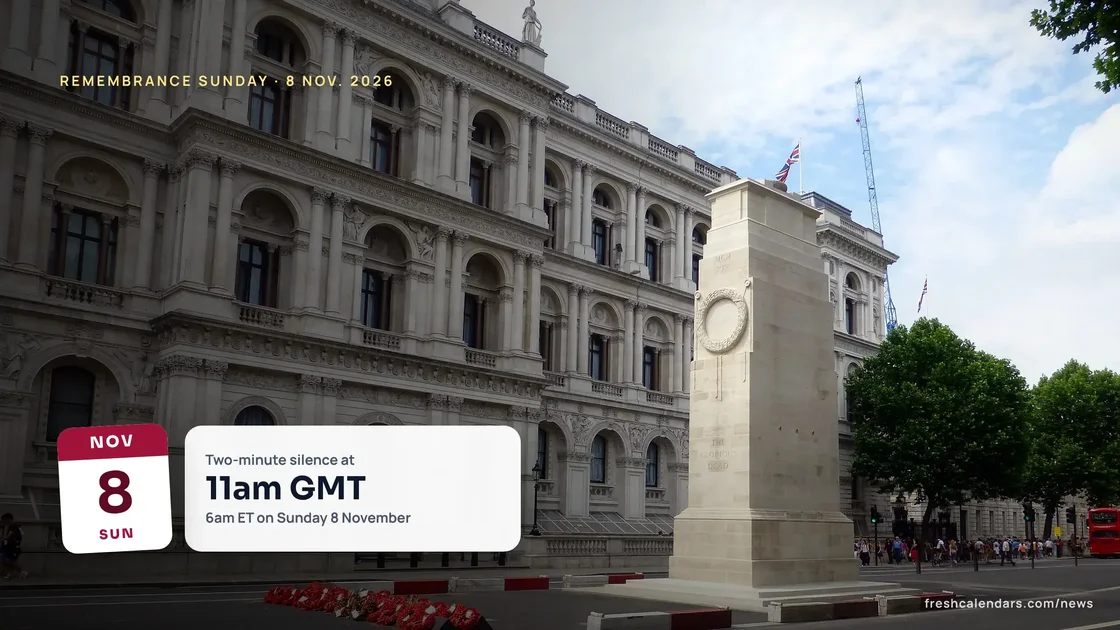
National Service of Remembrance Takes Place at Cenotaph
Remembrance Sunday 2026 is being marked across the United Kingdom today, with the annual National Service of Remembrance at the Cenotaph in Whitehall serving as the focal point of commemorations. The event, held on the second Sunday of November, brings together members of the Royal Family, senior politicians, veterans, and serving military personnel to honor those who have died in conflicts.
His Majesty The King and the Prime Minister are expected to lay wreaths at the Cenotaph, while a two-minute silence will be observed at 11am. More than 10,000 veterans and loved ones of veterans are marching through central London, with detachments forming up at 10.30am and proceeding toward the memorial at 10.50am. The march past is scheduled to commence at 11.25am, after the service concludes.
Members of the public have been invited to watch the proceedings from pavements along Whitehall and Parliament Street, with Whitehall opening from 8am. Large screens are broadcasting the service at locations north and south of the Cenotaph for those unable to secure a viewing spot.
Parade Route and Public Participation
The parade assembles at Horse Guards Parade before moving through Horse Guards Arch toward Whitehall. Following the two-minute silence, participants proceed down Whitehall past the Cenotaph, turn onto Great George Street, and finish on Horse Guards Road, where a member of the Royal Family takes the salute.
Thousands of representatives from the Armed Forces, Girlguiding, Scouting movements, and the NHS are marching alongside members of the public and special guests. Scouts have participated in the National Service of Remembrance at the Cenotaph since 1922, and young people from Scouting and Girlguiding continue to take part in local events across the country.
Commemorations Extend Across the UK and Beyond London
While the capital hosts the largest event, services, parades, and wreath-laying ceremonies are taking place in towns and cities nationwide. In Nottinghamshire, events have been confirmed in Nottingham, Mansfield, Worksop, Retford, Beeston, Arnold, and several other towns and villages.
Nottingham's main ceremony is at the County War Memorial on Victoria Embankment, with a parade involving military personnel, veterans, and cadets. A service at St Giles Church at 9am precedes a wreath-laying ceremony at the Musters Road War Memorial at 10.50am. A further service is scheduled at Nottingham General Cemetery at 1pm.
In London, a series of events have been held since Friday, including Lloyd's of London's annual Act of Remembrance and Royal Greenwich's local commemorations. The Royal British Legion's annual Festival of Remembrance took place at the Royal Albert Hall on Saturday, featuring music and performances in tribute to the Armed Forces. The evening performance was broadcast on BBC One and BBC iPlayer.
Armistice Day to Follow on November 11
Remembrance Sunday is distinct from Armistice Day, which falls on Wednesday, November 11. On that day, the UK will hold a two-minute silence at 11am to mark the moment World War One ended in 1918. Communities across the country are expected to observe the traditional silence.
Context: Why Remembrance Matters in 2026
Remembrance Sunday has been marked annually since the end of the First World War, serving as a moment to honor those who gave their lives in historic and ongoing conflicts. The ceremony at the Cenotaph, designed by Edwin Lutyens and unveiled in 1920, remains the nation's chief war memorial and the centerpiece of national commemoration.
The participation of organizations such as the Scouts and Girlguiding reflects the longstanding connection between youth movements and remembrance. During the First and Second World Wars, older Scouts, leaders, and Guides supported the military as messengers, lookouts, and stretcher-bearers. Their continued involvement ensures that younger generations remain engaged with the act of remembrance.
This year's commemorations take place amid ongoing global conflicts, lending additional poignancy to the services. The Royal British Legion's poppy appeal, which funds support for veterans and their families, remains a central feature of the period, with volunteers collecting donations nationwide.
Perspective: A Tradition Adapting to Modern Times
While the core elements of Remembrance Sunday—the two-minute silence, the wreath-laying, and the march past—remain unchanged, the way the public engages with the event continues to evolve. Live broadcasts on BBC One and iPlayer, along with large screens at public viewing sites, allow those unable to attend in person to participate remotely.
The involvement of the NHS in this year's march reflects the broadening scope of remembrance, acknowledging the service of healthcare workers alongside military personnel. This inclusion aligns with a broader trend of recognizing contributions beyond traditional armed forces, while maintaining the ceremony's focus on those who have died in conflict.
As the UK observes Remembrance Sunday 2026, the event serves as a reminder of the sacrifices made by service personnel and the importance of collective memory. With Armistice Day approaching on November 11, the nation will have another opportunity to pause and reflect. For those in the United States, similar commemorations will take place on Veterans Day, which this year coincides with a federal holiday amid a record government shutdown—a reminder that honoring service members transcends borders.
Comments