
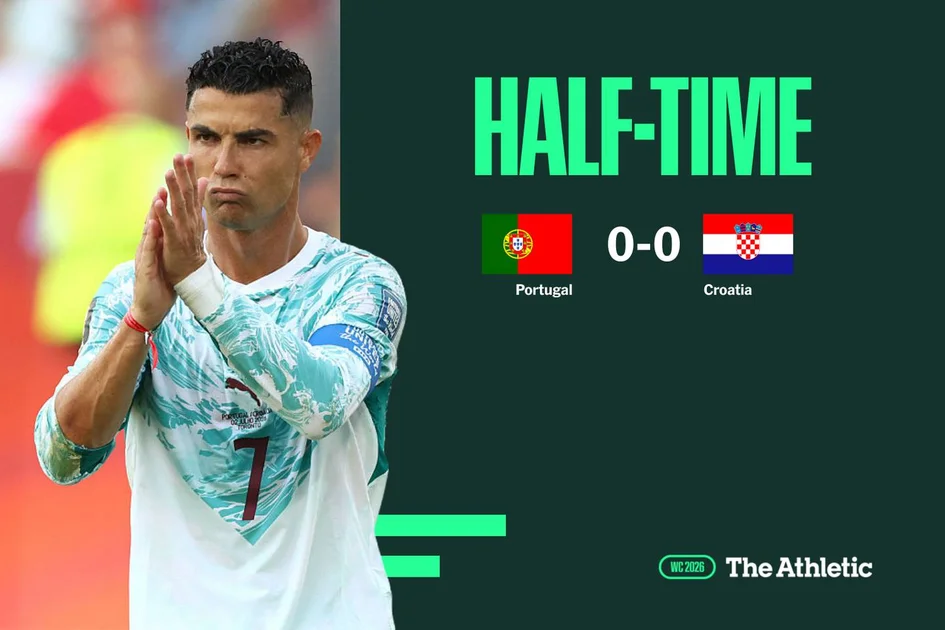
Portugal and Croatia Locked in Tense Goalless Draw at Half-Time in Toronto
Portugal and Croatia played out a fiercely competitive first half in their World Cup 2026 round-of-32 clash at BMO Field in Toronto on Thursday evening, with the scoreline remaining 0-0 at the break. Despite dominating possession and creating several clear chances, Portugal were unable to break through a resilient Croatian defense marshaled by veteran goalkeeper Dominik Livakovic.
Key Moments from the First Half
From the opening whistle, Portugal imposed themselves on the game, pressing high and forcing Croatia into defensive errors. The best chance of the half fell to AC Milan winger Rafael Leao, who sent a looping volley over the bar from close range after a poorly cleared corner in the 46th minute. Livakovic was called into action multiple times, making crucial saves to keep Croatia level, notably denying Bruno Fernandes and Joao Cancelo from distance.
Croatia struggled to establish any sustained attacking rhythm, managing only a handful of half-chances. Luka Modric, starting in midfield, was tightly marked and unable to dictate play as he usually does. The Balkan side’s best moment came when Martin Baturina fired a shot from the edge of the box that was comfortably gathered by Portugal goalkeeper Diogo Costa.
As the half wore on, the game became more fractured, with both sides committing tactical fouls to break up play. Croatia’s Perisic was booked for a late challenge on Nuno Mendes, while Portugal’s Ruben Dias escaped a yellow card for a similar foul on Andrej Kramaric. The intensity remained high, but clear-cut opportunities were scarce in the final 15 minutes.
Stakes and Context: A Battle of Generational Talents
This is a historic matchup—the first time Portugal and Croatia have met in a World Cup. The winner will face either Austria or Spain in the round of 16, adding extra significance to a tie that pits two of the tournament’s most experienced squads against each other.
How They Reached This Stage
Portugal entered the knockout rounds as runners-up in Group K after a mixed group stage: a 1-1 draw against DR Congo, a resounding 5-0 win over Uzbekistan, and a goalless draw with Colombia that was marred by controversial refereeing decisions. Despite boasting an attack led by Cristiano Ronaldo, now 41, and Bruno Fernandes, the team has struggled for fluency and consistency, scoring just six goals in three matches.
Croatia, meanwhile, finished second in Group L behind England. They opened with a 4-2 loss to the Three Lions, but recovered with a 1-0 win over Panama and a dramatic 2-1 victory over Ghana to secure progression. Zlatko Dalic’s side has relied on its trademark resilience and midfield control, though the squad—built around the aging but brilliant Luka Modric—has shown vulnerabilities against pace and direct attacking.
Both teams have long-standing rivalries that extend beyond this tournament. Portugal have dominated the head-to-head record, with seven wins, two draws, and just one defeat in ten previous meetings, though none have come in a World Cup. Every encounter has featured goals, a streak that remains intact despite the goalless first half.
What This Match Means for the Tournament and the Players
For Cristiano Ronaldo, this tournament represents a final opportunity to add a World Cup title to his glittering career. His performances have been mixed so far, and the pressure on him to deliver in knockout football is immense. Similarly, Luka Modric, at 40, is playing what is likely his last World Cup, hoping to replicate the heroics of 2018 when Croatia reached the final. Their personal duel—two of the greatest European players of their generation—has added an emotional layer to the contest.
Broader Implications for the World Cup
This match is part of a competitive round-of-32 that has already seen several upsets. The winner here will face either Austria or Spain, both formidable opponents. If Austria advance, they would be a dangerous underdog; if Spain, a heavyweight clash looms. The result of this match could shape the path to the quarterfinals for either side.
Beyond the immediate result, the match highlights a broader trend at this World Cup: the persistence of experienced, aging stars in major tournaments. While younger teams like England and Spain have impressed, Portugal and Croatia have shown that tactical intelligence and tournament nous remain invaluable. A victory for either side would reinforce the importance of experience in knockout football.
Second Half Outlook and Key Factors
Portugal will likely continue their aggressive approach after the interval, looking to exploit Croatia’s aging defense with pace on the wings. Roberto Martínez may introduce Diogo Jota or Goncalo Ramos to add attacking impetus. Croatia, meanwhile, will aim to slow the game down and rely on set pieces and counterattacks—the same formula that took them to the final eight years ago.
The key battle will be in midfield, where Portugal’s Bruno Fernandes and Otavio will look to disrupt Modric and Mateo Kovacic. If Portugal score early, Croatia may struggle to mount a comeback; if the game remains tight, the Balkan side’s experience in knockouts could prove decisive.
Fans can watch the second half on FOX Network, Telemundo, and fuboTV in the US, and on ViX Premium in Mexico. In Spain, coverage continues on DAZN.
Comments