
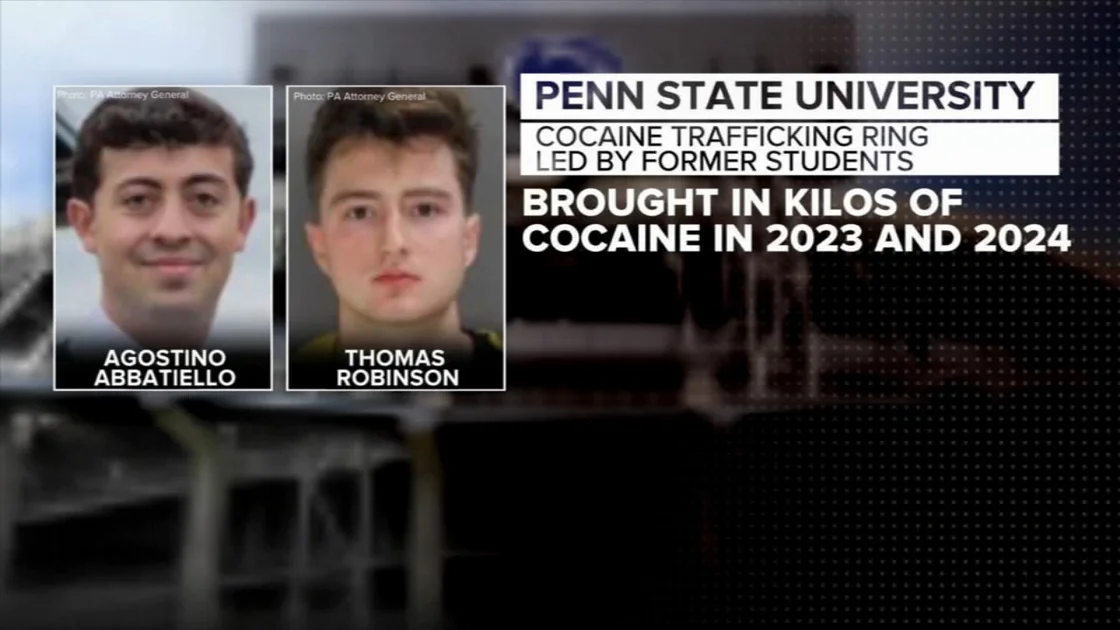
Pennsylvania AG announces charges in Penn State fraternity cocaine trafficking ring
Pennsylvania Attorney General Dave Sunday announced charges Monday against 14 people in connection with an alleged cocaine-trafficking operation run out of two Penn State University fraternities, according to a press release from his office. The investigation, dubbed "Operation Drugs Unlimited," uncovered what prosecutors describe as a "coordinated and highly profitable" drug crew that distributed cocaine primarily to Penn State students.
Thirteen of the defendants are current or former Penn State students, and four are still enrolled, the attorney general's office said. The 14th defendant, Paul Robinson, is the father of one of the students and faces felony charges for allegedly trying to conceal evidence, including a safe containing drugs and cash.
At a news conference Monday, Attorney General Sunday said the case involved "two senior members of the fraternities, other fraternity brothers, and pledges." He added, "In fact, according to the evidence uncovered, cutting and packaging cocaine was, for some pledges, an indoctrination into the fraternities."
Penn State said it was "horrified" by the allegations and placed the Delta Upsilon fraternity on interim suspension. The other fraternity, Sigma Chi, is not recognized as an official Penn State organization, according to the university.
Alleged ringleaders and operations
Prosecutors identified Agostino Abbatiello, 24, of Westbury, New York, as the alleged leader and largest distributor of the operation. Abbatiello, a former Penn State student and Sigma Chi member, surrendered Tuesday morning and was denied bail at his arraignment, according to court records.
The investigation alleged that Abbatiello and co-defendant Thomas Robinson made "regular trips" to Philadelphia and New York City to purchase "large quantities" of cocaine, which they then transported back to State College. At the fraternity houses, the cocaine was cut and packaged, according to the attorney general's office, before being sold to students, with most payments made in cash or via payment apps.
Abbatiello, Robinson, Mohammed Hurabi, and Lars Zeepvat face felony charges including corrupt organizations, conspiracy, and dealing in proceeds of unlawful activity. Robert Zanolla, 24, of Manhasset, New York, is charged with felony conspiracy and criminal use of a communication facility for allegedly helping move cocaine from New York City.
Eight other defendants—Liam Smith, Michael Brogno, Kaden Howe, Connor Hurleigh, Seth Beardsley, Kyle Ridpath, Daniel Price, and Charles Wiseman—face misdemeanor charges related to drug possession and paraphernalia. Paul Robinson is charged with felony tampering with evidence and hindering apprehension.
Investigation timeline and evidence
The drug activity allegedly occurred during 2023 and 2024, according to the attorney general's office. Investigators used wiretaps, surveillance, and undercover purchases to build the case, according to the criminal complaint. The complaint details how the group operated with "military precision," using encrypted messaging apps and a system of runners to deliver drugs to customers across the Penn State campus.
In one instance, investigators observed Abbatiello meeting a supplier in a parking lot near State College, exchanging a duffel bag for cash, according to the affidavit. The cocaine was then taken to the Delta Upsilon house, where pledges were allegedly instructed to cut and package the drug into small bags for resale.
Sunday said the arrests should serve as a warning to college students nationwide. "Just because you're at college and you're making money and you think that this is something you can get away with ... it's not," he said.
University response and fraternity status
Penn State Vice President for Student Affairs Andrea Dowhower issued a statement saying the university is "horrified by these serious allegations against current and former students." She added, "Criminal activity, including hazing such as this, has no place at our institution."
The university said it has cooperated fully with law enforcement and is conducting its own internal review. Delta Upsilon, which is located off campus, has been placed on interim suspension, meaning the fraternity cannot host events or recruit new members while the investigation and legal proceedings continue.
Sigma Chi, the other fraternity involved, is not recognized by Penn State. In a statement, Michael Church, Sigma Chi's executive director, said the alleged conduct "is an egregious violation of our values" and that all three members charged have been suspended. He added that the chapter has also been placed on interim suspension by the national organization.
The attorney general's office noted that both fraternities operate off campus, which places them outside the university's direct oversight. However, prosecutors said the fraternities' ties to Penn State were central to the drug operation, since the customer base was overwhelmingly composed of students.
Hazing and fraternity culture under scrutiny
The case has reignited concerns about hazing in college fraternities. Attorney General Sunday specifically noted that pledges were forced to participate in drug packaging as part of their initiation, calling it "an indoctrination into the fraternities." This detail, he said, elevates the case beyond simple drug trafficking to one involving a pattern of abuse and criminal activity.
Pennsylvania has strict anti-hazing laws, which were strengthened after the 2017 death of Penn State student Timothy Piazza. That incident led to a crackdown on fraternity hazing and increased accountability for Greek organizations. In this case, prosecutors said the drug activity and hazing happened simultaneously, adding a layer of severity to the charges.
Broader implications for college campuses
The Penn State case is not an isolated incident, experts say. Drug trafficking rings at universities have become increasingly common, fueled by the ease of electronic payments and the demand for drugs among college students. The use of fraternity houses as distribution points is particularly concerning, as it normalizes illegal activity within an already closed social structure.
Attorney General Sunday said the investigation remains ongoing, and he hinted that more arrests could follow. He also called on other universities to review their policies regarding off-campus fraternity operations, noting that the close-knit nature of Greek organizations provides cover for criminal behavior.
The case has sent shockwaves through the Penn State community, where students and parents are grappling with the news that a drug operation was running openly for more than a year. In a statement to ABC News, a university spokesperson said the school is working with law enforcement and will take "appropriate disciplinary action" against any students found to have violated the student code of conduct.
For the families of the defendants, the cost is high. Abbatiello, a graduate, now faces a lengthy prison sentence if convicted on all charges. His arraignment was followed by a bail hearing, where a judge ordered him held without bail due to the seriousness of the charges and his alleged role as the operation's leader.
A wake-up call for students
As college students across the country prepare to return to campus, the attorney general expressed hope that the case will serve as a cautionary tale. "If you're not in a good place call your parents, call somebody that you love that will help you that's really what it's about," one neighbor of a defendant told ABC 7 New York, echoing the sentiment of many in the community.
The case also highlights the risks of associating with fraternities that may engage in illegal activities. Students who participated in the drug ring, even in minor roles, now face criminal records that could affect their futures. The attorney general's office said it expects to file additional charges against other individuals who have not yet been named.
What comes next
The legal proceedings for the 14 defendants will unfold over the coming months. Defense attorneys for several of the accused have declined to comment, but some have indicated they will fight the charges. The case is being prosecuted by the Pennsylvania Office of Attorney General, with a preliminary hearing expected to be scheduled in the coming weeks.
Meanwhile, Penn State is reviewing its fraternity policies and considering whether to strengthen oversight of off-campus Greek organizations. The university's statement emphasized its commitment to student safety and its intolerance for criminal behavior. "We will continue to cooperate with law enforcement and take any action necessary to ensure that our campus is safe and free from illegal activity," the statement read.
As the investigation continues, the case has become a national talking point about fraternity culture, drug abuse, and the legal consequences for young adults who make poor choices. Attorney General Sunday said he hopes the case sends a message: "There is nothing junior or childlike about this type of conduct. This was an upper level trafficking organization for this region in Pennsylvania."
The Penn State cocaine ring case is a stark reminder that drug trafficking can occur in even the most idyllic college settings. For the university, the challenge now is to rebuild trust with parents and students while ensuring that such an operation never happens again.
Comments