
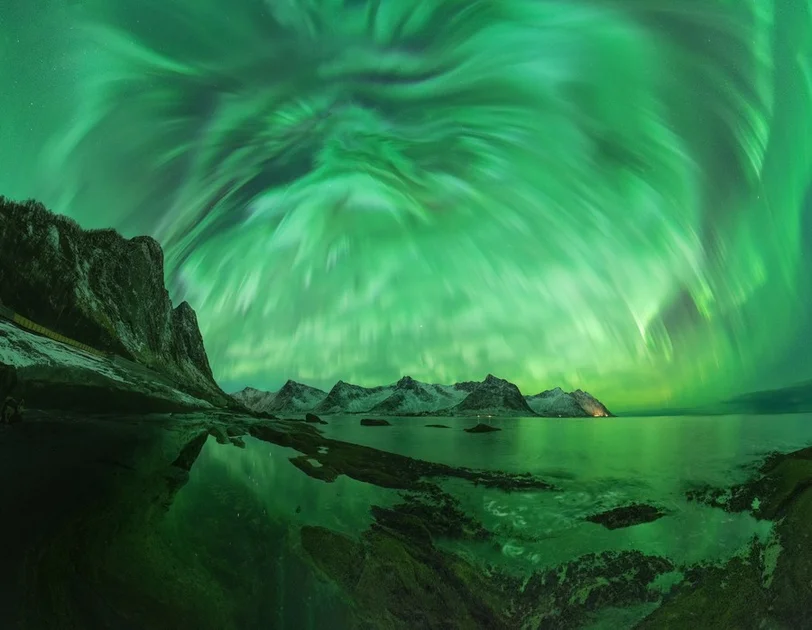
Northern Lights Forecast: 9 States May See Aurora Tonight as CMEs Hit
Skywatchers across the northern United States are in for a potential celestial treat tonight, as the National Oceanic and Atmospheric Administration's Space Weather Prediction Center (SWPC) forecasts a 25 to 30 percent chance of G1-class geomagnetic storm activity. Two coronal mass ejections (CMEs) are traveling toward Earth, and if their trajectories align as expected, the northern lights could become visible across nine states, with the possibility of more if activity ramps up.
According to the latest aurora forecast, Alaska, Washington, Idaho, Montana, North Dakota, South Dakota, Minnesota, Wisconsin, and Michigan have the greatest chance of seeing the aurora borealis tonight. The window for optimal viewing is between 10 p.m. and 2 a.m. local time, with the best views from north-facing locations away from light pollution. NOAA emphasizes that the chances could increase depending on the CME trajectories, so even those just south of these states should keep an eye on the sky.
What Are CMEs and Why Do They Matter?
Coronal mass ejections are massive clouds of magnetic fields and charged particles ejected from the Sun's corona. When these clouds interact with Earth's magnetosphere, they can trigger geomagnetic storms, which in turn produce the dazzling light displays known as auroras. The current forecast is based on two CMEs expected to arrive in quick succession, potentially intensifying the geomagnetic activity. While G1 storms are considered minor, they can still push the aurora oval southward, making the lights visible at lower latitudes than usual.
This event comes on the heels of a period of heightened solar activity. Earlier this year, the strongest solar storm in 23 years lit up skies as far south as Arkansas and Alabama, a testament to the Sun's current cycle peak. For those who missed that spectacle, tonight offers another chance to witness nature's light show, though summer's short nights and the recent full moon may dim fainter displays.
How to Watch the Northern Lights Tonight
If you're in the northern tier of the U.S. and want to catch the aurora, preparation is key. Find a spot with a clear, unobstructed view of the northern horizon, ideally away from city lights. Allow your eyes at least 15 to 20 minutes to adjust to the darkness, and avoid looking at your phone or other bright screens during that time. Interestingly, your phone's camera can be a powerful tool: it is often more sensitive to faint auroras than the naked eye, so point it at the sky and take a long-exposure shot to reveal colors you might otherwise miss.
Patience is also crucial. Auroras are notoriously unpredictable, with activity often coming in waves. Even if the sky appears quiet at first, a sudden burst of solar wind can ignite the lights within minutes. Set up a comfortable chair, bring warm layers (even in summer, late nights can be cool), and be prepared to wait it out. If you're in one of the nine forecast states, your odds are decent; if not, don't despair—monitor real-time aurora alerts from SWPC, as the oval can shift and expand without much notice.
Why This Forecast Matters: Solar Cycle Peaks and Growing Public Interest
The current northern lights forecast is more than just a nice-to-have for skywatchers; it underscores a broader trend. We are approaching the peak of Solar Cycle 25, a roughly 11-year period of solar activity. As the Sun becomes more turbulent, the frequency and intensity of geomagnetic storms increase, leading to more frequent aurora sightings at lower latitudes. This cycle has already produced memorable events, including the May 2026 superstorm that brought auroras to the southern U.S. and disrupted some satellite operations.
For scientists, each CME is a data point that helps refine space weather models, which are critical for protecting power grids, GPS systems, and communication networks. For the public, it's a reminder of our Sun's immense power and its direct connection to our technological world. But there's also a cultural dimension: the northern lights have captured human imagination for millennia, and with each major display, interest surges in remote destinations known for aurora viewing.
Churchill, Canada: A Prime Aurora Destination
One place that has long capitalized on this interest is Churchill, Manitoba, a tiny town of fewer than 1,000 residents perched on the shores of Hudson Bay. Nicknamed the "Polar Bear Capital of the World," Churchill sits directly beneath the auroral oval, a ring-shaped region around Earth's magnetic poles where auroral activity is most frequent. Scientists flock there to study the lights, and it's considered one of the top three places on the planet to view them.
But Churchill offers more than just auroras. During the summer, thousands of beluga whales gather at the mouth of the Churchill River, drawing tourists eager to see these white whales up close. In the fall and winter, polar bears roam the coastline as they wait for the bay to freeze, making it a bucket-list destination for nature lovers. While the best aurora viewing months are January through March, when nights are long and dark, Churchill's year-round attractions keep it on the map for adventurers.
The growing popularity of such destinations reflects a broader trend in experiential travel: people are increasingly willing to travel far off the beaten path to witness natural phenomena. As the solar cycle peaks, this trend is likely to continue, with bookings to aurora hotspots seeing a noticeable uptick during periods of high solar activity.
The Broader Implications: Solar Storms, Tech, and the Night Sky
The immediate news is the nine-state aurora forecast, but the bigger story is how solar activity affects our daily lives. Geomagnetic storms don't just create pretty lights; they can disrupt power grids, interfere with GPS signals, and even damage satellites. The same CMEs that produce auroras can induce electrical currents in long pipelines and power lines, leading to voltage irregularities and, in extreme cases, blackouts. As we become more dependent on technology, understanding and predicting space weather becomes increasingly vital.
NOAA's SWPC is at the forefront of this effort, providing real-time forecasts and alerts to utilities, aviation, and other sectors. The current G1 watch is a routine event, but it's a reminder that the Sun is entering a period of heightened activity. Over the next few years, we can expect more frequent aurora alerts, and with them, more opportunities for photographers and enthusiasts to capture stunning images. At the same time, infrastructure operators will be on alert for potential disruptions.
For the casual observer, the practical takeaway is simple: tonight offers a real chance to see the northern lights, but even if you miss it, more chances are coming. The solar cycle won't peak until 2027 or 2028, and each passing month brings the Sun closer to its stormiest phase. If you're inspired by tonight's forecast, consider planning a trip to a dark-sky destination, or simply step outside on the next clear night and look north. You might be surprised by what you see.
How to Stay Updated and What to Expect Next
If you're hoping to catch the aurora tonight, keep an eye on SWPC's website or download a reliable aurora forecast app. These tools provide real-time updates on geomagnetic activity and the likely aurora oval position. Also, cloud cover will be a decisive factor; check your local weather forecast to ensure clear skies. For those in the Northeast or upper Midwest, where the forecast is most favorable, the combination of a G1 storm and clear skies could yield a memorable show.
Looking ahead, the double meteor shower peaking tonight—the Southern Delta Aquariids and the Alpha Capricornids—adds to the celestial excitement. While the aurora and meteor showers are separate phenomena, they both offer reasons to look up. If you're already planning to watch the meteors, keep your eyes peeled for a green or red glow near the horizon as a bonus. And if you miss tonight, don't worry: the Perseids, the most popular meteor shower of the year, are just around the corner in mid-August.
Conclusion: A Night Not to Be Missed
Tonight's northern lights forecast is a simple yet profound reminder of the universe's beauty and power. Nine states have a solid chance of seeing the aurora, and with a little luck and preparation, you might cross one item off your bucket list. Whether you're a seasoned skywatcher or a curious first-timer, stepping outside to face the night sky is always worthwhile. So find a dark spot, turn your phone to night mode, and let the sky become a canvas of dancing lights.
And if the aurora stays elusive, remember that the solar cycle is only ramping up. There will be more nights like this in the coming years—and perhaps a trip to Churchill might be in your future. In the meantime, stay tuned to NOAA's forecasts, and keep looking up. The universe has a way of rewarding the patient and the curious.
Comments