
Nepal's Flood Warning System Fails, Community Networks Step In to Save Lives
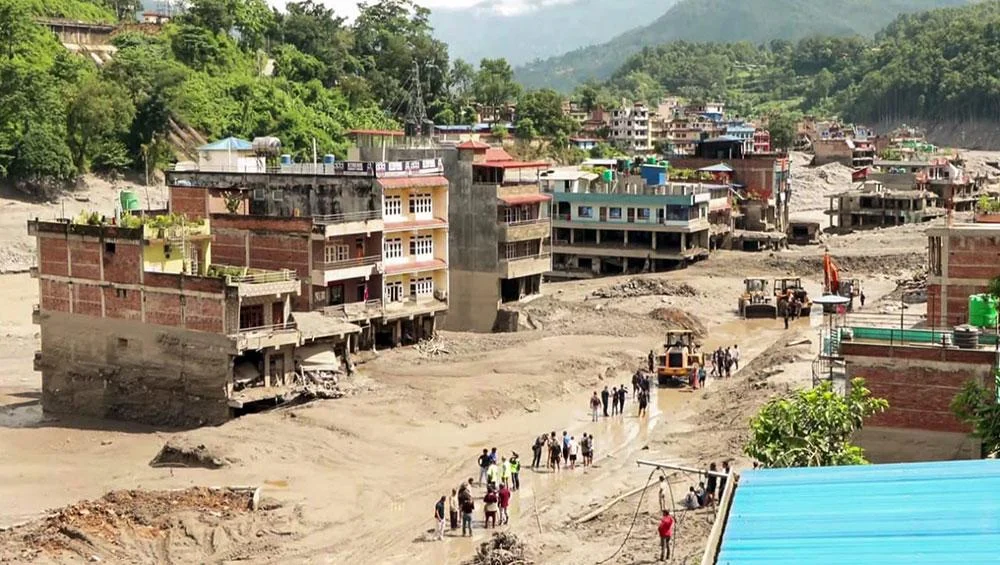
KATHMANDU — At 9:10 a.m. on Aug. 26, head teacher Rajendra Dawadi received frantic phone calls about a flood heading downstream toward Tribhuvan Trishuli Secondary School. He ordered his roughly 900 students to run for higher ground. Ten minutes later, the flood hit the evacuated school. When flood waters receded, the whole compound was buried under debris, with only a fragment of the school’s roofline left showing.
Dawadi's quick action saved lives, but the warning he received did not come from the official government alert system. It came through informal, community-based networks — a network of phone calls from upstream villages that proved more reliable than Nepal's state-run SMS alert system. The discrepancy between these two "systems" has become a central issue in the aftermath of the disaster, which has killed at least 1,252 people and left more than 4,200 missing across five districts, according to the National Disaster Risk Reduction and Management Authority (NDRRMA).
Official System's Fatal Flaws
The government's alert mechanism, operated by the Department of Hydrology and Meteorology, relies on automated sensors and SMS messages. However, survivors and researchers report that these alerts arrived late, were issued only in Nepali, and lacked actionable, location-specific guidance. In the Trishuli corridor, communication researcher Bhuwan KC observed that one-half of the corridor (upstream) had no information at all, while the other half had information that failed to convey the urgency and scale of the threat.
In areas nearest to the border, on both the Nepal and China sides, the event unfolded in just seven minutes — so quickly that sensors were knocked out immediately. Farther downstream, in Trishuli Bazaar, Betrawati and toward Muglin and Devghat, some residents received an SMS or heard loudspeaker announcements. But an analysis of social media posts suggests that many messages were generic and did not prompt immediate evacuations.
The Human Cost of Delayed Warnings
While Dawadi's school survived with no casualties, many communities were not as fortunate. The discrepancy in outcomes has sparked outrage and renewed calls for reform. A 2022 study, conducted after a 2021 rainfall disaster that killed 120 people, found the same systemic failures and explicitly called for binding standard operating procedures (SOPs) linking forecasts to mandatory evacuation orders. That recommendation remains unimplemented.
"The state has the ability to forecast, but it has no legal authority to order evacuations," said one disaster management expert familiar with the situation. "No law requires a forecast to automatically trigger one. Decisions rest on individual heads of households or institutions, which is not a reliable system."
Why This Matters: The Rising Threat of Climate-Driven Floods
The Nepal disaster is not an isolated event. It is part of a broader, deadlier trend driven by climate change. As global temperatures rise, the cryosphere — the sum total of the planet’s frozen water, including glaciers, snow, and permafrost — is receding rapidly. This destabilizes mountain terrain and creates new, lethal hazards.
In the Himalayas, as in the Andes, Greenland, and Alaska, retreating glaciers expose unstable slopes prone to landslides. Thawing permafrost makes mountain faces increasingly fragile, while glacial meltwater accumulates in expanding lakes that are prone to sudden breaches. The Aug. 26 flood appears to have been triggered by a glacial lake outburst flood (GLOF) or a similar cryospheric chain reaction, sending a torrent of water and debris down the Trishuli River Valley.
A Pattern of Cascading Disasters
This event mirrors a series of recent climate-geology disasters. In 2021, a similar deluge ripped through mountain valleys in the Indian Himalayan state of Uttarakhand, severely damaging two hydroelectric power plants and killing about 200 people. In August 2025, a colossal landslide in an Alaskan fjord created a 500-meter-high wave in an area frequented by cruise ships. Earlier that year, the collapse of part of a glacier in Switzerland’s Valais canton caused a debris-laden torrent that destroyed most of the evacuated village of Blatten.
These events highlight a dangerous blind spot: the understanding that a changing climate can destabilize the geosphere. The tragedy in Nepal and Tibet is a clear warning that melting snow and ice will bring more such disasters around the world.
What Works: Community Networks and Cell Broadcast Technology
Despite the official system's failure, the disaster also offered proof that effective, low-cost solutions exist. In communities along the Trishuli River, informal networks of phone calls, local radio, and loudspeaker announcements by village leaders saved thousands of lives. These informal systems were not only faster but also carried the trust and context needed to spur action.
Head Teacher Dawadi's experience illustrates this point. He acted on the word of colleagues and family members upstream, not on an official text message. The difference between receiving a government alert and receiving a call from a known relative was the difference between hesitation and immediate action.
Two Potential Models for the Future
Experts identify two promising fixes that could bridge the current gap. The first is cell broadcast technology, already studied by the GSMA and ITU. This technology can push alerts to every mobile phone in a specific geographic zone in about 10 seconds, in multiple languages, and at an estimated cost of $1.75 to $3 million. Unlike SMS, cell broadcast does not suffer from network congestion and can target devices in a precise radius.
The second is scaling and formalizing the community-based networks that proved effective on Aug. 26. The "East" network model, which relies on trained local volunteers and community ties, could be integrated into the official system rather than left to function as an informal backup. Neither model, however, has yet been scaled up or funded by the Nepali government.
The Broader Implications: A Global Warning for Infrastructure and Preparedness
The failure in Nepal holds lessons far beyond the Himalayas. As climate change accelerates, cities and rural areas worldwide face similar threats from extreme weather and glacial hazards. The assumption that official early warning systems alone can protect populations is no longer tenable, particularly for fast-moving events like flash floods.
In urban contexts, similar systemic fragility is visible. For example, the recent Verizon outage hitting Oklahoma and Arkansas underscores that even basic communication infrastructure can fail during crises, exacerbating the impact of disasters. If a warning system relies on a single channel, such as SMS, it is vulnerable to failure at exactly the moment it is needed most.
The Role of Redundancy and Local Trust
The Nepal flood demonstrates that redundancy is not a luxury but a necessity. Relying solely on centralized, top-down systems is a fatal flaw. A robust early warning network must be multi-layered, combining high-tech cell broadcast, official SMS, and—critically—local community networks that can operate independently of power grids and central authorities.
The human element is equally vital. People respond to warnings from trusted sources. In chaotic situations, a message from a family member or a respected community leader carries more weight than an anonymous text from a government department. Training local volunteers, as the community-based model suggests, could accelerate response times and save lives.
Calls for Legal Reform and Binding SOPs
In the absence of reform, individual villagers like Dawadi will continue to be the de facto first responders. But the 2022 study's recommendation for binding SOPs has gained new urgency. Experts argue that a forecast of imminent danger should automatically trigger an evacuation order for at-risk zones, transferring the decision-making burden from individual heads to an institutional protocol.
''The system currently depends on the initiative of individual headmasters and village elders,'' said a Kathmandu-based disaster risk analyst. "We cannot rely on that in a disaster of this scale. There needs to be a legal mandate. If the state forecasts a flood, it must have the authority and the duty to move people out of harm's way."
The NDRRMA reported that roughly 1.6 million people were affected across the five districts, displacing tens of thousands and destroying critical infrastructure, including roads and bridges. The immediate priority remains search and rescue, but the longer-term debate over accountability and reform is already underway.
Looking Ahead: From Reaction to Prevention
As the floodwaters recede, the debris in Trishuli Valley serves as a grim monument to what went wrong. But the event also provides a stark blueprint for what must change. The technology and social structures for a life-saving system already exist; what has been lacking is the political will and the funding to combine them.
The cost of inaction is measured in lives. While $1.75 million to $3 million for cell broadcast might seem significant, it is negligible compared to the economic and human losses from a single major flood event. The conversation is no longer about whether climate change will bring more flash floods, but whether warning systems can adapt quickly enough to protect vulnerable populations.
The tragedy in Nepal and Tibet shows that the earth's frozen regions are becoming more unstable. But it also shows that preparedness, independent of scale, can make a difference. For every school that was buried, there is a story of a head teacher who got the right call at the right time. The challenge now is to ensure that everyone gets that call.
Comments