
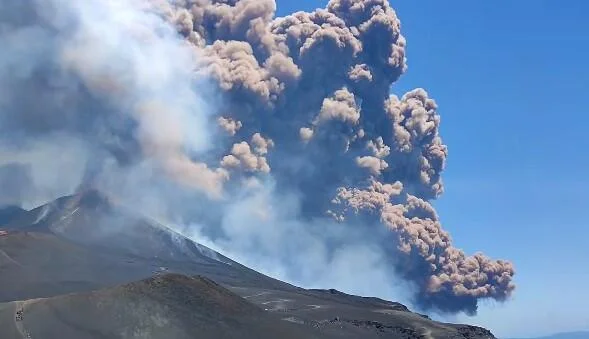
Mount Etna Erupts: Red Alert Issued as Ash Grounds Flights at Catania Airport
Mount Etna, Europe’s most active volcano, erupted on July 5, 2026, sending a massive plume of ash approximately 1.5 kilometers (0.9 miles) above its summit and prompting an aviation red alert across Sicily. The eruption, which began at around 5:45 UTC with ash emissions from a vent on the upper eastern flank of the Voragine crater, intensified rapidly, forcing the suspension of all incoming flights at Catania Airport—a key hub for British holidaymakers and international travelers.
Italy’s National Institute of Geophysics and Volcanology (INGV) raised the Aviation Color Code from Orange to Red at 6:08 UTC, signaling a significant volcanic threat to aircraft. By midday, Catania Airport had halted arrivals, with only departing planes allowed to take off. ITA Airways canceled all flights to and from the airport, while 23 flights were diverted to Palermo. The airport announced that certain areas would remain closed until the morning of July 6.
Visual and Seismic Activity
Images and footage circulating on social media show dramatic plumes of smoke and ash rising from Etna’s summit, accompanied by glowing, orange lava fragments ejected during intense Strombolian activity—bursts of molten rock propelled by expanding gas. The INGV reported that the average amplitude of volcanic tremor remains high, with a steady increasing trend and strong fluctuations in recent hours. At 6:30 UTC, the maximum tremor amplitude for this eruptive episode was recorded, with the centroid of tremor sources located in the Voragine crater area at an elevation of approximately 3,000 meters above sea level.
Infrasonic activity, while generally low in terms of event count, has shown periods of intense activity reaching very high levels. Deformation-monitoring networks detected minor changes, including about 0.3 microradians at the summit clinometric station and decompression of approximately 8 nanostrain at a nearby dilatometric station. These indicators suggest ongoing magma movement beneath the volcano.
Why the Eruption Matters
The eruption of Mount Etna poses immediate risks to air travel and local communities. The red alert, issued specifically when an ash cloud presents a hazard to aircraft, has led to the disruption of hundreds of flights. Catania Airport serves millions of passengers annually, including many British tourists visiting Sicily. Passengers were advised to contact their airlines before traveling, with flights from London Gatwick and Luton among those affected.
Lava Flow Risks and Historical Context
Despite the dramatic display, authorities have stressed that lava flows from Etna generally pose little threat to human life. According to the Italian Civil Protection Department, the lava’s high viscosity and slow sliding speed mean it rarely reaches populated areas unless an eruption is prolonged. The current effusive lava flow, which had been active since June 26, actually ceased on July 4, the day before the new ash emissions began. During the night of July 2–3, a minor lava flow emerged from a point between the Strombolian vent and the effusive vent, traveling just over 100 meters before stopping.
Mount Etna sits on a continental collision zone between the Eurasian and African plates, where extensional faults allow magma to rise from the Earth’s mantle. Each of its main summit craters—Bocca Nuova, Voragine, Northeast Crater, and Southeast Crater—has a diameter of about 200 meters. This geological setting makes Etna one of the most monitored volcanoes in the world, with INGV providing constant updates on tremor, deformation, and ash dispersion.
Broader Implications
The eruption comes amid a period of heightened volcanic activity in the Mediterranean. While Mount Etna erupts frequently, the intensity of this event—combined with the aviation disruption—underscores the vulnerability of modern air travel to natural hazards. The INGV’s forecasts indicate that the ash cloud will move toward the southern and south-southeast sectors in the coming hours, potentially affecting more airports and airspace.
Travel and Economic Impact
For British travelers, Sicily’s popularity as a summer destination means that any prolonged disruption at Catania Airport could lead to significant logistical and financial repercussions. The suspension of flights and diversions to Palermo may strain regional transport networks. This event also highlights the need for robust contingency plans for airlines and airports facing volcanic ash, which can damage jet engines and compromise safety.
In a broader context, the eruption serves as a reminder of the dynamic nature of Earth’s geology. As climate change and tectonic activity continue to influence volcanic behavior, monitoring agencies face ongoing challenges in predicting and communicating risks. The successful coordination between INGV, Italian civil protection, and airport authorities—quickly raising the alert level and implementing flight restrictions—demonstrates a mature response system, but the economic costs of such disruptions remain high.
For those interested in other global happenings, such as the Mexico vs England World Cup 2026 match, or severe weather elsewhere, like the tornado warnings in Ohio and Pennsylvania, this eruption is a stark reminder that nature often upends even the best-laid plans.
What the Experts Say
INGV scientists continue to monitor the situation closely. They note that while the current eruptive episode may subside, the potential for further ash emissions and stronger Strombolian activity remains. The red alert will likely remain in place until ash dispersion no longer poses a risk to aviation. Residents and tourists in towns around Etna are advised to stay informed through official channels, as local authorities may issue warnings about ashfall.
“The lava flows of Etna, due to their viscosity and consequent low sliding speed, are not such as to constitute a danger to the safety of people,” the Italian Civil Protection Department stated. However, they added that in the case of long-duration eruptions, flows could potentially reach inhabited areas—a scenario that is not currently unfolding, but one that scientists are prepared for.
As the world watches Etna’s fiery display, the key takeaway is clear: nature remains unpredictable, and preparedness is paramount. From the red alert over Sicily to the grounded flights at Catania, the immediate impacts are being felt by thousands of passengers. Yet, for volcanologists, this is a routine—if spectacular—reminder of the powerful forces shaping our planet.
Comments