
Tickets Now on Sale, Final Trailer Reveals Tamatoa and Te Fiti
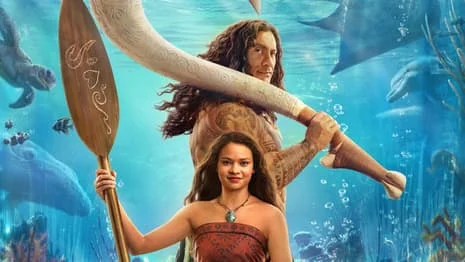
Disney’s live-action adaptation of Moana has entered its final marketing push, with tickets officially going on sale on June 10, 2026, alongside the release of the film’s final trailer. The movie is set to arrive exclusively in theaters on July 10, 2026, marking the tenth anniversary of the original animated hit. The final trailer offers the most complete look yet at the film, including first glimpses of the giant treasure-hoarding crab Tamatoa (voiced again by Jemaine Clement), the deity Te Fiti, and Maui’s animal transformations and moving tattoos. Heihei the rooster and Pua the pig also make appearances, recreating beloved moments from the 2016 original.
The announcement came via the Walt Disney Studios Twitter account, which posted: “The ocean chose them 🌊 Tickets are now on sale for #Moana! Only in theaters July 10.” The final trailer, embedded in multiple press outlets, runs just over two minutes and showcases the film’s lush visual effects, with Catherine Laga’aia stepping into the title role as Moana. Dwayne Johnson returns as the demigod Maui, while John Tui, Frankie Adams, and Rena Owen round out the cast. Directed by Thomas Kail, best known for his Emmy- and Tony-winning work on Hamilton and Grease Live!, the film is produced by Johnson, Beau Flynn, Dany Garcia, and Lin-Manuel Miranda. Miranda also returns as a songwriter, alongside Opetaia Foaʻi and Mark Mancina, though the trailer does not hint at whether any new songs have been added to the score.
The ticket sales date and trailer drop coincide with a wider promotional push. On June 8, Disney announced a one-day Moana Experience pop-up in London’s Potters Fields Park, scheduled for June 30. The free-to-visit event will feature a giant recreation of Maui’s magical hook, a replica of Moana’s canoe, a pig petting farm, lei-making workshops, karaoke pods, and Pacific food and drink. The event is designed to build hype for the film’s July 10 release and deepen engagement with families in the UK market.
Why This Remake Matters: A Decade-Long Gap Collapses
The Moana live-action remake represents a notable shift in Disney’s strategy. For over a decade, the studio has mined its animated classics for live-action reimaginings, delivering blockbusters such as The Lion King (2019), Alice in Wonderland (2010), and last year’s Lilo & Stitch (2025). Until now, Disney had largely stuck to remaking films that were at least 20 years old. Lilo & Stitch, for instance, revived a 2002 film after 22 years. Moana, by contrast, premieres less than ten years after the original—a remarkably short interval in Hollywood’s remake timeline.
This acceleration signals that Disney has largely exhausted its backlog of older titles. The move also reflects the studio’s confidence in the Moana franchise’s commercial and cultural staying power. The original grossed $684 million worldwide, earned an Academy Award nomination for Best Original Song (“How Far I’ll Go”), and has remained a streaming staple on Disney+. The 2024 animated sequel, Moana 2, further cemented the brand’s strength, drawing large audiences despite mixed critical reception. By remaking the original rather than waiting decades, Disney is betting that today’s young viewers—who grew up with the 2016 film—will pay to see a photorealistic version on the big screen.
The casting choices also carry weight. Catherine Laga’aia, a relative newcomer of Samoan descent, described Moana as one of her favorite characters and stressed the importance of representing her Pacific Islander heritage. Original voice actor Auli’i Cravalho stepped aside to Laga’aia and took on an executive producer role, calling the transition a meaningful “passing of the baton.” Dwayne Johnson, who is of Samoan and Black heritage, returns as Maui, a role that has become synonymous with his on-screen persona. Jemaine Clement’s return as Tamatoa adds continuity, while introducing the character to a new generation in live-action form.
The Financial and Strategic Stakes
Disney’s live-action remakes have proven to be reliable revenue engines. The Lion King earned over $1.6 billion, Aladdin crossed $1 billion, and Lilo & Stitch outperformed expectations last year, even surpassing Avatar: Fire and Ash at the domestic box office. The Moana remake is projected to open strongly, though analysts note that the crowded summer 2026 calendar and lingering consumer skepticism about unnecessary remakes could cap its upside. The film’s PG rating—for action, peril, some scary images, rude humor, and brief thematic elements—positions it as family-friendly summer fare.
Mixed Reactions and Online Backlash
Despite Disney’s confidence, the road to opening night has been bumpy. An earlier trailer for Moana drew significant backlash on YouTube, accumulating 85,000 dislikes against 37,000 likes. Critics and fans alike questioned the necessity of a live-action remake so soon after Moana 2 (2024). Specific criticism targeted the visual rendering of Dwayne Johnson’s Maui, with some comparing it to AI-generated imagery and taking issue with his line delivery. Others argued that the original’s animation style is already visually stunning and that a photorealistic version adds little artistic value.
Disney has not publicly addressed the backlash, and the studio’s track record suggests that controversy has rarely slowed its live-action machine. The final trailer appears designed to win over skeptics by showcasing the film’s most spectacular sequences: Maui shapeshifting into a hawk, the climactic confrontation with Te Kā, and the sweeping ocean vistas. Still, the online discourse highlights a broader tension: audiences are increasingly questioning whether every animated hit needs a live-action treatment, especially when the original is still culturally fresh.
Broader Implications for Disney’s Remake Strategy
The Moana remake reflects a turning point in Disney’s approach. Having remade most of its pre-2000s classics, the studio is now turning to more recent, digitally animated hits. This raises questions about how long the live-action trend can sustain itself. With Moana arriving in summer 2026 and Frozen reportedly in early development, Disney is essentially remaking films that are still part of living memory for many moviegoers.
Critics argue that this strategy risks cannibalizing the originals rather than expanding their reach. Proponents counter that live-action remakes introduce the stories to younger viewers who may not engage with older animation styles, while also giving adults a nostalgic theater experience. The Moana remake also serves as a showcase for new talent: director Thomas Kail, whose background is in theater and filmed stage productions rather than big-budget visual effects, brings a fresh perspective to Disney’s filmmaking pipeline.
The Industry Trend: Immediacy Over Nostalgia
Disney is not alone in shortening the gap between original and remake. Warner Bros. is reportedly fast-tracking a live-action Harry Potter series, while Netflix has produced live-action adaptations of Avatar: The Last Airbender and One Piece within years of their animated runs. The shift suggests that studios view live-action remakes not as nostalgic tributes to the past, but as contemporaneous brand extensions. Moana fits this model: its Pacific Islander mythology, Lin-Manuel Miranda songs, and themes of environmental stewardship and self-discovery remain culturally relevant in 2026.
What This Changes for Audiences and the Box Office
For audiences, the Moana live-action remake offers a visually reimagined version of a story already deeply familiar. The film’s success or failure will likely influence how quickly Disney proceeds with other recent-animation remakes, including Frozen and possibly Encanto. If Moana performs strongly, expect Disney to continue shrinking the gap between original and remake, potentially turning live-action versions into a regular production pipeline for films only five to ten years old.
The box office performance will also test whether nostalgia alone can drive ticket sales, or whether audiences demand new elements—new songs, expanded storylines, or altered character arcs. The final trailer does not reveal any new songs, though Lin-Manuel Miranda has stated in earlier interviews that the music team is returning. Whether they added an original song for Oscar consideration remains to be seen, but Disney’s track record with remakes suggests at least one new track is likely.
The International Dimension
The Moana remake also arrives amid heightened interest in Polynesian and Pacific Islander representation in global cinema. The original film was praised for its cultural consultants and casting, but also faced criticism for certain narrative choices. The live-action version, with a predominantly Pacific Islander cast and a director committed to cultural authenticity, aims to deepen that legacy. Disney’s promotional push in London—including the Moana Experience pop-up—underscores the film’s global ambitions at a time when international markets account for over 60% of major studio revenues.
Broader Context: Disney’s Live-Action Machine and Its Limits
Beyond Moana, Disney’s live-action strategy faces structural limits. The studio’s most successful remakes have been of films with strong emotional core audiences—The Lion King, Beauty and the Beast, Aladdin. Less successful entries, such as Dumbo and Mulan, underperformed relative to expectations. With fewer older titles left to adapt, the pressure to deliver hits on newer films increases. Moana is effectively a test case: if it works, the remake pipeline could be retooled to produce live-action versions of films from the 2010s and 2020s. If it falters, Disney may need to rethink its dependence on familiar IP.
At the same time, the broader entertainment landscape is shifting. Streaming services like Netflix and Apple TV+ are investing heavily in original family content, while theatrical attendance among younger demographics remains uneven. Disney’s decision to release Moana exclusively in theaters—rather than as a Disney+ day-and-date release—suggests confidence in the theatrical experience. The film’s July 10 opening positions it as a summer tentpole, competing against other family films and superhero releases.
A Note on the Broader Cultural Moment
Moana arrives at a time when Hollywood is grappling with questions of representation, originality, and franchise fatigue. The live-action remake debate—whether these films are creative necessities or corporate cash-grabs—will likely intensify as Disney pushes deeper into recent IP. The Samad Taylor career night Padres rally coverage on this site offers a lighter counterpoint to the heavy discussions around media consolidation and audience fragmentation. Meanwhile, the storms and squirrels power outage story reminds us that real-world disruptions still command attention, even as Hollywood offers escapist blockbusters.
The Moana live-action remake is scheduled for a July 10, 2026 release. Tickets are on sale now.
Comments