
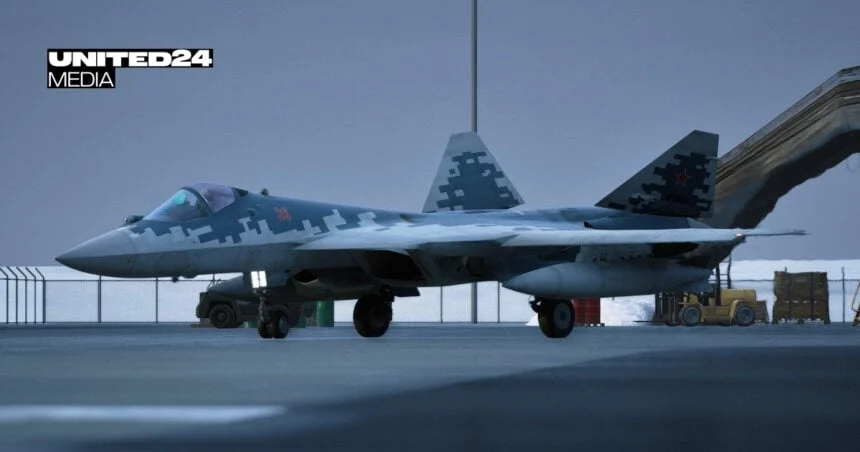
Su-57 Destroyed in Engine Fire at Russian Airfield
A Russian Sukhoi Su-57 fifth-generation stealth fighter jet exploded during engine startup at the Akhtubinsk military airfield in Russia's Astrakhan Oblast on October 29, according to Ukraine's Defense Intelligence Directorate (HUR). The agency reported the incident on November 2, stating that the aircraft, valued at approximately $150 million, was destroyed in what it described as a catastrophic engine failure.
The Su-57, powered by AL-41F1 turbofan engines, was reportedly preparing for takeoff when the explosion occurred. Ukrainian intelligence identified poor-quality aviation fuel as one possible cause but did not confirm the exact trigger. HUR noted that the Su-57's engines can "explode or undergo catastrophic destruction" when filled with low-grade jet fuel. The Russian Defense Ministry has not commented on the claim, and the incident could not be independently verified.
If confirmed, this would mark the fourth known case of a Russian Su-57 being destroyed or damaged in 2026, following a Ukrainian drone strike on two Su-57s at the Shagol airfield in April and a friendly-fire incident near Moscow in July.
Fuel Quality Concerns Linked to Ukrainian Strikes
Ukraine's military intelligence suggested that the engine fire may have resulted from deteriorating jet fuel quality tied to Ukraine's long-range drone campaign against Russian oil refineries. According to HUR, Russia has become increasingly dependent on imported aviation fuel as Ukrainian strikes disrupt domestic production. The agency reported that nearly 40,000 metric tons of Jet A-1 fuel were shipped from India's Vadinar refinery in August, transferred between sanctioned tankers near Malaysia, and more than 37,000 metric tons reached Russia's port of Nakhodka on September 23. HUR identified Rosneft subsidiaries involved in supplying aviation fuel to Russia's defense industry, including manufacturers associated with the Su-57 program. However, no direct link between the imported fuel and the reported explosion has been confirmed.
Context: A Troubled Stealth Program
The Su-57, known by NATO as Felon, is Russia's most advanced fighter jet, promoted as a rival to the U.S. F-35 and F-22. However, Western aviation experts have long questioned its stealth capabilities, and the aircraft has seen limited use in Ukraine, with Russian pilots preferring to launch long-range strikes from outside Ukrainian air defense range. Russia had roughly 21 Su-57s in operation at the start of 2026, according to the International Institute for Strategic Studies, with production slowed by the demands of the war.
The loss of a single Su-57 represents a significant blow to a small and costly fleet. Ukrainian estimates put the cost of each jet at around $150 million, though Russian outlet Kommersant reported a lower figure of $35 million in 2019. The incident underscores the broader challenges facing Russian military aviation, which has suffered a series of setbacks in 2026, including combat losses and technical failures. The reported explosion also highlights the vulnerability of Russia's fuel supply chain, which has been strained by Ukraine's sustained drone strikes on refineries.
Perspective: Mounting Pressure on Russia's Air Force
The reported destruction of another Su-57 adds to the narrative of a program plagued by delays, limited production, and operational setbacks. While the Su-57 remains a potent symbol of Russian military ambition, its small fleet and the difficulty of replacing lost airframes mean each incident carries outsized strategic weight. The reliance on imported fuel, potentially of varying quality, raises questions about maintenance and readiness standards for high-end equipment. As Ukraine continues to target Russian energy infrastructure, the ripple effects on military aviation could become more pronounced. For now, the Kremlin has not acknowledged the loss, but the pattern of incidents in 2026 suggests that Russia's most advanced fighter jet remains vulnerable—both on the ground and in the air.
Comments