
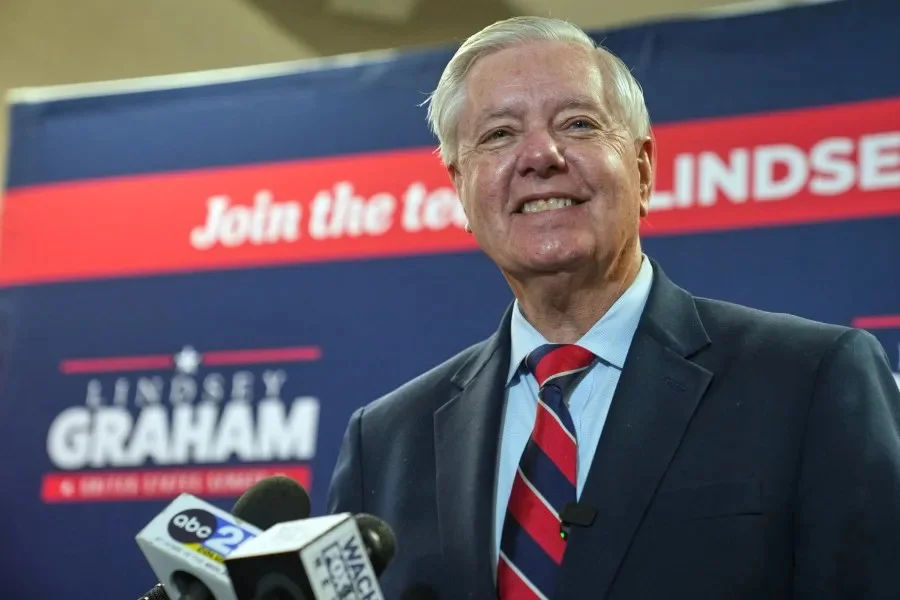
Graham's Senate Seat on the Line in High-Stakes Primary
Senator Lindsey Graham is fighting for his political future Tuesday as South Carolina Republicans head to the polls in a contentious primary election. Early returns show the incumbent locked in a tight race against a field of challengers, with the outcome potentially reshaping the state’s political landscape.
With 20.9% of expected votes counted, Graham leads with 58.7% of the Republican vote, according to NBC News results. However, he remains short of the majority threshold required to avoid a runoff. Primary rules stipulate that if no candidate secures over 50% of the vote, the top two finishers will face off in a June 23 runoff election.
Graham’s closest challenger, Mark Lynch, has garnered 27.4% of the vote so far, while Thomas Dismukes trails with 4.9%. The race has drawn national attention as a bellwether for the GOP’s internal divisions and the endurance of established incumbents in an era of populist momentum. On the Democratic side, Annie Andrews leads with 61.3% of the vote in a separate primary contest.
Why This Primary Matters for South Carolina and the Nation
The stakes in this race extend far beyond state lines. Graham, a six-term senator and prominent voice on foreign policy and national security, has long been a fixture in Washington. His willingness to work across the aisle and his evolving stance on issues like immigration and judicial appointments have made him a target for both moderate and conservative critics.
Challenger Mark Lynch has positioned himself as a more staunchly conservative alternative, hammering Graham over votes on spending and what he calls insufficient border security measures. The primary reflects a broader trend in Republican primaries where incumbents face heightened scrutiny from activist bases demanding ideological purity.
South Carolina’s GOP has enjoyed a winning streak in high-profile races, but this contest tests whether that momentum holds when the party’s own establishment figure is under fire. The primary also serves as a proxy for larger national debates about the direction of the Republican Party, particularly on issues like Ukraine aid and federal spending.
Graham has defended his record, pointing to his seniority and ability to deliver for the state. He has emphasized his role in securing military funding for South Carolina bases and his experience on the Senate Judiciary Committee during high-profile Supreme Court confirmations.
The Runoff Reality: What Comes Next
If Graham fails to cross the 50% threshold, the runoff will become a do-or-die moment for his career. Runoffs typically draw lower turnout, which could benefit a well-organized challenger. Graham’s campaign has been preparing for that scenario, ramping up ads and ground operations in anticipation.
For context, the South Carolina primary is one of several key electoral battles unfolding in 2026, a year when control of the Senate hangs in the balance. Republicans are defending a number of seats, and any surprise defeat — even in a reliably red state — could shift the national calculus.
The Democratic primary, led by Annie Andrews, a pediatrician and political newcomer, signals that Democrats are hoping to capitalize on any Republican disunity. However, South Carolina has not elected a Democrat to the Senate since 1998, making a general election win a steep uphill climb regardless of the GOP nominee.
Broader Implications for the GOP and 2026 Midterms
Graham’s primary battle is more than a local story — it is a window into the Republican Party’s ongoing identity crisis. The rise of outsider candidates and anti-establishment sentiment has reshaped primaries across the country, from House races to Senate contests. Graham, once a vocal critic of Donald Trump, later became one of his key allies, a shift that has not fully insulated him from primary challenges.
This race also highlights the increasing role of money in politics. Lynch has attracted significant funding from out-of-state donors, while Graham relied on a deep war chest built over decades. The financial arms race reflects the nationalization of even local primaries.
The outcome will be closely watched by political strategists, donors, and voters alike. A Graham loss would be one of the biggest upsets of the 2026 cycle, signaling that even entrenched senators are not safe. A narrow win or runoff victory would underscore the growing fragility of incumbency.
As results continue to trickle in, all eyes remain on South Carolina. The race is too early to call, but the trajectory suggests a long night ahead for both campaigns.
In related news, the broader political landscape continues to evolve, with events like the House Passes $70B Immigration Bill, Ending Shutdown Standoff reshaping the national conversation. Meanwhile, international developments such as the US strikes on Iran add another layer of complexity to the issues Graham and his rivals are debating on the campaign trail.
Comments